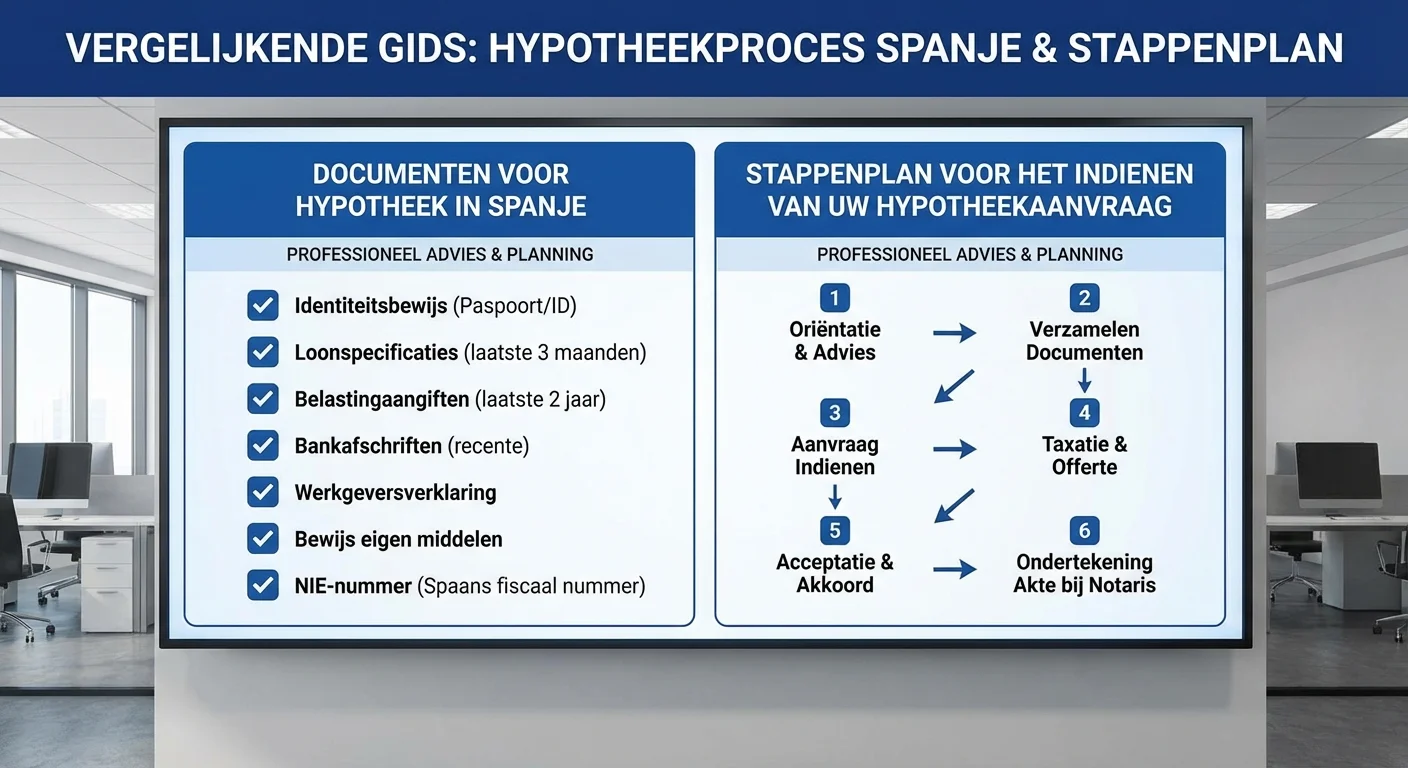
To take out a mortgage in Spain as a non-resident, you will usually need: your passport or identity card, a Spanish NIE-account number, recent proof of income (payslips and annual tax statement, or, for the self-employed, annual accounts and tax returns), bank statements for the past three to six months, an overview of existing loans and credit facilities, an employer’s statement, proof of your own contribution and the property documents such as the Note Simple and the contract of sale. A Spanish bank will usually lend to a non-resident up to around 70% of the valuation, and will use these documents to assess your creditworthiness. If you have the documents ready, translated correctly and on time, you will avoid most delays during the approval process.
For buyers from Belgium, the Netherlands, Germany and France who are looking to purchase a second home, an investment property or a retirement home on the Costa Blanca, a well-prepared application is the key to securing financing without a hitch. In this article, our local experts list all the necessary documents, explain why the bank requires each one, and provide practical tips to help your application sail through the Spanish credit committee. Would you prefer direct guidance? Then find out how we can help you with the Applying for a mortgage in Spain.

Why is the Spanish bank asking for so many documents?
For many people, dreaming of owning a home under the Spanish sun marks the start of a wonderful adventure, but the path to securing successful financing begins with thorough preparation of your application. When you apply for a loan from a Spanish bank, the red tape is often more stringent than you are used to in Belgium, the Netherlands or Germany, as the lender seeks additional security from foreign buyers. A bank wants to establish two things beyond any doubt: your solvency (Can you afford the monthly payments on a long-term basis?) and the legal status of the property that you wish to purchase. Each document requested serves one of these two purposes.
As a non-resident is generally subject to approximately 70% of the valuation When assessing how much you can borrow, the bank carefully calculates your own contribution and your net income. At most Spanish banks, your total monthly debt repayments must not exceed approximately 30 to 35% of your net income. A complete and well-organised application therefore not only increases your chances of approval, but often also leads to a more favourable interest rate offer. A more technical explanation of the binding interest rate offer can be found in our article on the FEIN in Spain, the official document setting out all the terms and conditions, which you will receive before the notary.
The complete checklist: all the documents you need for a mortgage in Spain
Below you will find the key documents that virtually every Spanish bank requires from a non-resident. Make sure you have these documents to hand, both digitally and on paper, before you have your first meetings with a mortgage adviser or banker.
- A valid passport or identity card of all applicants.
- A Spanish NIE number (Foreign National Identity Number) for each buyer.
- Proof of income: the last three to six payslips plus the most recent annual statement (for employees), or annual accounts and tax returns for the past two to three years (for the self-employed).
- Recent bank statements from the last three to six months of your main account.
- A overview of existing loans and credit facilities in your country of residence (mortgage, car loan, revolving credit).
- A employer’s certificate confirming the position, terms of employment and annual salary.
- Proof of personal contribution: savings accounts, investments or a donation receipt for the portion you are contributing yourself.
- The property documents: the Note Simple from the land registry and the signed purchase agreement (contrato de arras).
In practice, it has been found that a clearly organised file significantly increases the chances of swift approval by the credit committee. We advise our clients to scan each document, name them logically and compile them into a single folder, so that the bank does not need to ask for any further information.
Identification: passport and NIE number
The first category of documents relates to your personal identification and tax status in both your home country and in Spain. Without a valid passport and the well-known NIE number, the process comes to an immediate halt: the bank needs to know exactly who you are and where you are tax-resident in order to assess the risk. Furthermore, the NIE is a legal requirement for any property transaction, and the notary cannot finalise the deed without this number. You should therefore apply for it as a matter of priority, as it can take several weeks to obtain it via the consulate or the local authorities. You can read about how to apply for this number and what else you need it for in our comprehensive article on the NIE number in Spain.

Proof of income for employees and the self-employed
The crux of your application is demonstrating that you have a stable and sufficiently high income to cover your monthly expenses. Employees in paid employment They usually provide the last three to six payslips, together with the most recent annual statement and a copy of the employment contract to confirm the continuity of employment. An employer’s statement specifying the job title and annual salary is often a mandatory requirement. Make sure that the salary payments are also clearly visible on your bank statements.
For entrepreneurs and the self-employed The burden of proof is greater, as the bank regards the income as less predictable. You must submit, as a minimum, the annual accounts and tax returns for the past two to three financial years, preferably prepared or audited by a qualified accountant. These figures must provide a clear picture of your company’s profitability and solvency and demonstrate that the business generates sufficient liquid assets to meet its obligations even during less favourable periods. Pensioners should instead provide recent pension statements.

Bank statements and an overview of existing loans
As well as your income, the bank will take a close look at your spending habits and your existing financial commitments. Recent bank statements covering the last three to six months show how you manage your money and confirm your saving habits. In addition, the lender will request a full overview of your current loans and credit facilities in your country of residence: after all, an existing mortgage, a car loan or a revolving credit facility will affect your borrowing capacity. By providing this overview transparently yourself, you can prevent the risk department from requesting additional documents at a later stage, which would slow down the process.
Proof of personal contribution and financial means
As a non-resident can generally borrow up to around 70% of the valuation, you will need to contribute around 30% yourself, plus the buyer’s costs. Spanish banks therefore place great importance on your overall financial position. This can range from statements of savings accounts and investment portfolios to proof of ownership of property in your home country. Demonstrating a solid level of equity strengthens your negotiating position. Bear in mind that the purchase costs themselves (taxes, notary, land registry and solicitor’s fees) are in addition to the mortgage; you’ll find a detailed breakdown of these in our tool for buyer’s costs in Spain.
Property documents: Nota Simple and contract of sale
The bank is not only providing you with a loan, but is also financing a specific property, and therefore wants to be certain of the legal status of the property. The Note Simple The extract from the land register shows who the owner is, whether there are any debts, mortgages or attachments on the property, and what the exact cadastral description is. In 2026, you can apply for this document online via registradores.org for €9.02 plus VAT, or in person for €3.64 plus VAT. You will also need to submit the signed koopovereenkomst (contrato de arras) aan, zodat de bank de aankoopprijs kent en de taxatie kan inplannen. Een grondige juridische controle van het vastgoed voorkomt onaangename verrassingen in deze fase.
Van dossier naar taxatie, rente en notaris
Het indienen van een aanvraag voor een Spaanse lening vereist een gestructureerde aanpak om vertragingen te voorkomen. In de praktijk begint het proces vaak met een oriënterend gesprek waarbij de bank uw financiële draagkracht globaal beoordeelt. Zodra u een woning op het oog heeft, start u direct met het verzamelen van de documenten om vaart in het traject te houden. De bank doet pas een bindend aanbod wanneer het volledige dossier compleet is en door de risicoafdeling is goedgekeurd.

De taxatie bepaalt de hoogte van uw lening
Nadat u de eerste stukken heeft ingediend, volgt de fase van de juridische controle en de taxatie van de woning. De bank stuurt een onafhankelijke taxateur (tasador) langs om de marktwaarde vast te stellen. Dit cijfer is cruciaal, want de bank berekent de ongeveer 70% financiering over de taxatiewaarde, niet over de aankoopprijs. Ligt de taxatie lager dan de koopsom, dan moet u het verschil zelf bijpassen. Tijdens deze periode kunt u alvast onderhandelen over de prijs van de Spaanse woning om uw eigen inbreng te beperken.
Vaste of variabele rente kiezen
Zodra het dossier en de taxatie rond zijn, ontvangt u een renteaanbod. U kiest doorgaans tussen een vaste rente (tipo fijo) voor zekerheid over de gehele looptijd, of een variabele rente (tipo variable) die meebeweegt met de Euribor. Welke keuze het beste past, hangt af van uw risicoprofiel en de marktverwachtingen; wij bespreken de afweging tussen een vaste en variabele rente uitgebreid in onze toelichting bij het FEIN-document. Lees alle voorwaarden zorgvuldig door voordat u zich vastlegt.
De ondertekening bij de notaris
De laatste stap is de ondertekening bij de Spaanse notaris, waar zowel de koopakte als de hypotheekakte worden gepasseerd. De notaris controleert of alle stukken correct zijn nageleefd en of de betalingen via bankcheques op de juiste wijze plaatsvinden. Na de ondertekening bent u officieel eigenaar en wordt de hypotheek ingeschreven in het lokale eigendomsregister. Met een volledig en vertaald dossier verloopt deze afsluiting doorgaans vlot en zonder onaangename verrassingen.
Praktische tips: alles tijdig en vertaald klaar
Veel vertraging ontstaat niet door de bank, maar door een onvolledig of slecht voorbereid dossier. Met de volgende tips houdt u zelf de regie en versnelt u het proces aanzienlijk:
- Vraag uw NIE-nummer als eerste aan. Dit duurt het langst en blokkeert anders elke vervolgstap.
- Laat documenten beëdigd vertalen. Veel Spaanse banken accepteren stukken in het Engels, maar vragen voor officiële documenten vaak een beëdigde vertaling naar het Spaans. Informeer vooraf bij uw adviseur.
- Zorg voor actuele stukken. Bankafschriften, loonbrieven en de Nota Simple mogen meestal niet ouder dan drie maanden zijn.
- Bundel digitaal én op papier. Een logisch geordende map maakt indruk op de kredietcommissie en voorkomt navragen.
- Reken de kosten koper apart. Houd 10 tot 15% bovenop de aankoopprijs gereed naast uw eigen inbreng van ongeveer 30%.
How we can help you
At Invest in Spain, our team, led by property expert and CEO Kenzo Fayot, dagelijks kopers uit België, Nederland, Duitsland en Frankrijk bij hun aankoop aan de Costa Blanca. Of u nu een tweede verblijf zoekt in Dénia, Jávea, Altea of Moraira, een investering overweegt in Torrevieja of Orihuela Costa, of als gepensioneerde uw plek onder de zon wilt vinden: wij nemen het volledige hypotheektraject uit handen. Van de pre-audit van uw documenten en de begeleiding bij uw NIE-aanvraag tot de coördinatie met Spaanse banken, de legal review en de afspraak bij de notaris. Zo combineert u onze property services in Spain met een gerust gevoel en een dossier dat in één keer klopt.
Wilt u exact weten welke papieren in uw persoonlijke situatie vereist zijn? Onze ervaren adviseurs staan klaar om u te begeleiden van de eerste inventarisatie tot de uiteindelijke handtekening. Please feel free to contact us, with no obligation en zet met een veilig gevoel de volgende stap naar uw Spaanse woning.
Veelgestelde vragen over documenten voor een hypotheek in Spanje
Welke documenten heb ik nodig voor een hypotheek in Spanje als werknemer?
Als werknemer levert u uw paspoort, NIE-nummer, de laatste drie tot zes loonbrieven, uw meest recente jaaropgave, een arbeidscontract met werkgeversverklaring en recente bankafschriften aan. Daarmee toont u de bank uw financiële stabiliteit en kredietwaardigheid aan.
Welke documenten heeft een zelfstandige nodig?
Zelfstandigen en ondernemers overleggen de jaarrekeningen en belastingaangiften van de afgelopen twee tot drie boekjaren, bij voorkeur door een accountant opgesteld, samen met bankafschriften en een overzicht van bestaande leningen. De bank wil zien dat het bedrijf voldoende en stabiel inkomen genereert.
As a non-resident, how much can I borrow?
Spaanse banken financieren een niet-resident doorgaans tot ongeveer 70% van de taxatiewaarde. U brengt dus zelf zo’n 30% in, plus de kosten koper van 10 tot 15% bovenop de aankoopprijs. Bewijs van eigen inbreng is daarom een vast onderdeel van het dossier.
Waarom is een NIE-nummer verplicht?
Het NIE-nummer is uw fiscale identificatienummer in Spanje en wettelijk verplicht voor elke vastgoedtransactie. Zonder dit nummer kan de bank de hypotheekakte niet passeren bij de notaris en kunt u geen officieel eigenaar worden. Vraag het daarom als allereerste aan.
Moeten mijn documenten vertaald worden naar het Spaans?
Veel Spaanse banken accepteren documenten in het Engels, maar voor officiële stukken is regelmatig een beëdigde vertaling naar het Spaans vereist. Het is raadzaam om vooraf bij uw hypotheekadviseur te informeren welk papierwerk vertaald moet worden, zodat u geen vertraging oploopt.