At a notary in Spain – purchase The notario (the Spanish notary) performs three key tasks: he verifies the identity and legal capacity of the buyer and seller, and he draws up the public deed (the official deed of sale) and reads it out, and he formalises the transfer of ownership legally so that it can be registered in the Registro de la Propiedad. What the notary in Spain expressly not What we do is carry out a full legal due diligence check on your property — that investigation (title, debts, planning permission, local planning regulations) is the responsibility of your own solicitor. It is precisely that distinction that makes the difference between a smooth purchase and a costly surprise later on.
For buyers from Belgium, the Netherlands, Germany and France who are purchasing a property on the Costa Blanca — from Dénia, Jávea, Altea and Moraira in the north to Torrevieja, Orihuela Costa and Pilar de la Horadada in the south — the role of the notary is often the most misunderstood part of the entire purchase process. In this guide, you will find out exactly what the notary does and does not do, how the day of signing unfolds, what the costs (the tariff), how the registration in the land register proceeds thereafter, and why a separate legal control of real estate in Spain remains indispensable.

What is the role of the notary in Spain when buying a property?
In Spain, a notario is a civil servant (civil servant) who is appointed by the state to authenticate legal acts. He is impartial: he serves neither the interests of the buyer nor those of the seller, but ensures the legal validity of the transaction on behalf of the Spanish government. This neutrality is a strength — the notary guarantees that the deed is legally valid and enforceable — but at the same time it is a pitfall for foreign buyers, as they expect the notary to actively defend their interests as well. He does not do so.
Specifically, when a property is purchased, the notary does the following:
- Verifying identity and legal capacity: he checks passports, the NIE-number of each purchaser and any authorised representatives, and confirms that all parties are acting of their own free will and with full knowledge of the facts.
- Drawing up and reading out the public deed: He draws up the official deed of sale and reads it out loud, so that all parties know what they are signing.
- Requesting a current ‘nota simple’: Just before signing, he checks the land register to see who the registered owner is and whether there are any mortgages or charges on the property.
- Verifying the payment and the source of the funds: In accordance with anti-money-laundering legislation, he checks the bank cheques or bank transfers used to make payments.
- Making the transfer official: Once the contract has been signed, ownership is transferred and the solicitor sends an electronic notification to the land registry to block the property from further transactions.
The notary therefore verifies that the seller, as currently registered, is free to transfer ownership of the property. However, he does no an in-depth investigation into the history of the property, unauthorised extensions, outstanding service charges or a deviation from the zoning plan. That falls outside the scope of his statutory duties.
What a notary in Spain does not do
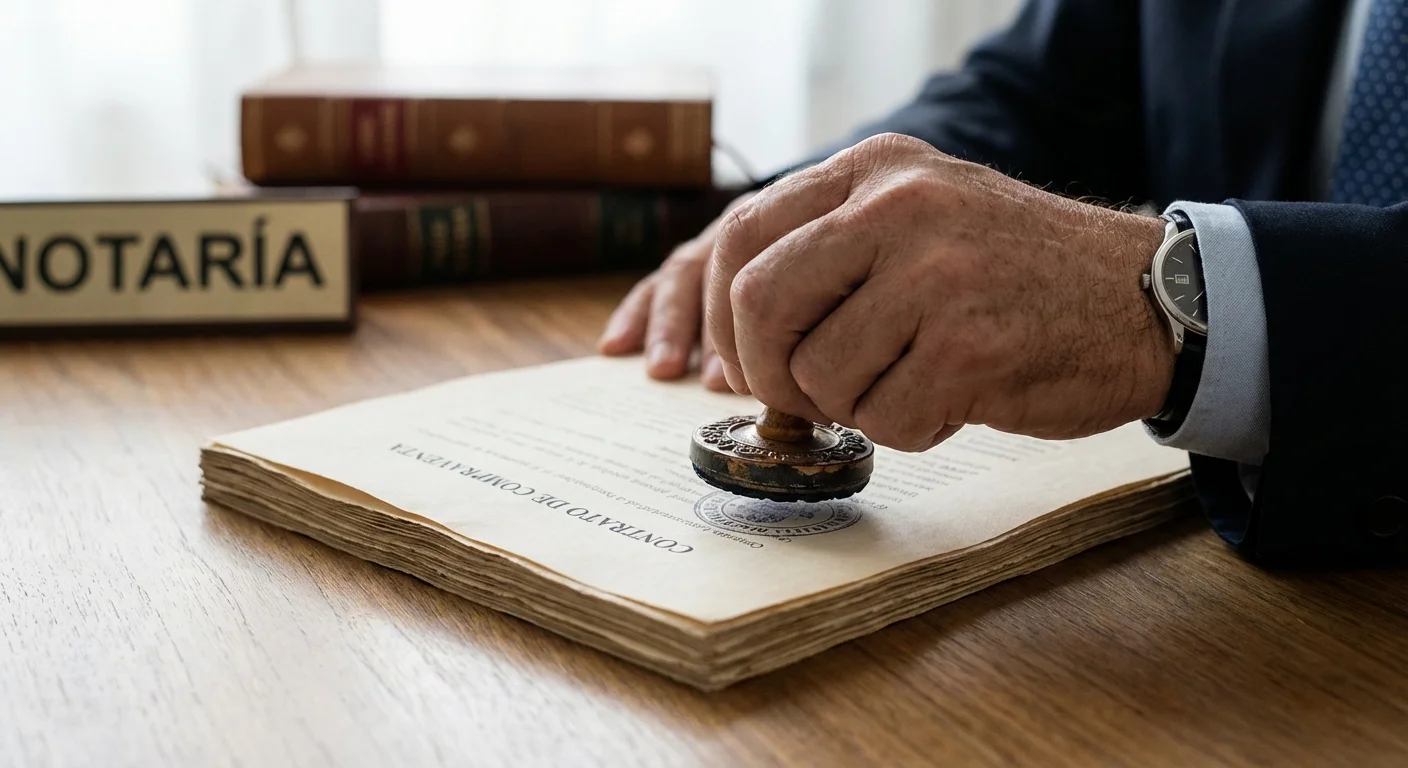
This is the most important point to bear in mind for anyone buying property from Belgium, the Netherlands, Germany or France. The notary carries out no full due diligence . He does not check whether the property is free from hidden defects, whether the swimming pool extension has been legally authorised, whether any planning offences have been recorded, or whether the previous owner has IBI or whether you have paid your service charges, nor whether the purchase price is in line with market rates. Nor does he advise you on the tax or commercial aspects of the deal.
These tasks are part of your own solicitor (lawyer). Before the signing, it carries out a thorough legal review from: he is reading the note simple checks permits and certificates of fitness for habitation (certificate of occupancy), checks for unauthorised extension and on hidden defects, and draws up a secure contract of sale with the appropriate conditions precedent. The notary authenticates the contract; the solicitor protects your interests. You need both.
The difference between the Belgian and Dutch systems
Many buyers unconsciously apply the notarial system of their own country to the situation in Spain, and this leads to misunderstandings. In Belgium You are no doubt accustomed to the Belgian notary, who, as the central figure in the transaction, carries out a thorough preliminary investigation: he consults the mortgage registry, checks town planning information, the soil certificate, any pre-emption rights and the seller’s tax status. In this way, the Belgian notary takes on a large part of your legal protection.
In Netherlands The notary carries out searches in the public registers and the Land Registry, checks for attachments and mortgages, and manages the flow of funds via his escrow account — the purchase price is held securely by the notary. German and French notaries also fulfil a similar, fairly protective role.
The Spanish notary has a more limited remit. He checks the registered status of the property at the time of signing, but does not carry out a comprehensive preliminary legal investigation and, as a rule, does not manage an escrow account: payment is usually made directly from the buyer to the seller, often by bank cheque at the notary’s office. The consequence is simple: the level of protection that is “automatically” provided by the notary in Belgium or the Netherlands must be arranged by you yourself in Spain through your solicitor. Anyone who underestimates this difference is mistakenly under the impression that they are fully protected.
Signing day: what happens at the notary’s office
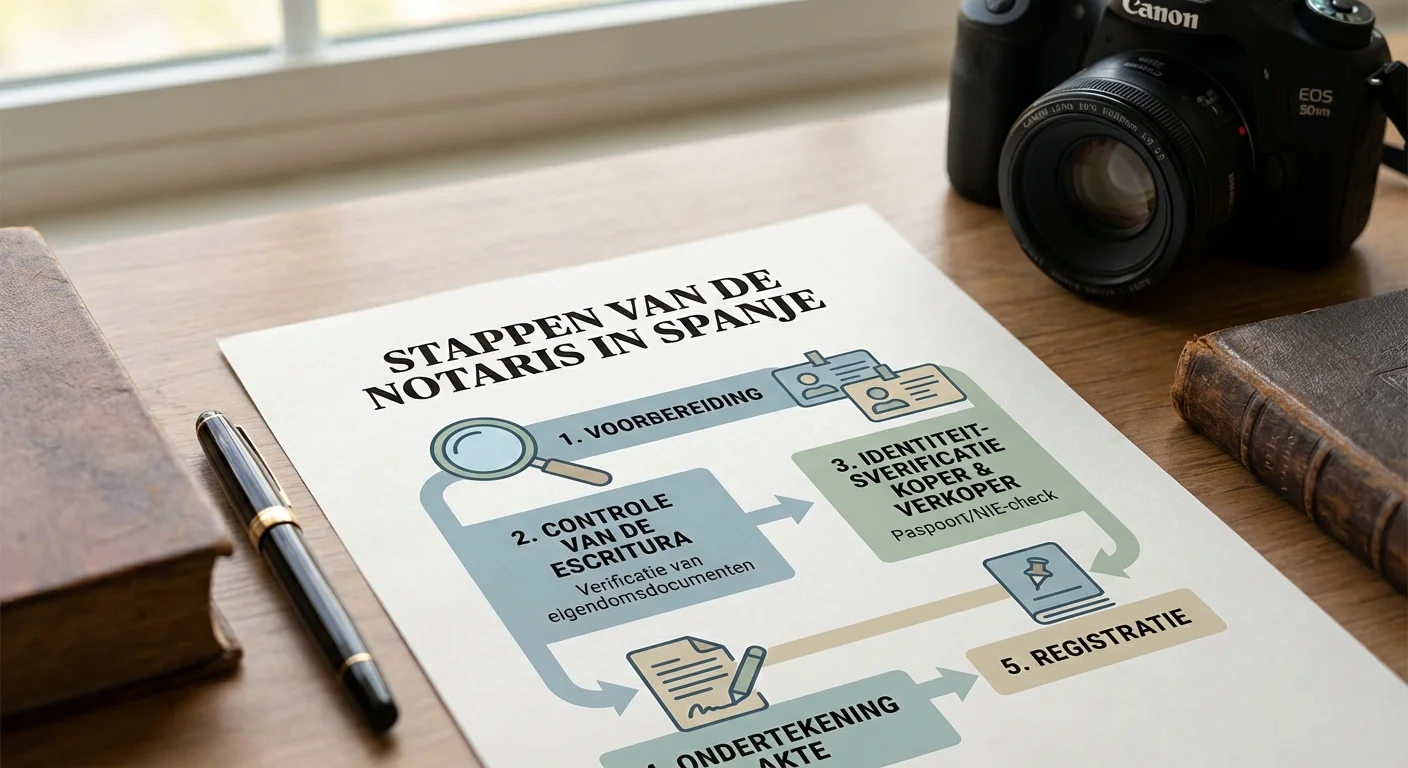
The signing of the escritura pública is the culmination of the entire purchase process. At the notary’s office, the buyer, the seller and, where applicable, a representative from your bank (in the case of a mortgage in Spain) together. Your solicitor or an interpreter is often present as well. The procedure usually goes as follows:
- Identity check: The notary checks the passports, NIE numbers and powers of attorney of all those present.
- Last register check: The notary consults the current ‘nota simple’ to confirm that the ownership status remains unchanged and that no new encumbrances have been added.
- Reading aloud from the escritura: The deed of sale will be read out aloud. If you do not understand Spanish well enough, your interpreter or bilingual solicitor will translate it for you; never sign a deed that you do not fully understand.
- Payment: the purchase price is paid, usually by bank cheque (bank cheque), and the notary checks the proofs of payment in accordance with anti-money laundering legislation.
- Signing and handover of keys: All parties sign the document, the notary authenticates it with his signature and seal, and the keys are handed over. From that moment on, you are the legal owner.
Immediately after the signing, the notary sends an electronic notification (dispatch note) to the land registry, thereby temporarily blocking the property from further registrations. You will receive a simple copy (plain copy); the original deed (matriz) is kept on file at the notary’s office. The full certified copy (certified copy) will follow later and is required for final enrolment.
“The notary is the guardian of legal certainty in Spanish property transactions, but he never replaces the need for your own legal advice.”
Notary fees in Spain: the arancel
Spanish notaries’ fees are not freely negotiable: they are determined by a statutory rate, the notarial fees, as laid down by Royal Decree. The basic fee is linked to the value of the transaction according to a degressive scale — the higher the purchase price, the lower the percentage. In practice, the notary’s fees for a standard house purchase amount to roughly 0.2% to 0.5% of the purchase price, with a minimum threshold for smaller amounts. For a property on the Costa Blanca costing several hundred thousand euros, you can therefore generally expect notary fees of between a few hundred and well over a thousand euros.
As the fee is set by law, in principle every notary’s office charges the same basic fee for the same service. However, the final invoice may vary due to additional items:
- The basic fee based on the transaction value scale.
- Additional copies of the deed, annexes and attached powers of attorney.
- Certified copies (certified copy) and simple copies.
- Surcharges for a second deed, for example the mortgage deed in the case of financing.
- Fees for electronic registration with the Land Registry.
Important: notary fees are just one part of the overall picture. When buying an existing property, you should allow for approximately 10 to 15% on top of the purchase price additional costs: the transfer tax (ITP), registration in the land register, your solicitor’s fees and, if applicable, those of a gestor, plus the notary’s fees. In the Comunidad Valenciana — which includes the Costa Blanca — the ITP for properties valued up to €1,000,000 will, incidentally, fall from 10% to 9% from 1 June 2026. A full overview can be found in our article on the buyer's costs in Spain, and you can work out the figures for your situation using our tool for buyer’s costs.
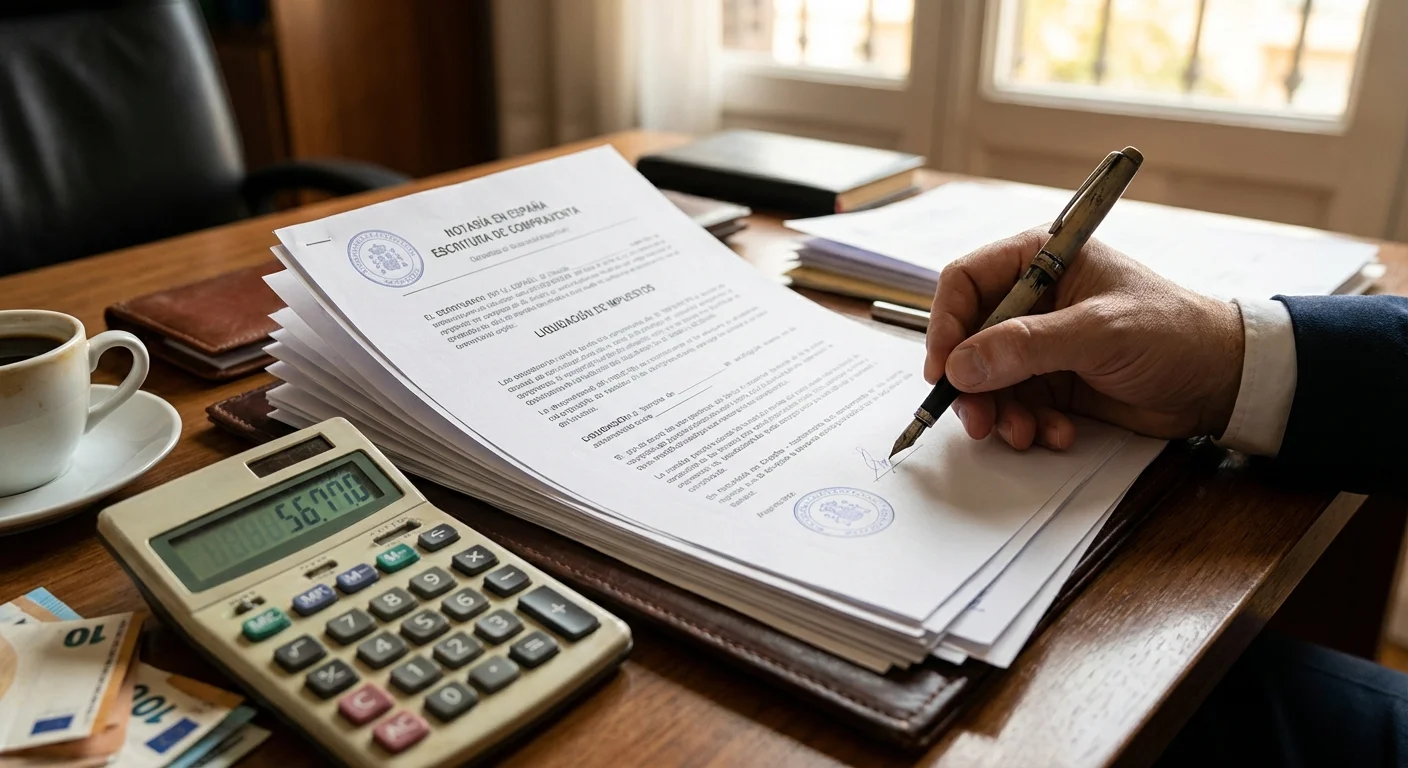
It is customary for the buyer to bear the notary’s fees, unless otherwise explicitly agreed during the negotiations. Always ask for an estimate in advance and a detailed receipt afterwards, so that you know exactly which items you are paying for.
After the notary: registration with the Registro de la Propiedad
Signing the documents at the solicitor’s makes you the legal owner, but the process is not yet complete. To ensure full legal certainty vis-à-vis third parties, the transfer of ownership must be registered in the Land Registry, the Spanish Land Registry. It is only once the property has been registered there that it is formally and publicly registered in your name. The key steps following the signing are:
- Paying tax: the transfer tax (ITP for existing properties, or IVA plus AJD (in the case of new-build properties) must be paid within thirty days of the deed being signed.
- Request registration: The certified copy of the escritura is submitted to the Land Registry, together with the tax payment receipts.
- Putting utility contracts in your name: Water, electricity and council tax (IBI) will be transferred.
- Check your final enrolment: After a few weeks or months, the registration process will be complete; please check that your property has been registered correctly.
In practice, this administrative process — tax return, registration and utility connections — is often handled by a gestor or by your solicitor, so that you don’t have to visit all the counters yourself. A note simple Requesting a copy afterwards — online for €9.02 plus VAT, or €3.64 plus VAT in person — is an inexpensive way to check that everything is correctly registered in your name.
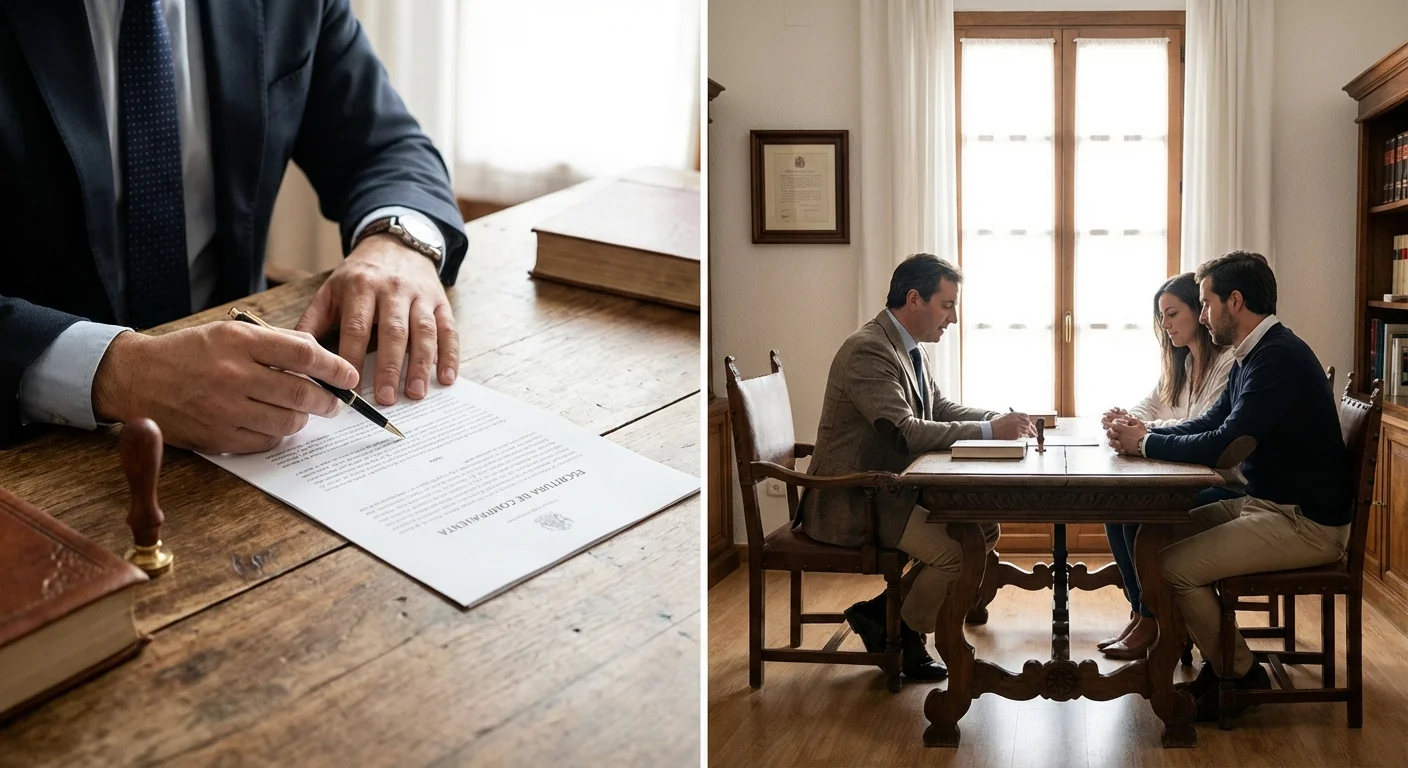
“The escritura makes you the owner, but it is only once the property is registered with the Registro de la Propiedad that you are fully protected against third parties.”
Why you need your own solicitor as well as a notary
As you’ve probably realised by now, the notary is indispensable, but does not cover everything. Because the notary is neutral and does not carry out a full due diligence check, an independent solicitor who exclusively your Having your interests represented is not a luxury, but the very essence of a secure purchase. Your solicitor will investigate the title deed, review the ‘nota simple’, check planning permissions, the local planning regulations and any unauthorised extensions, assess the service charges and draw up a watertight purchase contract with the appropriate conditions precedent. They will also accompany you to the solicitor and translate the deed where necessary.
For Belgian, Dutch, German or French buyers purchasing property from abroad, this combination — a notary for official certification and a solicitor to safeguard your interests — is the standard for a hassle-free purchase. If you’d like to find out more, please also read our guide on buying property in Spain, which sets out the entire buying process step by step.
How we can help you
At Invest in Spain We guide buyers from Belgium, the Netherlands, Germany and France through every stage of the notary process and the property transfer. Our team, led by property expert and CEO Kenzo Fayot, coordinates the appointment with the notary, arranges a power of attorney if required so that you do not need to travel for the signing, and, together with an independent solicitor, ensures a thorough legal review in advance. Whether you’re looking for a second home, seeking a return on your investment, or moving permanently to the Costa Blanca as a pensioner or expat: we offer a comprehensive property services in Spain, from buying advice and mortgages to letting and key management.
Would you like to enjoy your new home under the Spanish sun without any worries, and without any legal surprises later on? Please feel free to contact us, with no obligation and we’ll guide you safely through every stage of the purchase, from the first viewing to registration in the land registry.
Frequently asked questions about the notary in Spain when buying a property
What is the main task of the notary in Spain when buying a property?
The notary (notario) verifies the identity and legal capacity of the buyer and seller, draws up the escritura pública and reads it out, and formalises the transfer of ownership so that it can be registered in the Registro de la Propiedad. He is a neutral public official who certifies the legal validity of the transaction.
Does the Spanish notary also carry out the legal checks on my property?
No. The notary checks the registered status of the property at the time of signing, but does not carry out a full due diligence check. Investigations into hidden defects, unauthorised extensions, planning permission, the local planning scheme and any outstanding charges are the responsibility of your own solicitor. That is why buyers always engage an independent solicitor in addition to the notary.
How much does a notary cost in Spain when buying a property?
Notary fees are set by law under the arancel notarial and depend on the value of the transaction. In practice, for a property purchase, this amounts to approximately 0.2% to 0.5% of the purchase price. The notary’s fees are one component of the total buyer’s costs, which for existing properties usually amount to 10 to 15% on top of the purchase price.
What happens after the contract has been signed at the solicitor’s office?
Following the signing, the transfer tax (ITP or IVA plus AJD) must be paid within thirty days and the escritura must be registered with the Registro de la Propiedad. In addition, the utility contracts and the IBI will be transferred into your name. It is only once the property has been registered in the Land Registry that you are fully protected against third parties.
Is a Spanish notary different from a Belgian or Dutch notary?
Yes. Belgian and Dutch notaries carry out a comprehensive preliminary investigation and often manage the flow of funds via a third-party escrow account. The Spanish notario has a more limited remit and does not carry out that comprehensive preliminary investigation. The level of protection you are used to receiving from a notary in your own country must be arranged by you in Spain through your solicitor.
What is the main task of the notary in Spain when buying a property?
The notary (notario) verifies the identity and legal capacity of the buyer and seller, draws up the escritura pública and reads it out, and formalises the transfer of ownership so that it can be registered in the Registro de la Propiedad. He is a neutral public official who certifies the legal validity of the transaction.
Does the Spanish notary also carry out the legal checks on my property?
No. The notary checks the registered status of the property at the time of signing, but does not carry out a full due diligence check. Investigations into hidden defects, unauthorised extensions, planning permission, the local planning scheme and any outstanding charges are the responsibility of your own solicitor. That is why buyers always engage an independent solicitor in addition to the notary.
How much does a notary cost in Spain when buying a property?
Notary fees are set by law under the arancel notarial and depend on the value of the transaction. In practice, for a property purchase, this amounts to approximately 0.2% to 0.5% of the purchase price. The notary’s fees are one component of the total buyer’s costs, which for existing properties usually amount to 10 to 15% on top of the purchase price.
What happens after the contract has been signed at the solicitor’s office?
Following the signing, the transfer tax (ITP or IVA plus AJD) must be paid within thirty days and the escritura must be registered with the Registro de la Propiedad. In addition, the utility contracts and the IBI will be transferred into your name. It is only once the property has been registered in the Land Registry that you are fully protected against third parties.
Is a Spanish notary different from a Belgian or Dutch notary?
Yes. Belgian and Dutch notaries carry out a comprehensive preliminary investigation and often manage the flow of funds via a third-party escrow account. The Spanish notario has a more limited remit and does not carry out that comprehensive preliminary investigation. The level of protection you are used to receiving from a notary in your own country must be arranged by you in Spain through your solicitor.