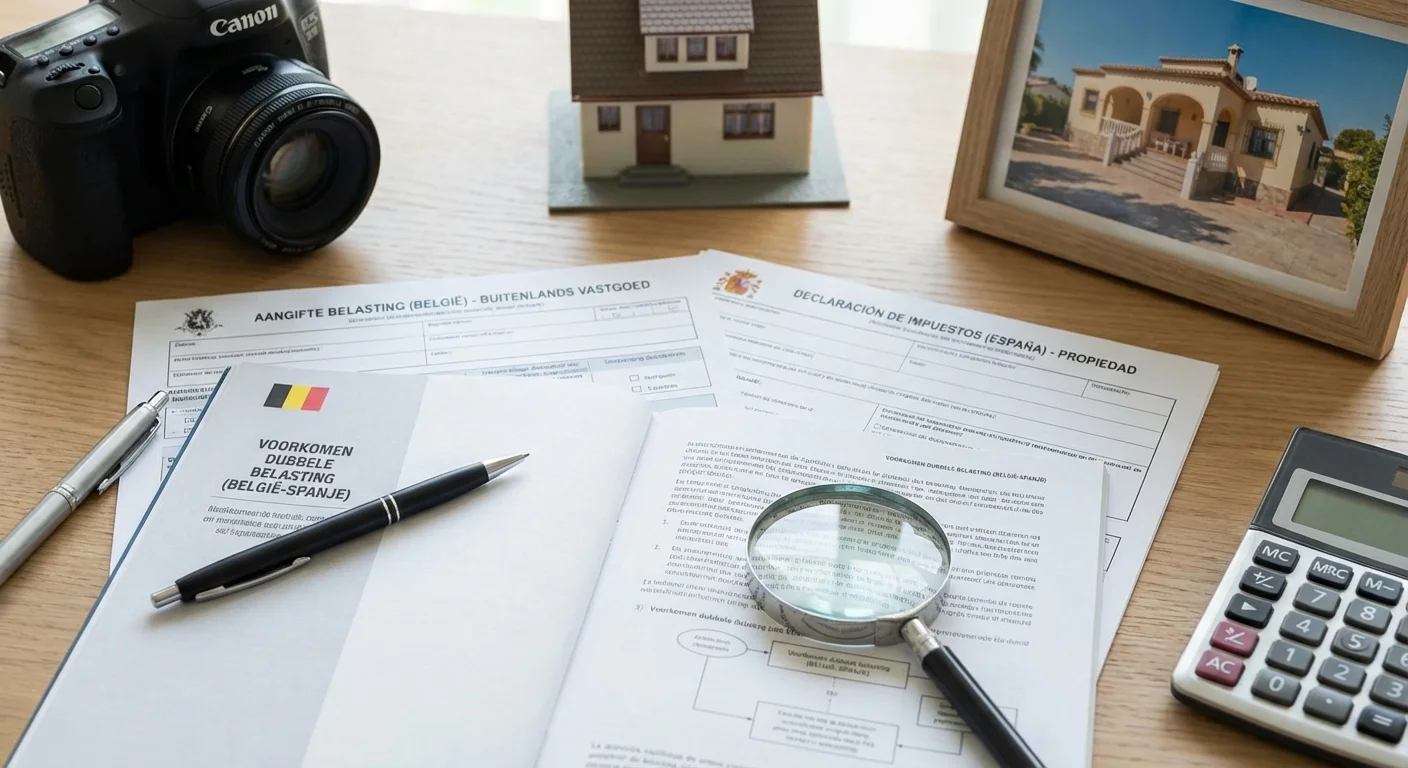
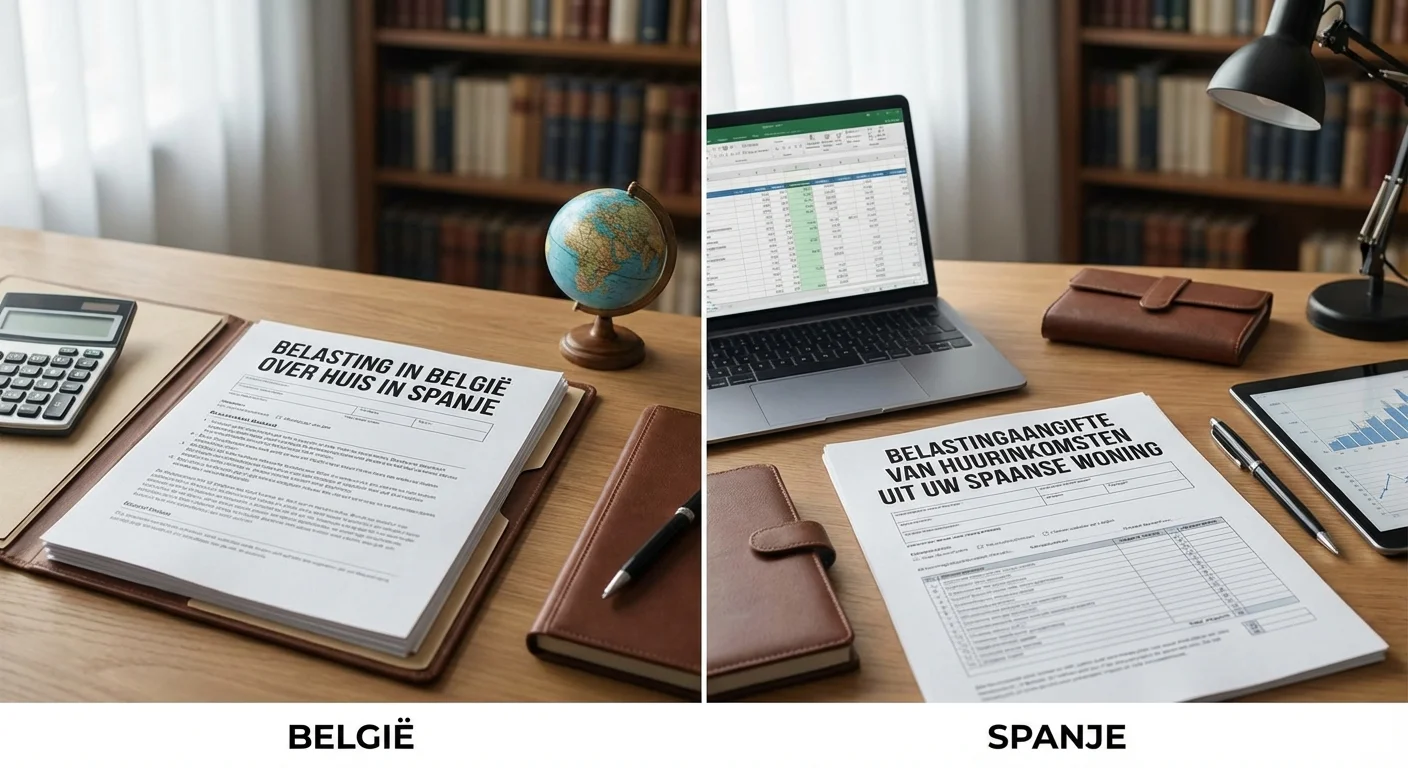
Taxation in Belgium on a property in Spain works as follows: you are required to declare your Spanish property in your Belgian personal income tax return on the basis of foreign cadastral income (KI), but, thanks to the double taxation agreement, Belgium does not levy any actual tax on it. However, the tax authorities do adjust it reservation regarding progression Note: your tax-exempt Spanish income is taken into account when determining which tax bracket your other Belgian income (salary, pension) falls into. As a result, your tax bill may increase, even if you do not pay any direct property tax in Belgium. In addition, you pay annual taxes in Spain itself. Below, as Costa Blanca experts, we clearly explain how the cadastral income and the progressive tax reserve work, and how the Belgian and Spanish tax systems interact.
For many Belgians, a second home under the Spanish sun — an apartment in Torrevieja, a villa in Jávea or a penthouse in Altea — is a long-cherished dream. However, as soon as the deed has been signed at the notary’s office, the same question invariably arises: what exactly do you need to declare in Belgium, and will you end up paying tax twice? The good news is that the double taxation agreement between Belgium and Spain protects you against double effective taxation. The less well-known fact is that you are still obliged to include the property in your Belgian tax return, and that the ‘progression clause’ may subtly increase your overall tax burden. Understanding this helps you avoid unpleasant surprises on your tax assessment notice. Would you first like to get a broader picture of the Buying property in Spain as a Belgian? If so, this article provides a useful supplement specifically covering the Belgian tax aspects.
How does the tax system in Belgium work in relation to a property in Spain?
As a Belgian resident, you are liable for tax in Belgium on your worldwide income. This also applies to property that is physically located abroad. Your Spanish property is therefore not hidden from the Belgian tax authorities, regardless of whether you use the property yourself as a holiday home or let it out. The core of the scheme consists of three interrelated elements, each of which we explore in more detail below.
- Obligation to declare: You must declare the foreign cadastral income from your Spanish property in your annual personal income tax return (Part 1 of the return, Box III for properties that are not let or are let privately).
- Exemption: Under the double taxation agreement, this income is exempt from actual tax in Belgium — so you do not pay any Belgian income tax on it.
- Progression clause: The exempt amount is, however, taken into account when determining the average rate applied to your other (Belgian) income.
The interplay of these three elements ensures that you are not subject to double taxation, but that your Spanish property still has a — usually modest — impact on your Belgian tax assessment. Important to remember: the heaviest taxes on the property itself (such as the annual non-resident tax and the local IBI) you pay in Spain, not in Belgium. You can find an overview of the Spanish side of things in our article on tax on your second home in Spain.
Foreign cadastral income (KI) clearly explained
Since the 2021 reform, the Belgian treatment of overseas property has been brought into line with that of properties on Belgian soil. Previously, owners of a property abroad were required to declare either the actual rental value or the actual rental income, which was a stricter requirement than for Belgian property — an inequality that was ruled against by the European Court of Justice. Today, every property abroad is subject to a cadastral income granted, just like a property in Bruges or Hasselt.
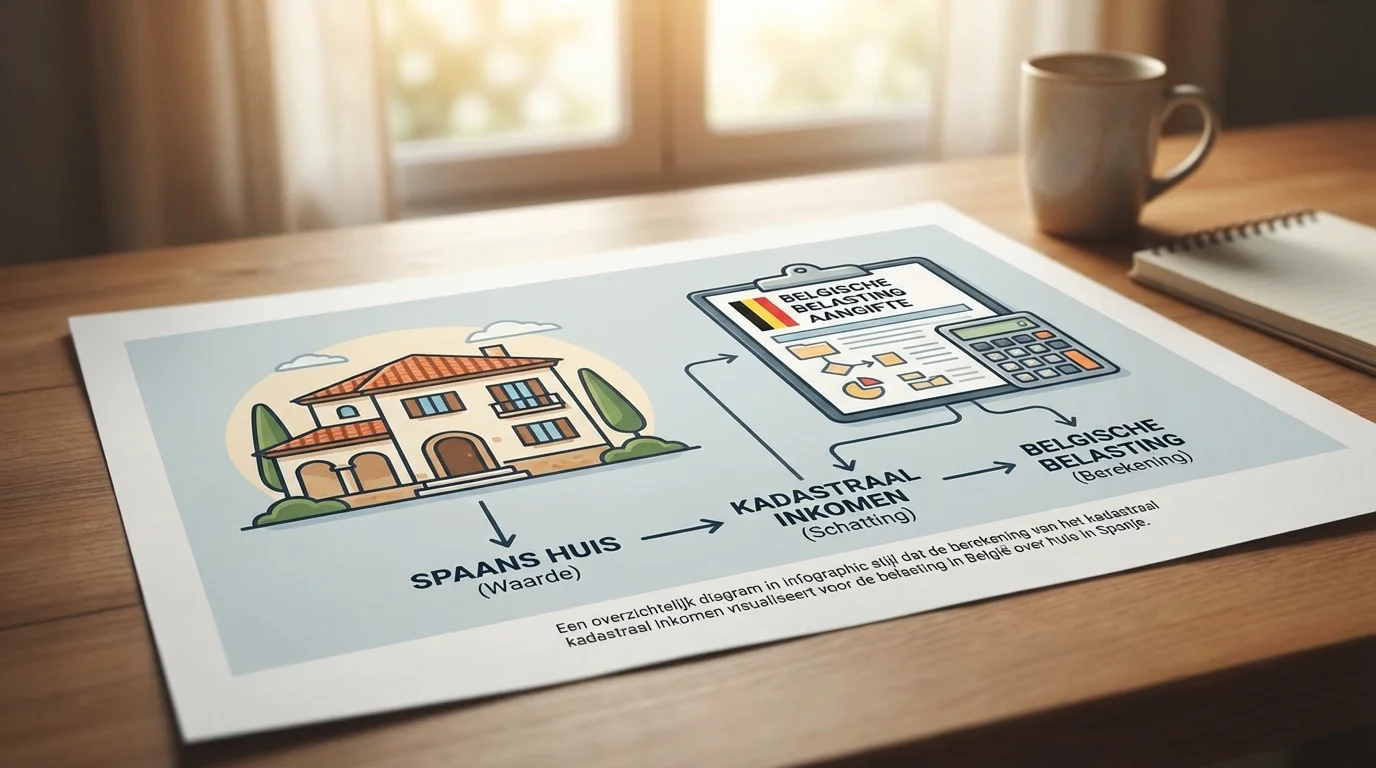
What exactly is the KI? It is a notional annual net rental income that the General Administration of Property Documentation assigns to your property. It is therefore explicitly not neither your actual rental income nor the current market value of your Spanish flat. The KI is usually a relatively low figure, as it is adjusted to the price level of the reference year 1975. In practical terms: the tax authorities take the current normal market value of the property, divide it by a correction factor (for recent years, this is around 15.036 for the reference year 1975) and then apply the rate of return. The result is a KI that is almost always modest in relation to the actual value of your Spanish villa.
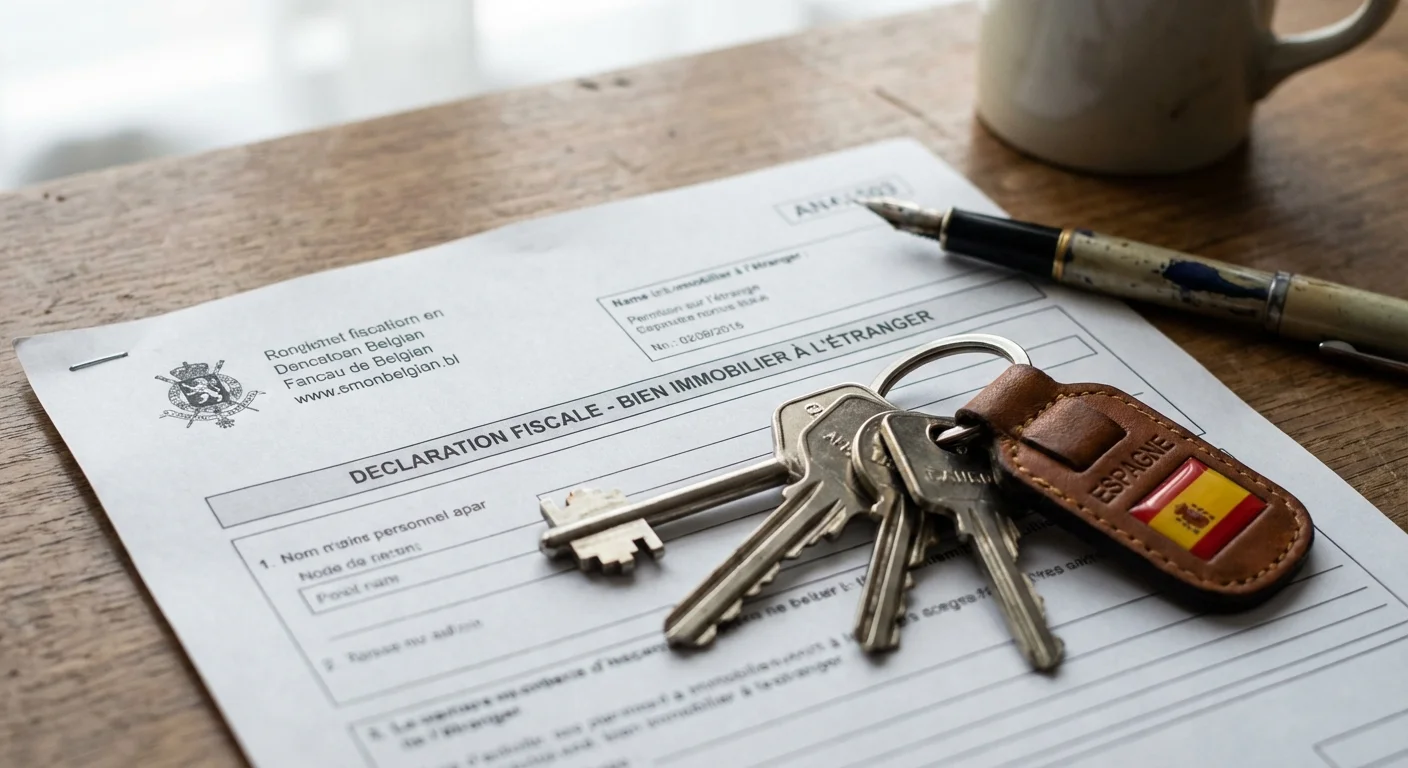
You are required to voluntarily report the purchase of a property abroad to the authorities within four months, whereupon they will issue you with a KI. If you sell the property at a later date, or carry out major renovation work that affects its value, you must also notify the authorities so that the KI can be revised. Ensuring this figure is correctly determined is the fundamental first step: a missing or incorrect declaration can lead to an official valuation, which is almost always less favourable, plus possible fines.
The progression clause: why you declare your income without paying tax
For many property owners, the progression clause is the most confusing aspect, so let’s break it down step by step. Belgian personal income tax operates on a progressive scale: the higher your income, the higher the rate applied to the top few euros. The double taxation treaty stipulates that Spain has the primary right of taxation on property situated within its territory. Belgium therefore exempts the corresponding income — but “exemption with a progression clause” means that Belgium first adds the exempt amount to your total income to calculate the average tax rate, and then applies that rate only to your taxable Belgian income.
A simplified example will make this clearer. Suppose you have taxable income in Belgium (for example, a pension or salary) and your Spanish property is assigned a KI of, say, 1,500 euros. Belgium virtually adds that KI (increased and indexed in the same way as for Belgian property) to your income, calculates the average tax rate on that higher total, and applies that slightly increased rate to your actual Belgian income. The net effect is usually small — often a few tens to a few hundreds of euros per year — but it is real. So you do not pay tax directly on the Spanish property, but your other income is taxed slightly more heavily. For those sitting right on the threshold of a tax bracket, the impact may be more noticeable, which makes it worth carrying out a simulation beforehand.
“You declare your Spanish property in Belgium in order to make use of the progressive tax allowance: the exempt income does not increase the tax on the property itself, but it does affect the tax rate on your other income.”
The difference between this and the Dutch approach is instructive: whilst the Netherlands classifies foreign property under ‘box 3’ on the basis of capital, Belgium uses a cadastral income system with a progressive tax reserve. If you are Dutch or are comparing the two systems, please also read our explanation of Dutch tax on a property in Spain. We discuss the broader principle — how a country taxes its residents’ overseas property — in general terms in how is foreign property taxed.
The interplay with Spanish levies
The Belgian tax return is only half the story. In Spain, as a non-resident, you also pay annual tax on your property, and this is entirely separate from your Belgian tax assessment. It is precisely this interplay that many owners underestimate. Let’s look at the two scenarios — owner-occupation and letting — separately, as the Spanish tax regime differs considerably.
Own use: imputed income (Form 210)
If you use the property exclusively for your own purposes and do not let it out, Spain will still levy a tax on a notional income — the so-called imputed income. The Spanish tax authorities assume that a second home provides you with a benefit, even if you do not let it out. The basis for this is a percentage of the valor catastral (the Spanish cadastral value): usually 1.1% if that value has been revised in the last ten years, otherwise 2%. You pay 19% on that amount (for EU/EEA residents, including Belgians) via the tax return form Model 210, to be submitted annually. In addition, you will pay the local property tax IBI to the local authority, roughly in the region of 200 euros per 100,000 euros of a property’s value, depending on the local authority.
Rental: the IRNR from rental income
If you do let out the property — for example, as a holiday home on the Costa Blanca — you will pay the Impuesto sobre la Renta de no Residentes (IRNR) in Spain on your actual rental income. As an EU/EEA resident, a rate of 19% applies to your net income, from which you may deduct costs such as maintenance, IBI, insurance and depreciation. Non-EU residents pay 24% on gross income without any deductions — a significant difference that highlights the tax benefits of Belgian (and therefore EU) residency. This tax return is also submitted using Form 210. If you wish to let out a property, please also bear in mind the regional letting licence; you can read more about this in our article on the rental licence in Spain.
The key point is that the Spanish tax and the Belgian tax return co-exist: you actually pay tax in Spain, and you declare the property in Belgium without actually paying tax on it (only via the progression clause). The treaty prevents the same income from being effectively taxed twice. A rough guide for anyone wishing to make their property profitable: a holiday home on the Costa Blanca typically yields a net rental return of 4 to 7% per year. You can find out how to calculate this in calculate return on holiday house Spain.
“The Belgian tax return and the Spanish tax are two separate obligations. The double taxation agreement ensures that you do not effectively pay tax twice anywhere, but it does not exempt you from the obligation to file a tax return in both countries.”
Capital gains tax, buyer’s costs and the broader tax picture
In addition to the annual income taxes, there are a number of other tax aspects that every Belgian buyer should be aware of. Belgium itself does not have a general wealth tax, but Spain does. The Spanish wealth tax (Impuesto sobre el Patrimonio) generally applies to net assets above a threshold of around 700,000 euros per person, although this threshold varies by region. For most owners of an average holiday home, the property remains below that threshold, but in the case of luxury property — such as a villa in Moraira or a penthouse in Ibiza — it is advisable to check.
There are also charges involved in the purchase itself. You should expect so-called ‘buyer’s costs’ of around 10 to 15% on top of the purchase price. For existing properties, you will pay stamp duty. ITP; in the Valencian Community — which includes the Costa Blanca — the ITP rate will, incidentally, fall from 10% to 9% for properties valued at up to 1,000,000 euros from 1 June 2026. For new-build properties, you pay 10% IVA plus AJD. On top of that, there are notary, registration and solicitor’s fees. You can find a full overview and a calculation tool on our page Cost of buying a house in Spain, and the full annual tax summary can be found in Property taxes in Spain 2026.
Belgian resident or Spanish tax resident?
The entire account above is based on the assumption that you remain a Belgian tax resident and are therefore not a Spanish tax resident. This distinction is fundamental: if you spend more than 183 days a year in Spain or if your centre of economic interests is there, you may become a Spanish tax resident, with very different consequences (including taxation of your worldwide income in Spain). Many retired Belgians who spend long periods overwintering on the Costa Blanca underestimate this risk. You can find out exactly when you become a tax resident in our article on if you are a tax resident in Spain.
One final, often overlooked detail: as your Spanish income affects your total taxable base via the ‘progressievoorbehoud’, this may also have an impact on the local surcharges on personal income tax in some municipalities. The effect is small, but it does exist. You should also keep all official Spanish documents — your Modelo 210 returns, IBI assessment notices and the property purchase file — as they are now, as the exchange of data between the Spanish and Belgian tax authorities is highly efficient and undeclared property is quickly detected.
Step-by-step guide to completing a Belgian tax return correctly
To ensure your application is processed smoothly and correctly, please follow the steps below. For the official codes and the most up-to-date instructions, please always consult the website of the Federal Public Service Finance.
- You must voluntarily report the purchase of your Spanish property to the General Administration of Property Documentation within four months, so that a foreign cadastral income can be determined.
- Check the KI allocated to you via MyMinfin and enter it in the relevant section (Part 1, Box III) of your personal income tax return.
- Please notify us in good time of any major renovations or a subsequent sale, so that the KI can be revised.
- Keep your Spanish tax returns (Modelo 210) and IBI assessment notices as supporting documents in case of a Belgian tax audit.
- If in doubt, carry out a simulation of the progressive tax allowance in advance, especially if your income is close to a tax bracket threshold.
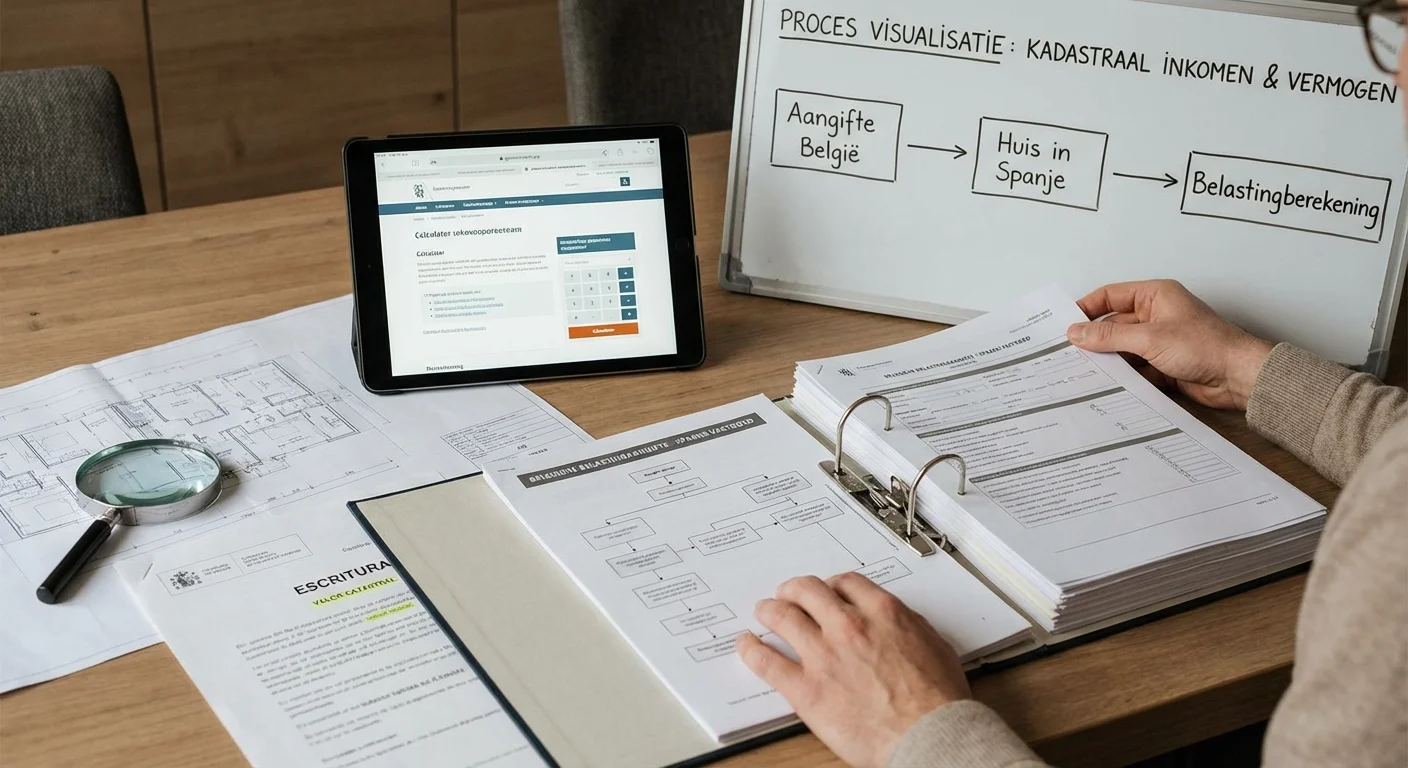
“Failure to declare foreign cadastral income results in an ex officio assessment, which is almost always less favourable than a correct and timely declaration.”
How we can help you
The tax implications arising from the interaction between the Belgian progressive tax allowance and Spanish tax charges are technical in nature, but can be fully managed with the right guidance. Our team at Invest in Spain, led by property expert and CEO Kenzo Fayot, guides buyers from Belgium, the Netherlands, Germany and France through the entire process: from the search for the right property on the Costa Blanca North (Dénia, Jávea, Altea, Moraira) or South (Torrevieja, Orihuela Costa, Pilar de la Horadada), through to the legal review …from purchase support to letting management and key management afterwards. This way, you can be sure that both your Spanish and Belgian obligations are properly taken care of right from the start.
Whether you’re an investor, looking for a second home, moving here as an expat, or a pensioner wanting to spend the winter in the sun: we combine estate agency services, investment advice and practical support all under one roof. Please feel free to browse our listings via search for property in Spain or discover our full range property services in Spain. Do you have a specific question about tax in Belgium relating to your home in Spain, or would you like a personalised calculation? Please feel free to contact us, with no obligation — We’re happy to discuss options with you, with no obligation.
Frequently asked questions about tax in Belgium on a property in Spain
What is the basic rule for taxation in Belgium on a house in Spain?
Although your property in Spain is subject to tax, you are required to declare ownership of it in your Belgian personal income tax return as foreign cadastral income. Thanks to the double taxation agreement, you do not pay any actual tax on this property in Belgium, but the exempt amount is taken into account under the progression clause to determine the tax rate on your other Belgian income.
What exactly is the progression clause?
The progression adjustment means that Belgium first adds your exempt Spanish income to your total income to calculate your average tax rate, and then applies that rate to your taxable Belgian income only. You therefore do not pay any tax directly on the Spanish property, but your salary or pension may be taxed slightly more heavily because you will be subject to a higher average tax rate.
How is foreign cadastral income calculated?
Since 2021, every foreign property has been assigned a cadastral income, just like Belgian property. The Belgian tax authorities take the normal market value of the property as their starting point, adjust it to the price level of the reference year 1975 using a correction factor, and then apply a rate of return. The result is a notional annual income which is usually modest and does not correspond to your actual rent or the market value.
Will I have to pay double tax in Belgium and Spain?
No. In Spain, you effectively pay the non-resident tax (imputed income for owner-occupied property, or IRNR under form 19% for EU residents letting out property) plus the local IBI. In Belgium, you declare the property, but thanks to the double taxation agreement, you do not pay any actual tax on it — only the progressive tax adjustment applies. The same income is therefore never effectively taxed twice.
When do I need to notify the Belgian tax authorities of any changes?
You must voluntarily report the purchase of your Spanish property to the General Administration of Property Documentation within four months. You must also report any subsequent sale or major renovation that affects the property’s value, so that the cadastral income can be revised. This has a direct impact on your annual tax return and the applicable progressive tax bracket.