In the strict sense, there is no such thing as a completely tax-free investment in Spain: every property involves purchase costs, annual charges and tax on rental income or capital gains. However, you can legally and significantly reduce your effective tax burden through deductible expenses when letting to EU residents, regional benefits in the Comunidad Valenciana, the wealth tax exemption threshold of approximately €700,000 per person, and the reinvestment exemption when selling your main residence. With the right structure and timing, you can thus achieve a tax-optimised return, without any false promises.
Many buyers and investors from Belgium, the Netherlands, Germany and France are looking for ways to protect their assets on the Costa Blanca from high taxes. It’s good that you’re being sceptical, because when it comes to the term tax-free investments in Spain There is a lot of marketing jargon in circulation that paints a rosier picture of reality than is actually the case. In this article, we provide you with an honest and expert overview: what is possible, what isn’t, and how you can get the most out of your Spanish property whilst staying within the law.
The Spanish government has introduced a number of schemes designed to reduce your actual tax burden. The most important of these are:
- Exemption from capital gains tax when reinvesting the proceeds from the sale of your main residence in a new home you own.
- Deductibility of expenses incurred by EU or EEA residents when letting property.
- Regional benefits, such as the favourable inheritance and gift tax rates in the Comunidad Valenciana.
- A generous wealth tax exemption threshold (around €700,000 net per person).
Making sensible use of these schemes will help you with your income and capital gains tax legal to minimise. No loopholes in the law, but the correct application of the rules that apply to everyone.

Are there really any tax-free investments in Spain?
The honest answer is no, not in the literal sense. Anyone buying property in Spain will inevitably face purchase costs, annual taxes and charges on rental income or capital gains. However, the reality is more nuanced than the black-and-white portrayal you sometimes come across. Through smart planning, the right structure and good timing, you can significantly reduce your effective tax burden. For investors and buyers of a second home, this makes the difference between a meagre and a healthy net return. Our role as local specialists on the Costa Blanca is to guide you through these nuances, ensuring you have realistic expectations and avoid any unexpected bills.
Tax-free investments in Spain They are therefore rare in absolute terms, but tax efficiency is very much achievable. It is about optimising within the law, not about evasion.

The reality of the Spanish tax environment
The Spanish tax system is renowned for its complexity, with both national and regional legislation coming into play. Anyone buying an existing property today should expect to pay around 10 to 15 per cent in buyer’s costs on top of the purchase price. This includes stamp duty (ITP) in existing buildings or IVA plus AJD for new-build properties, together with notary, registration and solicitor’s fees. You can easily produce a detailed calculation using our tool for calculating the costs incurred by a buyer of a property in Spain. Good news for the Valencian Community: from 1 June 2026, the ITP on properties valued at up to €1,000,000 will fall from 10 per cent to 9 per cent, which will lower the barrier to entry for buyers.
Your tax status has a significant impact on how ‘flexible’ your investment is. Different rules apply to non-residents than to residents. It is therefore worth determining in advance which property, region and structure best suit your objectives. Anyone wishing to understand the current rates will find plenty of guidance in our overview of the Property taxes in Spain for 2026.
To gain a clear picture of the factors that determine your tax burden, we always consider the following elements:
- The length of time for which you intend to hold the investment (long-term versus short-term).
- The autonomous region in which the property is situated, given the regional differences in rates.
- The way in which you purchase and hold the property (privately or through a legal structure).
- The double taxation agreement between Spain and your home country (Belgium, the Netherlands, Germany or France).
Regional differences and exemptions

A notable feature of investing in Spain is the extensive power of the autonomous communities to set their own tax rates. This applies, amongst other things, to capital gains tax and inheritance and gift tax. It is precisely here that the most tangible benefits lie. On the Costa Blanca, in the Valencian Community, there is a 99 per cent relief on inheritance tax for spouses and children. From 1 June 2026, a 25 per cent reduction will also apply to brothers, sisters, uncles, aunts, nephews and nieces, rising to 50 per cent from June 2027. Important for our international clients: non-residents from the EU or the EEA are entitled to the same regional benefits as Spanish residents.
In addition, there is an exemption threshold for wealth tax of approximately €700,000 net per person, which varies by region. For a married couple, this means that a substantial portion of their wealth remains untaxed. A strategic choice of the right region and a well-considered allocation of ownership therefore contribute directly to a lower effective tax rate. In practice, this comes close to what many people have in mind when tax-free investments in Spain at regional level, without having to stretch the law even a millimetre. If you’d like to explore the inheritance and succession aspects in more detail, read on in our guide to Inheritance law and property in Spain.
It is advisable to follow the official guidelines issued by the Agencia Tributaria Please consult these for the most up-to-date legal frameworks and rates. This will ensure you do not rely on out-of-date information.
Although the dream of completely tax-free investments often turns out to be an illusion, the system offers plenty of legal ways to keep your tax liability to a minimum. By ensuring you are well-informed and setting up the right structure, you can make the most of the economic growth along the Spanish coast.
Tax benefits for property investors and residents
The Spanish system offers a range of interesting opportunities for those who manage their capital wisely. For many foreign buyers, the search for tax advantages investments in new-build properties in Spain a key motivation for moving south. Full exemption is rare, but there are numerous tax deductions and schemes that reduce the effective tax burden. This applies to residents whose main residence is in the country, but non-residents also benefit from double taxation agreements. Understanding local legislation is essential to maximising the return on your property portfolio.
The impact of tax residency on your returns
When you If you spend more than half the year in Spain, you will generally be considered a tax resident. This opens the door to a significant benefit: exemption from capital gains tax on the sale of your main residence, provided you reinvest the proceeds in a new home of your own. For those who move their permanent residence to the Costa Blanca, this is one of the most valuable schemes. For residents over the age of 65, a more generous exemption also applies when selling their main residence. Furthermore, regional differences come into play: the Valencian Community offers favourable rates for inheritance and gift tax, which significantly improve your net position.
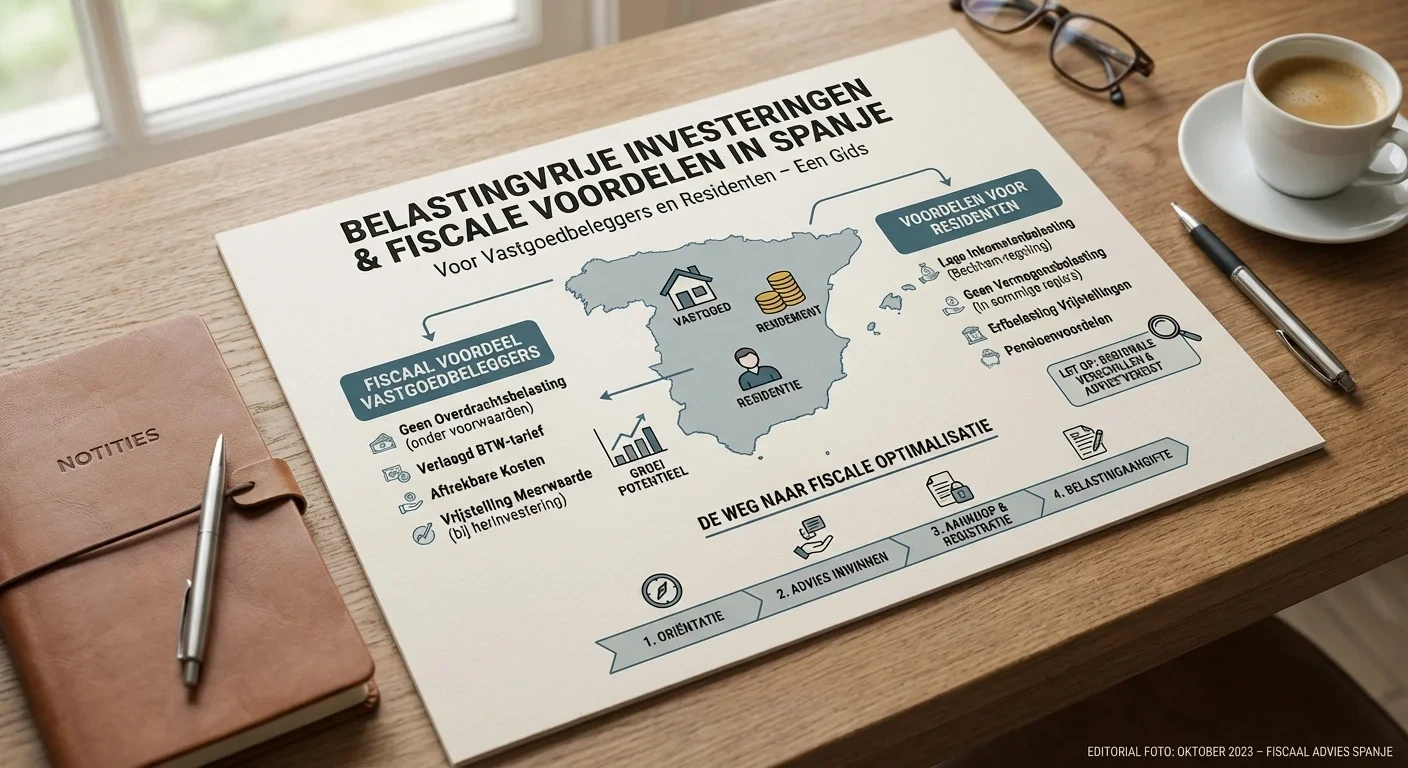
For non-residents, the system works differently, but there are opportunities here too. They pay the IRNR (Impuesto sobre la Renta de no Residentes) on their rental income. If you let out your property, a rate of 19 per cent applies to EU or EEA residents, and you may deduct the costs from the taxable base. For non-EU nationals, the rate is 24 per cent of gross income, with no deductions. It is precisely this deductibility for EU landlords that makes all the difference. By correctly claiming your expenses, the effective tax rate often falls significantly. The tax return is filed using Form 210. Engaging a reliable broker and a good tax adviser will help you navigate these administrative procedures.
When planning your finances, please bear the following points in mind:
- In the case of EU lettings, costs such as maintenance, insurance and mortgage interest are deductible from rental income.
- If the property is unoccupied, an imputed income applies: 19 per cent of 1.1 per cent of the cadastral value (in the event of a revaluation within 10 years) or of 2 per cent of that value.
- The annual IBI (property tax) amounts to roughly €200 per €100,000 of the property’s value.
- The double taxation agreement between your home country and Spain prevents you from paying twice.
“Tax optimisation is not a matter of tax avoidance, but of correctly applying the law to achieve your investment objectives within the Spanish framework.”
In addition to income tax, capital gains tax also comes into play, although the exemption threshold of around €700,000 net per person is high enough to spare the average investor. Anyone who has an attractive wants to calculate the return on a holiday home, should take into account a guideline figure of 4 to 7 per cent net per annum. The government also regularly introduces new schemes, for example to encourage sustainable renovation or long-term letting. By taking a proactive approach and keeping your records in order, your tax strategy will remain sound in the long term.
Structure and timing: the real drivers of optimisation
Whilst marketing copy often talks about ‘magical’ strategies, the real gains lie in two practical factors: the structure you use to buy and hold, and the timing of your transactions. A well-thought-out approach from the outset often yields better results than any retrospective arrangement. For those who really want to get to the bottom of the tax puzzle, this is the chapter that matters.
How to hold onto your investment
The way in which you hold ownership affects your tax liability. In practice, splitting ownership between two partners doubles the wealth tax exemption threshold. Financing is also a factor: a mortgage for non-residents usually covers up to around 70 per cent of the valuation, and the interest is tax-deductible for EU lettings. Anyone wishing to explore the options will find a clear explanation on our page about the apply for a mortgage in Spain. Whether a corporate structure is appropriate depends largely on the size and purpose of your portfolio and always requires personalised advice.

Timing of the rule changes in 2026 and 2027
The coming years will bring tangible opportunities for those who time their moves in line with the legislation. The reduction of the ITP to 9 per cent for properties valued at up to €1,000,000 from 1 June 2026 will make purchases in the Comunidad Valenciana more cost-effective. The phased extension of the inheritance tax relief for more distant relatives in 2026 and 2027 is relevant for estate planning. And the reinvestment exemption when selling your main residence requires careful timing of the sale and reinvestment. Good planning capitalises on these opportunities; waiting means missing out on money.
“Good tax planning in advance is half the battle when buying Spanish property.”
Anyone wishing to further expand their portfolio would be well advised to also consider the broader strategy outlined on our pillar page about real estate investments in Spain, taking into account the region, type of property and return on investment.
Tips for tax-efficient investments in Spain
Successfully navigating the Spanish tax landscape requires thorough preparation. To make the most of it, look at the regions with the most favourable schemes, identify properties that qualify for advantageous schemes – such as the reinvestment exemption for your own home – and work with a local gestor who knows the rules inside out. By choosing areas with a healthy economy on both the northern Costa Blanca (Dénia, Jávea, Altea, Moraira) and the southern Costa Blanca (Torrevieja, Orihuela Costa, Pilar de la Horadada), you increase your chances of a profitable return without unnecessary tax liabilities.
Strategic locations and fiscal planning
In practice, it appears that the location of your property determines your effective tax burden, for both residents and non-residents. The Costa Blanca, within the Comunidad Valenciana, offers a tax-friendly environment, whilst Ibiza may also be of interest to those seeking luxury.
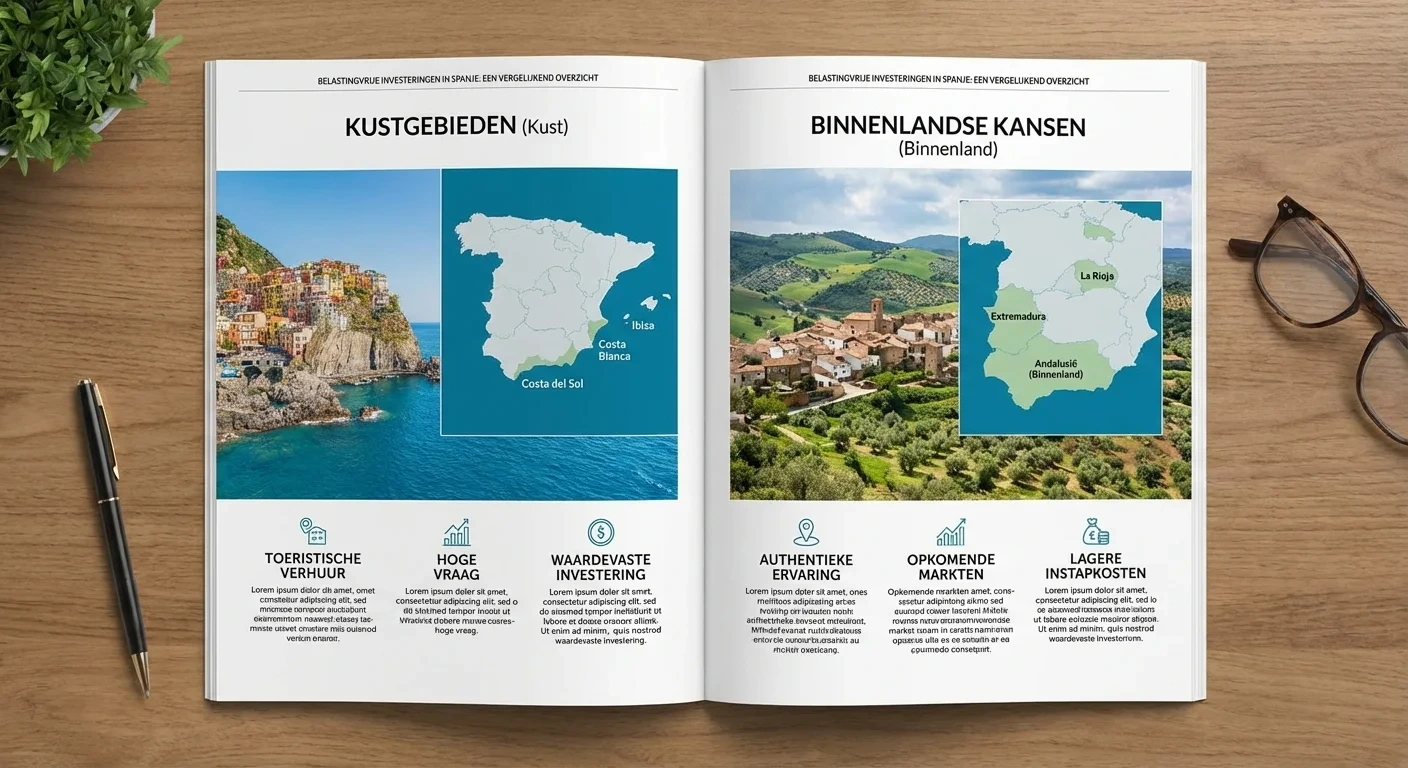
When looking for tax-efficient investments, it is advisable to follow these steps to establish a solid foundation:
- Check the current transfer tax by autonomous region before you buy.
- Check with EU-Verhuur to see which costs you can deduct from your rental income.
- Determine how ownership is divided between partners in relation to the capital gains tax threshold.
- Coordinate the timing of the sale and reinvestment to take advantage of the capital gains exemption.
You should also keep up to date with any changes to the double taxation agreements between your home country and Spain. The rules governing tax-efficient investments may change from year to year. For information relating to the Netherlands, please consult the official website of the Tax Office, and for the situation in Belgium, please refer to our explanation regarding Tax in Belgium on a property in Spain. Always opt for transparency and ensure that all documentation is correctly recorded, so as to avoid future fines.
Although Spain is known for its complex tax system, there are certainly genuine opportunities for savvy investors, pensioners and buyers of second homes. With the right legal structure and timely planning, you can significantly increase your net return, entirely within the law.
How we can help you
At Invest in Spain, our team, led by property expert and CEO Kenzo Fayot, with buyers and investors from Belgium, the Netherlands, Germany and France visiting every day. Whether you’re looking for a second home, want to move to a sunnier climate in retirement, or wish to diversify your assets in a tax-efficient manner, we combine local market knowledge of the Costa Blanca with guidance on purchasing, investment advice, assistance with your mortgage, letting, maintenance and key management, legal due diligence and sales. This ensures you maintain realistic expectations and get the most out of every euro, without false promises about ‘tax-free’ property. Please feel free to browse our full range of services or let us inspire you Current property listings in Spain.
Would you like to know how to structure your investment in Spain to maximise tax efficiency? Please feel free to contact us, with no obligation for a personal consultation. We’d be happy to discuss with you the structure, timing and the region that best suits your situation.
Frequently asked questions about tax-free investments in Spain
Are there really any completely tax-free investments in Spain?
No, there is no such thing as completely tax-free property. You will always have to deal with purchase costs, annual charges such as the IBI, and tax on rental income or capital gains. However, you can legally and significantly reduce your effective tax burden through deductible expenses, regional incentives, and the right structure and timing.
As a non-resident from the EU, what expenses can I claim as deductions when letting out a property?
EU or EEA residents pay 19 per cent IRNR on their rental income and may deduct expenses such as maintenance, insurance and mortgage interest from their taxable base. The tax return is filed using Form 210. For non-EU citizens, the rate is 24 per cent of gross income, with no deductions allowed.
How much is the wealth tax allowance?
The exemption threshold stands at around €700,000 net per person, with regional variations. For a married couple who split their assets, this means that, in practice, a considerable amount of their wealth remains untaxed. This is one of the reasons why the structure of ownership is so important.
What regional advantages does the Comunidad Valenciana offer?
The Valencian Community offers a 99 per cent inheritance tax relief for spouses and children. From 1 June 2026, there will be an additional 25 per cent discount for brothers, sisters, uncles, aunts, cousins and nieces, rising to 50 per cent from June 2027. The ITP rate for properties valued at up to €1,000,000 will also fall from 10 per cent to 9 per cent from 1 June 2026. Non-residents from the EU or the EEA are entitled to the same benefits.
How can I avoid capital gains tax when selling my home?
If you are a tax resident in Spain, you can claim an exemption on the capital gain realised on the sale of your main residence by reinvesting the proceeds in a new home. A more generous exemption applies to residents aged over 65. Timing the sale and reinvestment correctly is crucial in this regard.