Property investments in Spain combine an attractive rental yield with stability of value and a taste of the Mediterranean lifestyle. For Belgian and Dutch investors, the Spanish market — and certainly the Costa Blanca — remains one of the most profitable ways to grow capital outside of a savings account or the volatile stock market. In this guide, you’ll find out why Spain is such a good investment, which regions offer the highest returns, how the tax system works and how to maximise your returns with the right guidance.
At Invest in Spain We support buyers from Belgium, the Netherlands, Germany and France — from the initial search right through to post-purchase management — so that your investment becomes a reliable source of passive income rather than a source of worry.

Why invest in Spanish property?
The appeal of the Iberian Peninsula has been a given for many Belgians and Dutch people for decades. Whether it’s the sun-drenched Costa del Sol, the white beaches of the Costa Blanca or the authentic charm of the interior, Spain remains a top destination. In recent years, however, we have seen a clear shift. Whereas people used to look mainly for a holiday home for their own use, the focus today is increasingly on returns. An investment in Spanish property has become a fully-fledged alternative to the traditional savings account or the volatile stock market.
Looking at the economic context, the resilience of the Spanish property market is striking. Prices have stabilised following the 2008 crisis and are now showing healthy, steady growth — ideal for those seeking long-term capital appreciation. But it’s not just about the property’s appreciation in value. The rental market is thriving, driven by both mass tourism and a growing group of digital nomads and pensioners who spend the winter in the south.

One key reason to consider the Spanish market right now is the wide range of options available. Whether you opt for a modern flat in a bustling city such as Málaga or Valencia, or a rustic finca in the hills of the Costa Blanca hinterland, entry-level prices are often still noticeably lower than in Belgium or the Netherlands. This means that, for the same budget, you can often purchase a higher-quality property, which directly benefits your potential return on investment.
Furthermore, the legal framework for foreign investors has become highly professionalised. Bureaucracy can still be a challenge at times, but current legislation offers a high level of protection for buyers — provided you seek guidance from experts who know the local market and regulations inside out. Good preparation is half the battle, especially for Belgian or Dutch buyers looking to invest profitably.
The unique strengths of the Spanish market
Why Spain and not France or Italy? The answer lies in a combination of factors that come together so harmoniously nowhere else in Europe. Spain has excellent airports with direct connections from Brussels, Charleroi, Amsterdam and Eindhoven, which makes it easily accessible for both you and your tenants. On top of that, there is an unbeatable quality of life, which ensures a constant demand for accommodation. Here is a summary of the key advantages:
- Favourable climate: With more than 300 Sundays a year, the letting season is long, which is essential for a stable cash flow.
- Lower cost of living: Maintenance, taxes and the cost of living are lower than in Northern Europe, which increases your net return.
- Growing tourism sector: Spain remains one of the world’s top three destinations, meaning that demand for high-quality holiday homes remains consistently high.
- Tax options: With the right structure in place, investing in Spanish property can be an attractive proposition for foreigners.
- Modernisation: Many new-build properties meet the strictest European energy standards, which safeguards their future resale value — see our guide for a comparison of the pros and cons buying a new-build or an existing property.
As well as economic factors, emotional value also plays a part. An investment in Spain is often an investment in a lifestyle: many investors use their property themselves for a few weeks each year. That dual benefit — financial return and personal enjoyment — is the decisive factor for many buyers.
However, it’s not all plain sailing. A good investor also considers how their property is managed. When you’re not there, it’s essential that your property is in good hands: from garden maintenance to security. You can read about how to protect your investment in practical terms in our guide on professional key management. The market has also matured in terms of financing: Spanish banks are familiar with foreign buyers and generally grant non-residents a mortgage of up to around 70% of the valuation.
The most profitable regions for a Spanish property investment
Spain is not a homogeneous market. Each autonomous region has its own tax rules, tourist appeal and price dynamics. For those seeking a healthy mix of rental income and capital appreciation, understanding the nuances between the different coastlines and cities is crucial. After all, location determines not only the purchase price, but also summer occupancy rates and the stability of rental income during the low season. You can find an in-depth comparison in our guide to the best regions for property investment.
The Costa del Sol remains the frontrunner in terms of prestige. Marbella, Estepona and Benahavís attract a wealthy clientele, resulting in higher rental prices. Entry-level prices there are significantly higher, but the constant demand for luxury rental properties more than makes up for this.
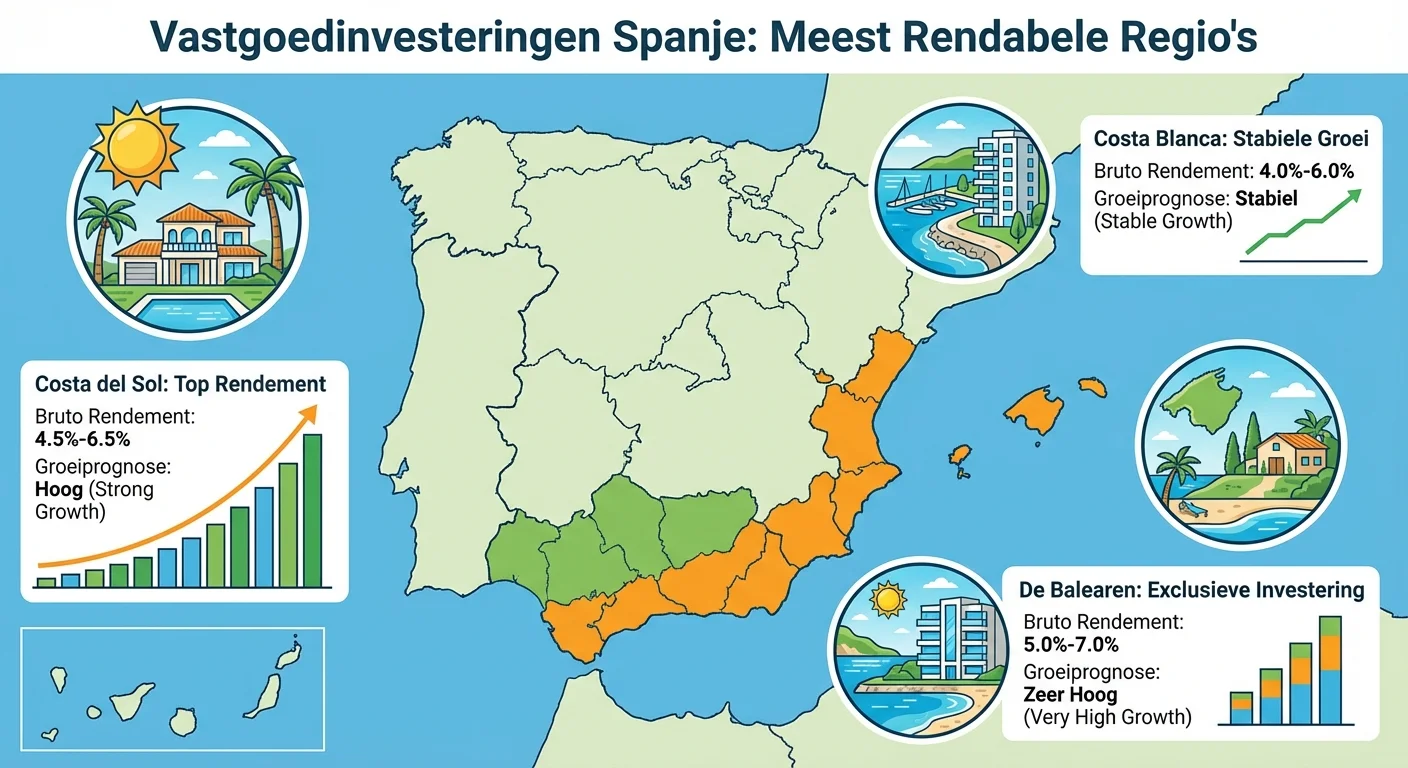
Our own home base, the Costa Blanca, is currently proving very popular with savvy investors. Both the north, around Dénia, Altea and Moraira, and the south, around Torrevieja, Orihuela Costa and Pilar de la Horadada, offer an excellent balance between authentic atmosphere and modern amenities. The Costa Blanca is traditionally more affordable than the Costa del Sol, which can yield a higher net initial return. Its accessibility via the airports of Alicante and Valencia is a decisive advantage for holidaymakers from the Low Countries. It is therefore the region where we can provide you with the most specialised guidance.
For those looking to capitalise on urban growth, Málaga and Valencia are particularly interesting. These cities are transforming rapidly and attracting digital nomads and international companies, which is shifting the market from purely tourist-oriented rentals towards medium- and long-term lets. Diversifying risk within your strategy often starts with a location that is not solely dependent on the summer season. Here is an overview of the key regions:
- Costa del Sol: the highest rental potential in the luxury segment and a strong international profile.
- Costa Blanca: Excellent value for money, very popular in the Belgian and Dutch markets — our core market.
- Costa Cálida: an up-and-coming region around Murcia with lower entry-level prices and plenty of growth potential.
- The Balearic Islands (Ibiza & Mallorca): An exclusive market with strict letting regulations, but with very high stability of value.
- Major cities (Madrid, Barcelona, Valencia): ideal for capital growth and a steady stream of residential tenants.
As well as the region, the specific neighbourhood and proximity to amenities also play a role. A flat right on the seafront is always easier to let out, but maintenance costs are often higher there due to the effects of the sea. So do think carefully in advance about how you will manage the property after purchase. Also, bear in mind the local regulations regarding letting licences: in Catalonia or the Balearic Islands, these can sometimes be difficult to obtain or have been temporarily suspended, whilst in the Valencian Community and Andalusia they are currently more favourable. This legal aspect is often just as crucial to your return on investment as the location itself — read our guide on this subject Applying for a letting licence in Spain. Finally, we mustn’t forget the up-and-coming Costa de la Luz on the Atlantic coast: a region with unspoilt beaches which, despite a shorter season, is steadily increasing in value.
Tax aspects and legal steps when buying
The Spanish property purchase process differs significantly from the practice in Belgium or the Netherlands. Whereas in Belgium the notary is responsible for the entire due diligence process, in Spain it is the solicitor who (lawyer) a much more active role in safeguarding your interests. Watertight legal preparation is therefore the foundation of any successful investment.
The first crucial step is to applications for a NIE-number (Número de Identidad de Extranjero), your tax identification number for foreign nationals. Without this document, you cannot open a bank account, set up utility services or register property. You should also bear in mind the buyer's costs: on top of the purchase price, you should allow for an additional 10% to 15% for stamp duty (ITP) for existing buildings or VAT (IVA) plus stamp duty (AJD) in the case of new-build properties, in addition to notary, registration and solicitor’s fees.

The role of the lawyer and the notary
In the Spanish system, the notary is primarily a witness who verifies the identity of the parties and formalises the deed. The lawyer carries out the due diligence He checks that there are no outstanding debts on the property, that the seller is the rightful owner, and that all planning permissions are in order. That is exactly where our legal control of real estate in Spain It’s essential to do this, as hidden flaws in the paperwork can cause major financial headaches later on. Furthermore, as Spain is a decentralised country, tax rates vary from one autonomous region to another — a local expert will tell you exactly which rates apply in your area.
Once the legal due diligence has been completed, you will often sign a Contrato de Arras: a reservation contract with a deposit of usually 10%. If, as the buyer, you subsequently decide not to go ahead with the purchase, you will forfeit this amount; if the seller withdraws, they will refund you double the amount. This offers both parties solid protection.
Tax liabilities after purchase
Even after the purchase, there are still annual obligations. The most important ones are:
- IBI (Impuesto sobre Bienes Inmuebles): the municipal property tax, which is similar to the property withholding tax.
- IRNR (Impuesto sobre la Renta de No Residentes): the non-resident tax. Even if you do not let out your property, you are deemed to derive a flat-rate benefit from owning it.
- Capital gains tax: depending on the region and the value of your total Spanish assets; this usually only applies above a threshold of €700,000 net per person.
- Community: not a tax, but the monthly contribution towards the upkeep of housing estates and communal facilities.
Full details of these taxes — including the rates of 19% (EU/EEA) and 24% (non-EU) on rental income — can be found in our guide on Taxes for property investors in Spain. Finally, don’t forget about inheritance tax: Spain has its own inheritance tax on property, and a Spanish will makes the settlement of your estate considerably easier for your heirs.
Maximising rental returns: holiday lettings versus long-term lettings
You are faced with a crucial choice: the dynamism of holiday lettings or the stability of long-term lettings? Holiday homes on the Costa Blanca or Costa del Sol generate substantial income during the high season, often with daily rates that exceed the monthly rent of a standard tenancy agreement. However, this model does require a more active approach: cleaning, marketing and a tourist licence. For those seeking passive income without weekly hassles, long-term lettings to local residents or expats are often a more attractive option, offering a steady cash flow and less wear and tear.
To make the right choice, it helps to understand local market needs:
- Location: Properties close to the sea are more popular as holiday homes; properties in city centres are ideal for annual tenancies.
- Management: Holiday rentals require a reliable local partner — see our guide on professional key management.
- Taxation: Rates vary depending on the type of rental and your residency status.
A hybrid model — using the property yourself in the off-season and letting it out in the summer — is popular with Belgian and Dutch owners. Ultimately, a realistic return-on-investment analysis will determine whether your purchase is a success. You can find out exactly how to carry out this calculation in our guide calculate return on holiday house Spain, with target figures for a healthy net return of 4% to 7% per year. Anyone with a business mindset can also investing in commercial property in Spain consider as a supplement to residential property.
Spreading risk and managing your portfolio
Diversification is the cornerstone of long-term success. It is unwise to invest all your capital in a single type of property or a single region. By diversifying between holiday homes on the coast and flats in up-and-coming cities, you can generate a more stable return and are less vulnerable to local market fluctuations. Effective management is at least as important as the purchase itself: a well-maintained property retains its value and attracts higher-quality tenants. To ensure a healthy portfolio, bear the following in mind:
- spread across different regions (for example, the Costa Blanca alongside the Costa Cálida);
- a mix of short- and long-term lettings to optimise cash flow;
- regular maintenance of facilities such as gardens and swimming pools;
- investing in security to minimise the risk of properties standing empty.
Investing in Spanish property remains one of the most attractive ways to build wealth in Southern Europe, but without a rigorous management plan, costs can mount up. By being proactive and drawing on local expertise, you can maximise your net return. Ultimately, a successful portfolio is all about the right location and a smart purchase price — which our guide negotiating the price of a Spanish property helps you further — and ensures the smooth running of day-to-day operations.
How we can help you
If your estate agent in Spain Under the leadership of property expert and CEO Kenzo Fayot, we guide buyers and investors from Belgium, the Netherlands, Germany and France through every step of the process: investment advice, property search and purchase, legal due diligence, financing and post-purchase management. Whether you’re looking for a profitable flat in Torrevieja or a luxury villa on the Northern Costa Blanca, we’ll bring your project to fruition in a secure and profitable manner. Start with our comprehensive guide buying property in Spain or find out straight away all our services.
Frequently asked questions about property investment in Spain
Why is investing in Spanish property so popular at the moment?
Spain combines a stable climate, a growing tourism sector and relatively low entry prices compared with Belgium and the Netherlands. The high demand for holiday homes ensures a steady stream of rental income, whilst the property increases in value over the long term.
How do I start a profitable investment in the Spanish property market?
Start by carrying out a thorough market survey of popular regions such as the Costa Blanca or the Costa del Sol, apply for your NIE number in good time, and engage local legal experts to guide you in avoiding tax pitfalls.
What return can I expect?
A well-maintained holiday home typically generates a net return of 4% to 7% per year, depending on location, occupancy rates and costs. On top of that comes the potential increase in the property’s value.
What are the main additional costs involved in a purchase?
Allow for an additional 10% to 15% to cover transfer tax (ITP) or VAT, as well as notary, registration and solicitor’s fees. These percentages vary by autonomous region, so be sure to seek proper advice in advance.
Do I have to pay tax if I don’t let out my property?
Yes. Even if you are using the property yourself, Spain levies a flat-rate non-resident tax (IRNR) plus the annual IBI. If you let the property, you pay 19% (EU/EEA) or 24% (non-EU) on the rental income.
Ready to invest profitably under the Spanish sun? Please contact our advisers for a personal consultation and a proposal tailored to your financial goals.