Would you like to buying property in Spain? This process requires thorough legal and financial preparation to secure your dream home under the sun. For many Belgians and Dutch people, buying property in Spain is the ultimate step towards a carefree life or a profitable investment. The Spanish housing market offers unique opportunities, but local regulations differ greatly from the Low Countries.
It is essential to follow the right steps, from the applications for a NIE-number to the transfer at the notary. With professional guidance, you will avoid unforeseen costs and legal pitfalls. Successful buying property in Spain starts with a watertight contract and a reliable local partner.

- Arrange your NIE number and bank account in time.
- Engage an independent lawyer for legal review.
- Count on 12-15% extra cost buyer.
- Always check building permits.
Why buying property in Spain is a smart investment
The appeal of the Iberian Peninsula has been undeniable to northern Europeans for decades. Whether it is the sun-drenched costas, the rich culture or the relaxed lifestyle, the motivation to make the move south is diverse. However, in recent years there has been a clear shift in the market. Whereas people used to mainly look for a holiday home for their own use, we now see that buying property in Spain is increasingly approached from a purely business and strategic point of view. The combination of a stable legal environment, a growing tourism sector and relatively favourable property prices makes the country a hotspot for investors looking for both returns and long-term value appreciation.
Looking at the current economic indicators, the Spanish housing market shows impressive resilience. Despite global fluctuations, demand for quality homes in regions such as the Costa del Sol, the Balearic Islands and Costa Blanca remains undiminished. This is due not only to foreign buyers, but also to a growing domestic market. For those considering capital diversification, buying property in Spain offers a tangible asset that is less volatile than the stock market, while benefiting from the steady stream of tourists visiting the country every year.
One of the main reasons investors choose this market is the net return on rentals. In popular coastal areas and major cities such as Madrid and Barcelona, rental yields can be substantial, especially during the high season. With the rise of platforms such as Airbnb and Booking.com, managing holiday homes has become more accessible than ever. Those who smartly choose a location with good infrastructure and proximity to amenities can count on an occupancy rate that remains stable throughout the year. Buying property in Spain for rental returns and value growth is therefore a strategy used by many experienced investors to strengthen their portfolio.
In addition, climate plays a crucial role in property value retention. With more than 300 sunny days a year, Spain is a destination that never goes out of fashion. This ensures a constant flow of potential tenants and buyers. If you look at the historical data, you will see that properties in prime locations not only retain their value, but often rise faster than the national average. The process of buying property in Spain however, requires thorough preparation and knowledge of local laws to minimise risks and maximise profitability.
To get a clear picture of the benefits, we have listed the main reasons for you:
- Favourable value for money: Compared to other Mediterranean countries, in Spain you often get more square metres and better facilities for your money.
- High rental potential: The tourism industry is one of the strongest in the world, creating a constant demand for short-term accommodation.
- Legal certainty: As an EU member state, Spain provides a transparent and secure legal framework for foreign investors.
- Quality of life: An investment in Spain is also an investment in a lifestyle that promotes health and well-being, which enhances the resale value.
- Infrastructure: Excellent connections via international airports and a modern high-speed train network make the country very accessible.
It is essential to understand that not every region in Spain offers the same growth potential. While some areas are becoming saturated, there are emerging districts where prices are still relatively low but expectations are high. For an in-depth analysis of current market trends and specific opportunities, read more on our page on real estate investment Spain. Here you will find detailed information on what to look out for when selecting the right property.
“The Spanish real estate market has transformed from a speculative bubble to a mature market where fundamental values and sustainable growth are central. For the serious investor, this offers unprecedented opportunities.”
Besides the direct financial benefits, buying property in Spain also tax advantages for certain groups of investors. Although the tax burden may vary by region, there are several schemes that make it attractive to invest capital in Spa
Popular regions for Belgians and Dutch on the Spanish coast
Looking at current trends in the Mediterranean housing market, it is striking that the interest of the Low Countries in the Spanish coastline remains undiminished. The dream of having your own place under the sun has become a tangible reality for many. Whether it is a modern flat with sea view or an authentic finca in the hinterland, the diversity of landscapes and microclimates ensures that there is a suitable location for every type of investor. Buying property in Spain is therefore a process where the choice of location is the single most important factor for both residential enjoyment and future returns.
The Costa Blanca remains without doubt the absolute front-runner for Belgians and Dutch alike. This region, divided into a northern and southern part, offers a unique combination of accessibility, excellent healthcare and a vibrant community that is active all year round. In the north, around places like Altea, Javea and Denia, we find a greener landscape with impressive cliffs and bays. The south, with towns like Torrevieja and Orihuela Costa, is known for its vast sandy beaches and very competitive prices, making it an ideal entry-level region for those considering buying property in Spain for the first time.
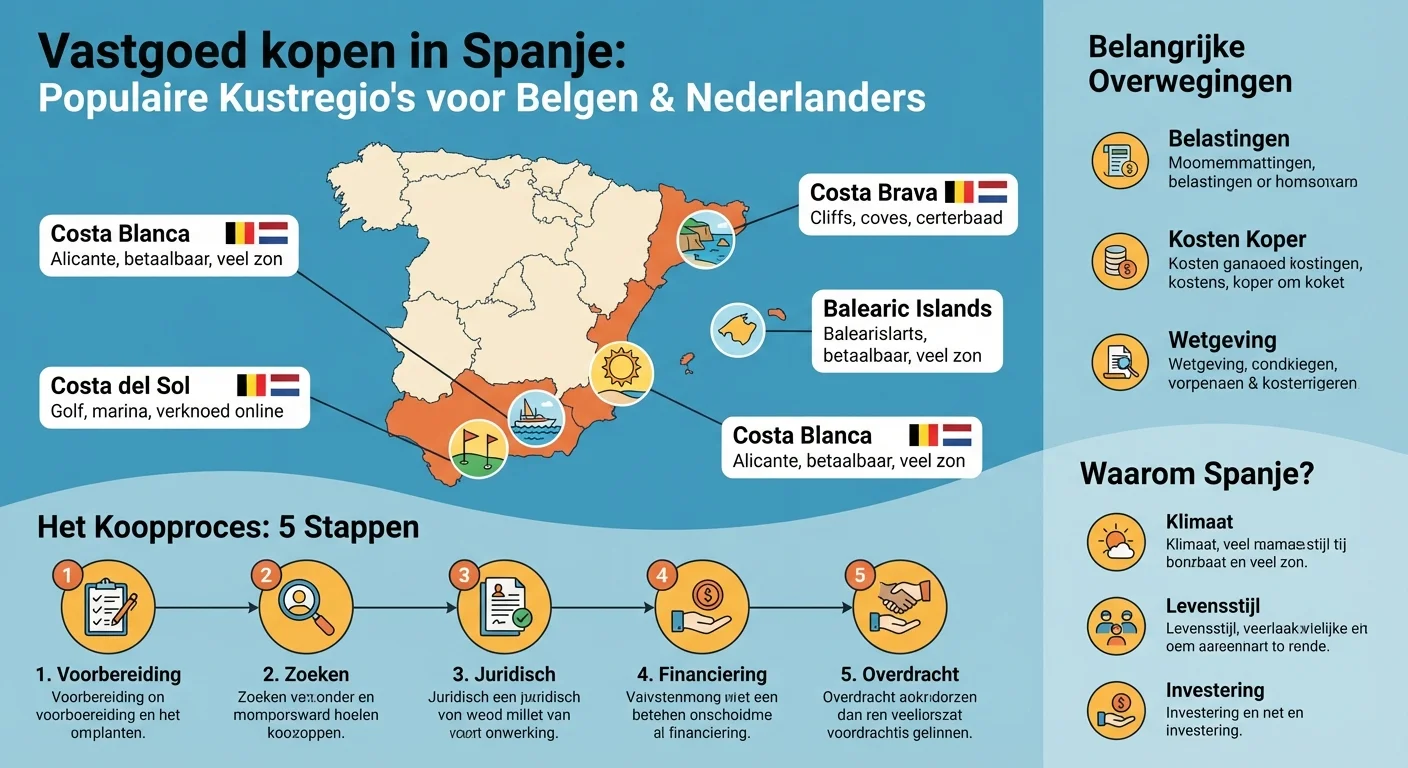
Another region that has boomed in recent years is the Costa del Sol. Whereas this coastal strip was previously known mainly for the jet set in Marbella, the region has now become much more accessible to a wider audience. Places like Estepona and Fuengirola attract many Belgians and Dutch looking for luxury and a vibrant social life. Málaga's proximity to the airport means you can travel from your front door in the Low Countries to your terrace in the sun within hours. For those seriously looking at buying property in Spain for rental and own use, this region offers a very stable market with high occupancy rates throughout the year.
Besides the well-known costas, we also see a shift towards the Costa Cálida in the Murcia region. This region is often praised for the Mar Menor, a unique inland sea with warm water and therapeutic mud baths. Price levels here are on average lower than on the Costa Blanca, making it an interesting option for budget-conscious buyers. Buying property in Spain in the Murcia region means choosing authenticity and tranquillity, without compromising on modern facilities. The local gastronomy and the many golf resorts make it a paradise for epicureans who prefer to avoid the massive crowds.
To give you a better overview of the most sought-after zones, we have listed the main features:
- Costa Blanca North: Mountainous, green, exclusive villas and a mild microclimate.
- Costa Blanca South: Flatter countryside, vast beaches, very good value for money.
- Costa del Sol: Luxury appeal, excellent infrastructure, high rental yields and plenty of sunshine hours.
- Costa Cálida: Authentic Spanish, quieter tourism, ideal setting for water sports and golf.
- Costa de Almería: The hidden gem with desert-like landscapes and pristine natural parks.
It is essential to understand that each region can have its own legal nuances and tax rules, as Spain works with autonomous regions. It is therefore wise to be well informed about the specific regulations for each province. For more in-depth information on the financial aspects and different investment options, please visit our page on real estate investment Spain. Here you will find detailed analyses to help you make the right choice.
“Choosing a specific region determines not only your lifestyle, but also the long-term value of your investment. Buying property in Spain is an emotional decision that needs to be backed up by rational data.”
The Costa de Almería is a region that is often overlooked, but has recently gained increasing interest among Dutch people looking for tranquillity. With places like Mojácar and Vera, this coast offers a unique atmosphere reminiscent of the Spain of thirty years ago, but with the modern conveniences of today. The climate here is the driest in all of Europe, making it a perfect winter destination. When you decide to buy property in Spain in this region, you are investing in an area that is still developing and where prices still have room for growth.
Finally, we should not forget the Balearic Islands, although prices are considerably higher on islands such as Ibiza and Mallorca. For the wealthy Dutchman or Belgian, a flat or villa remains
The roadmap: What does the buying process in Spain look like?
When you make the decision to invest in a second residence or yield property under the Spanish sun, you are stepping into a process that is substantially different from procedures in the Netherlands or Belgium. Understanding the chronological sequence of actions is crucial to avoid surprises. Buying property in Spain is a dream for many, but without a clear roadmap, the bureaucracy can feel overwhelming. In this section, we guide you through the essential stages of the purchase, from the initial reservation to the final transfer at the notary.
The very first step, even before you physically start viewing properties, is to arrange your administrative basics. In Spain, everything revolves around the NIE number (Número de Identidad de Extranjero). This is your personal identification number for foreigners and is strictly necessary for every official act, such as opening a bank account, closing utilities and, of course, the property transfer itself. It is advisable to start this process in good time through the Spanish consulate or a local lawyer.

Once you have found your dream home, the legal process begins. Contrary to what some people think, a verbal agreement in Spain is not enough to take a property off the market. You will have to work with a reservation contract (Contrato de Reserva). By paying a relatively small amount, usually between 3,000 and 6,000 euros, the seller declares that the property will temporarily no longer be offered to others. This gives your lawyer time to carry out initial legal checks.
During this phase, it is very important that you are assisted by independent counsel. Buying property in Spain legal roadmap for investors is a process where the lawyer checks that there are no debts on the property, that the building permits are in order and that the seller is actually the rightful owner. Many buyers make the mistake of relying on the seller's lawyer or the estate agent, but having your own representative is essential for your peace of mind.
After booking, the ‘Contrato de Arras’, the official sales contract. This lays down all the details: the purchase price, the transfer deadline and any resolutive conditions. Upon signing this document, you usually pay 10% of the purchase price. Note that if you, the buyer, abandon the purchase afterwards, you will lose this amount. However, according to Spanish law, if the seller withdraws, they must repay you double the deposit.
Key milestones in the process
- Applying for the NIE number and opening a Spanish bank account.
- Signing of the reservation document (Reserva) and payment of the deposit.
- Thorough legal investigation (Due Diligence) by a specialist lawyer.
- Signing of private purchase contract (Arras) and payment of 10% deposit.
- The official transfer at the Spanish notary (Escritura de Compraventa).
- Registration of the property in the property register (Registro de la Propiedad).
Buying property in Spain also requires good financial planning. In addition to the purchase price, you need to take into account around 12% to 15% of additional costs, such as transfer tax (ITP) or VAT (IVA), notary fees and registration fees. It is wise to know in advance exactly how much you can borrow if you need a mortgage. Spanish banks are generally willing to finance up to 60-70% of the assessed value for non-residents.
“The buying process in Spain is no more complicated than in northern Europe, provided you respect local customs and have the right experts on your side. Patience and thoroughness are your best allies.”
The apotheosis of the process takes place at the notary. This is where the buyer and seller (or their proxies) meet to sign the ‘Escritura’. The notary checks the identity of the parties and proofs of payment. Once the signatures are done and the remaining purchase price is paid, you will receive the keys. You are now officially the owner. Don't forget, however, that the administrative process continues afterwards. taxes must be paid within 30 days and the deed must be entered in the register.
Want to know more about the specific market opportunities?
Important legal documents: The NIE number and the deed of sale
When you make the decision to invest in the Spanish housing market, you step into a world of agency creation that is essential for a secure transaction. Buying property in Spain is a dream for many, but without the right legal documentation, this process can quickly turn into an administrative nightmare. The two most crucial elements in this process are undoubtedly the NIE number and the final deed of sale, also known as the ‘Escritura de Compraventa’. These documents form the backbone of your ownership and tax identity in the country.
The process always starts with obtaining an NIE (Número de Identidad de Extranjero) number. This is a unique tax identification number for foreigners. Without this number, official property buying in Spain is simply impossible. You need it for almost every action: from opening a Spanish bank account to cutting off utilities such as water and electricity. It is therefore advisable to apply for this number as early as possible in the process, as waiting times at consulates or local police stations in Spain can be considerable.

Besides the NIE number, the deed of sale is the final piece of your purchase. While a private contract (Contrato de Arras) establishes the agreements between buyer and seller, it is the notarial deed that makes the transfer of ownership official towards the Spanish state. When buying property in Spain, the signing of this deed always takes place in front of a Spanish notary. The notary checks the identity of the parties, the legal status of the property and ensures that all taxes are calculated correctly. It is a solemn moment where the keys are physically handed over in exchange for the final payment.
To give you a clear overview of exactly what is involved in these documents, we have listed the main steps and requirements:
- Application for NIE number: This can be done in person in Spain, through a Spanish consulate in your home country, or through a proxy (gestor or lawyer).
- Verification of Escritura: Check that the description of the property in the deed corresponds exactly to reality and the details in the land register (Catastro).
- Payment of transfer tax: After signing the deed, you have a limited time to complete the ITP (in the case of existing construction) or IVA and AJD (in the case of new construction) to be met.
- Entry in property register: The notary will send a copy to the Registro de la Propiedad to officially register your property against third parties.
“The NIE number is not just a number. it is your entry ticket into the Spanish system. Without this document, everything comes to a standstill, from the mortgage application to the registration of your home.”
Many buyers underestimate the complexity of Spanish bureaucracy. It is therefore wise to read up on the various aspects of the market. For more in-depth information on market trends and legal tips, please visit our blog page, where we share regular updates on current regulations. Indeed, buying property in Spain requires up-to-date knowledge of both local and national laws, which can change regularly.
A crucial aspect that is often overlooked in the sale deed is the check for outstanding debts. In Spain, debts (such as unpaid property taxes or community fees) stick to the property and not the person. The notary will make a ‘Note Simple’ request just before signing, but a good lawyer will conduct this research much earlier in the process. This will prevent you from having to go through the legal safe property buying in Spain roadmap face unpleasant surprises after the handover.
The deed of purchase process also includes checking the ‘Cedula de Habitabilidad’, the certificate of occupancy. This document confirms that the property meets the local government's minimum health and safety requirements. Without this certificate, you may face problems when transferring contracts for water and light into your name. When buying property in Spain, it is the seller's responsibility to provide this document, but as a buyer you should strictly monitor its validity.
Once the deed is signed and taxes paid, the final registration in the Registro de la Propiedad follows. This process can take several weeks to months. Only after this registration will you be protected for the full 100% against any third-party claims on the property. It is the ultimate confirmation that your investment is safe. For those looking seriously
Buying property in Spain: Costs and taxes to consider
When making the decision to invest in the Spanish housing market, thorough preparation for the financial picture is essential. Buying property in Spain is a dream for many, but the process involves specific costs beyond just the agreed purchase price. In practice, you need to factor in an extra budget of around 10% to 15% on top of the purchase price to cover all additional costs and taxes. This percentage varies depending on the region where you are buying and whether it is new construction or existing construction.
The biggest cost when buying a property is taxes. For existing homes, you pay the transfer tax, known in Spain as the Impuesto sobre Transmisiones Patrimoniales (ITP). This rate is set by the autonomous regions and is usually between 6% and 10%. A different regime applies to new-build properties. here, you pay 10% VAT (IVA) plus a stamp duty (AJD) which is usually around 1.5%. Understanding these nuances is crucial for anyone seriously considering switching to buying property in Spain.

Besides taxes, there are several professional fees that you cannot ignore. The notary plays a central role in the Spanish purchase process. Although notary fees are set by law, they vary based on the complexity of the deed and the value of the property. In addition, the property must be registered in the property register (Registro de la Propiedad), which also incurs costs. It is advisable to involve a specialised lawyer here to look after your interests and check the legal status of the property.
To get a clear overview of the one-off costs when buying property in Spain, we have listed the main items below:
- Transfer tax (ITP): Between 6% and 10% for existing homes, depending on the region.
- VAT (IVA) and Stamp Duty (AJD): Total around 11.5% for new construction projects.
- Notary fees: Usually between €600 and €1,200, depending on the house value.
- Registration fee: Cost of registering the property in the land registry, often around €500 to €800.
- Legal costs: A lawyer typically charges 1% of the purchase price (plus VAT) for full counselling.
- Valuation fees: If you are applying for a mortgage, an official valuation (tasación) is required, which costs around €300 to €600.
It is important to remember that the tax rules in Spain can be complex, especially for foreign investors. Buying property in Spain cost overview for investors shows that location has a huge impact on the final price. In regions such as Andalusia or the Comunidad Valenciana, ITP rates can vary significantly, directly affecting your return. Therefore, it is wise to be well informed in advance through reliable sources such as our blog on the Spanish property market.
“Good financial planning is half the battle when buying property in Spain. Many buyers get surprised by the additional costs, whereas with the right guidance they are perfectly predictable.”
After the purchase, however, the financial picture does not stop there. As an owner, you will face annual taxes. The most important of these is the IBI (Impuesto sobre Bienes Inmuebles), the municipal property tax. In addition, for non-residents, there is the non-resident income tax (IRNR). Even if you do not rent out the property, the Spanish tax authorities assume a lump-sum benefit on which you have to pay tax. This is a specific aspect of buying property in Spain that many foreigners face in the first year after purchase.
When looking at financing, you should also consider the cost of a mortgage. Spanish banks often charge closing commissions and require the property to be insured. Although interest rates are competitive in Spain, additional bank charges can add to the total investment. When buying property in Spain, it is therefore essential to look not only at the interest rate, but at the total cost of the loan over the entire term.
For those looking for a profitable investment, the essent
The role of the Spanish notary and lawyer in your purchase
When you make the decision to invest in the Spanish housing market, you are stepping into a legal system that is substantially different from the Dutch or Belgian system. The process of buying property in Spain therefore requires a specific approach in which the roles of notary and lawyer are crucial for a secure transaction. Many foreign buyers make the mistake of thinking that the Spanish notary performs the same extensive research tasks as in their home country. However, nothing could be further from the truth. In Spain, the division of roles is strictly separate, with the lawyer looking after your interests and the notary merely handling the formal ratification of the transfer.
The Spanish lawyer, also known as the ‘abogado’, is your main ally throughout the entire process. While you are orientating to buy property in Spain, a specialised lawyer will check the legal status of the property in every detail. This includes verifying the title deeds in the property register (Registro de la Propiedad), checking for outstanding debts or mortgages, and verifying that no urban planning violations have been committed. Without this thorough check, you risk unexpected costs or legal claims resting on the property.

The notary in Spain, the ‘notario’, has a more passive but legally obligatory function. He is a public official who oversees the authenticity of signatures and the identity of the parties. The notary draws up the ‘Escritura de Compraventa’ (the official title deed) and ensures that the purchase price is properly paid. Although the notary makes certain basic checks, such as requesting a current extract from the register just before signing, he is not responsible for advising the buyer on the commercial or in-depth legal risks of the purchase.
To give you a clear idea of the specific duties that lie with these professionals, we have listed the main responsibilities of the lawyer:
- Applying for the NIE (Número de Identidad de Extranjero) number for the buyer.
- Checking the ‘Nota Simple’ to identify the current owner and any charges.
- Verification of building permits and the ‘Licencia de Primera Ocupación’ (occupancy permit).
- Drafting and checking the ‘Contrato de Arras’ (the reservation or deposit contract).
- Guidance on payment of transfer tax and other local levies.
- Registering the new title deed in the land registry after the transfer.
The process of buying property in Spain can feel complex due to the language barrier and bureaucratic procedures. This is why many investors choose to give their lawyer a power of attorney (poder notarial). This allows the lawyer to act on your behalf, which is particularly convenient if you cannot be physically present at every step of the transaction. This saves time and travel costs, while giving you peace of mind that an expert will handle your affairs on the spot. It is essential that you are assisted by an independent party who has no ties to the seller or broker.
When looking at the fee structure, you need to consider the fees of these professionals. Notary fees are set by law and depend on the value of the property, while lawyer fees are usually a percentage of the purchase price or are a flat rate. It is an investment that pays for itself in peace of mind. Buying property in Spain legal guidance tips often suggest that saving on a good lawyer can be the most expensive mistake a buyer makes. For more in-depth information on the financial aspects of such transactions, please visit our page on real estate investment Spain.
“The Spanish notary is the state's witness, but the lawyer is the guardian of your capital. Without proper legal screening, buying property in Spain is a leap of faith.”
Another aspect often overlooked when buying property in Spain is the control of municipal taxes (IBI) and owners' association fees (Comunidad de Propietarios). Your lawyer will request certificates to confirm that the seller is fully up-to-date with these payments. Indeed, in Spain, debts attached to the property pass to
Financing and mortgage options for a second residence
Once you have made the decision to invest in a holiday home under the sun, the next crucial step is to map out the financial structure. Buying property in Spain is a dream for many, but it requires a thorough knowledge of the local banking system and the specific conditions that apply to non-residents. Unlike financing a primary residence at home, a second residence abroad is often subject to stricter rules and different coverage rates.
Most buyers face a choice: arrange financing through a bank in the home country or take out a mortgage with a Spanish bank. Although a national bank is sometimes willing to use an excess value on your current property, most investors opt for a local Spanish mortgage. This is because Spanish banks can directly value the collateral and register it in the local property register. This often makes the process of buying property in Spain more straightforward, provided you have the right documentation and healthy equity.
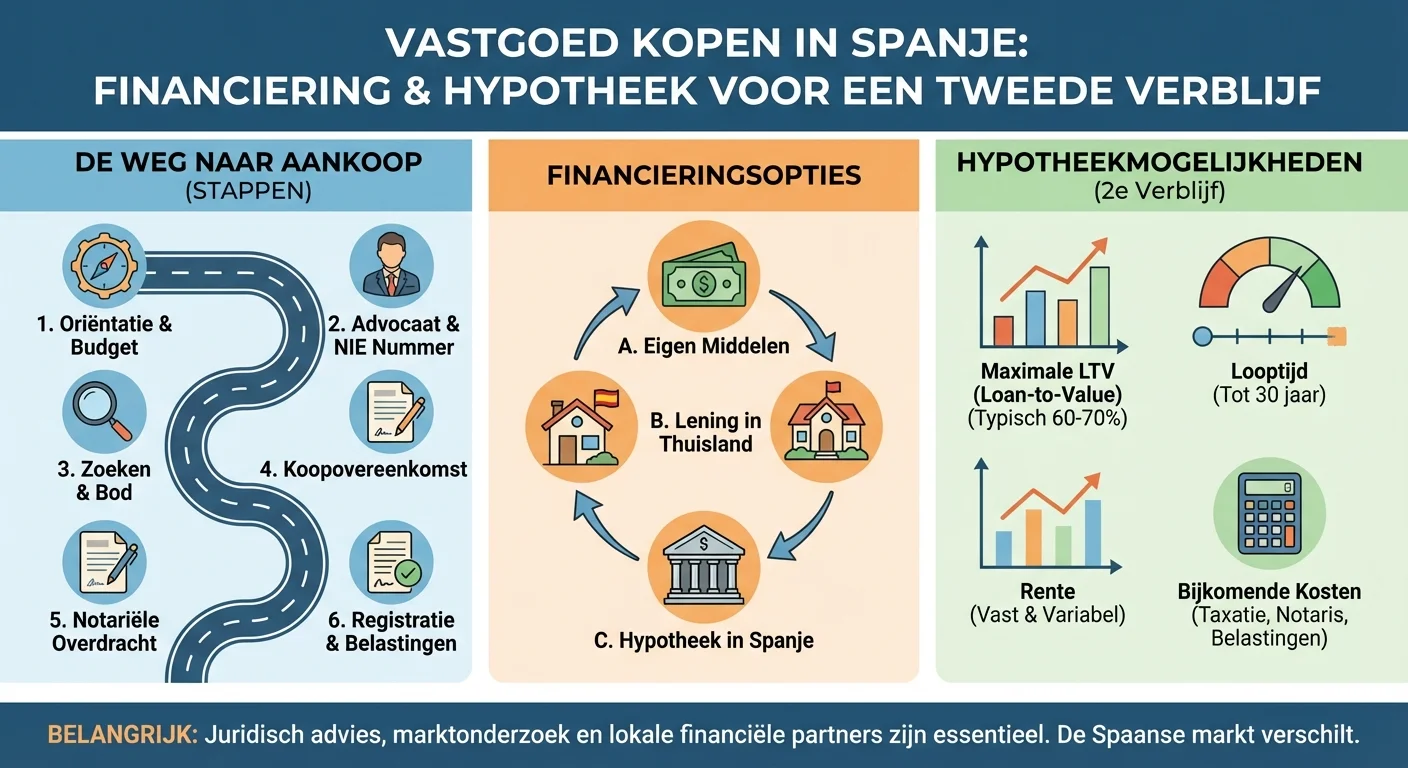
An essential aspect to understand is the Loan-to-Value (LTV) ratio. For non-residents, Spanish banks typically apply a financing rate of 60% to 70% of the purchase price or the assessed value (whichever is lower). This means that as a buyer, you will have to put in a minimum of 30% to 40% of the purchase price yourself, plus the additional costs for taxes, notary and registration, which are usually around 12% to 15%. Effectively, therefore, you need to factor in an own contribution of around half of the total investment.
Important conditions for a Spanish mortgage
Banks in Spain look very closely at your debt-to-income ratio. Generally, the total monthly burden of all your loans (including your current home mortgage and the new Spanish loan) should not exceed 30% to 35% of your net monthly income. This is a strict rule designed to prevent over-indebtedness. In the process of buying property in Spain financing for non-residents Therefore, the submission of pay slips, tax returns and bank statements for the past six months is a standard requirement.
Here are the most common documents you will need:
- A valid passport and your NIE (Número de Identidad de Extranjero) number.
- Employment contract or proof of pension income.
- The last three to six pay slips.
- The most recent income tax return from your home country.
- An overview of your current debts and current loans.
- A purchase agreement (Arras) of the property in Spain.
The term of a mortgage for a second residence usually varies between 15 and 25 years, depending on your age. Most banks have an age limit where the mortgage must be paid off before you reach the age of 75. This can affect your monthly expenses if you decide to buy property in Spain at a later age. It is therefore advisable to start the orientation process in good time and possibly engage an independent mortgage advisor who specialises in the Spanish market.
“Good preparation of your financial file is half the battle. Spanish banks appreciate transparency and an orderly presentation of your solvency, which significantly increases the chances of a quick approval.”
Besides the interest rates, which can be either fixed or variable, you need to consider the closing costs of the mortgage. Since the legislative changes in 2019, many of these costs, such as the AJD tax (stamp duty) and notary fees for the mortgage deed, have been shifted from the customer to the bank. However, valuation fees (tasación) usually remain the responsibility of the buyer. This makes buying property in Spain a little more transparent these days in terms of the initial start-up costs of a loan.
For those looking for more in-depth information on the different regions and their specific tax advantages, it is useful to read our blog to consult. Here you will find regular updates on changing legislation and tips on how to optimise your investment. After all, combining a smart financing strategy with a prime location is the key to a successful long-term return.
Also don't forget the impact of exchange rates if you generate revenue in a currency other than the euro, although for most European buyers this does not matter. However, it does
Avoiding pitfalls when buying a Spanish property
The process of buying property in Spain is a dream come true for many, but without the right preparation, this dream can quickly turn into a bureaucratic nightmare. The Spanish property market works fundamentally differently from the Dutch or Belgian markets. One of the biggest mistakes buyers make is assuming that local laws and procedures are identical to those in their home country. This lack of local knowledge is often the basis for costly missteps, and this is no different in 2026.
A crucial pitfall is not checking the legal status of the property. In Spain, it regularly happens that houses are (partly) built illegally or that no occupancy permit (Cedula de Habitabilidad) is present. Without this document, you cannot conclude contracts for water and electricity. When you decide to buy property in Spain, you need to be absolutely sure that all structures on the plot are officially registered in the Property Register (Registro de la Propiedad) and the Land Registry (Catastro).

In addition, financial settlement is an area where many buyers stumble. In Spain, additional costs are considerably higher than people often expect. Consider transfer tax (ITP) for existing construction or VAT (IVA) for new construction, plus notary fees, registration fees and legal fees. On average, you need to factor in 12% to 15% on top of the purchase price. Ignoring these costs in your budget planning can lead to great financial stress at the time of transfer.
Engaging an independent lawyer is not a luxury, but an absolute necessity. Many buyers make the mistake of relying on the seller's lawyer or estate agent. While this may seem cheaper, this person does not exclusively serve your interests. An in-house lawyer carries out a thorough due diligence. This investigation is essential in Buy property in Spain safely and legally without hidden debts, because debts in Spain stick to the property and not the person. If you buy a property with an outstanding mortgage or unpaid municipal taxes, you become responsible for it as the new owner.
Common stumbling blocks listed
- Missing building permits: Especially in rural houses (fincas), extensions or swimming pools are often installed without planning permission.
- No NIE number: Without this tax identification number, you cannot put property in your name or open a bank account.
- Forgetting the ‘Plusvalía’: A municipal tax on the increase in value of land that is often the subject of negotiation between buyer and seller.
- ‘Comunidad’ ambiguity: In flats or urbanisations, monthly service charges and overdue maintenance of common parts can be high.
Another aspect often overlooked when buying property in Spain is the structural condition of the property. In Spain, it is not common for the seller to submit a comprehensive architectural report. The ‘as is’ principle is the norm here. Therefore, it is wise to hire your own expert to check the construction, the state of the roof and the electrical installations. After all, a shiny coat of paint can hide many structural problems that only come to light after the first heavy rain.
“The biggest mistake a foreign buyer can make is signing a reservation contract (Contrato de Arras) without a lawyer having fully verified the legal status of the property.”
Communication is also a barrier. Even if you speak a fair bit of Spanish, the legal jargon is complex. Misunderstandings about what exactly is included in the purchase - such as furniture or kitchen appliances - can lead to nasty discussions on the day of the transfer. Make sure all agreements are in writing and translated by a sworn translator if necessary. For more in-depth information on market dynamics, please visit our blog page.
Buying property in Spain also requires patience. Spanish bureaucracy can be slow, and forcing processes often backfires. Whether it is getting a mortgage from a Spanish bank or arranging utilities, allow for a wider timeline than you are used to in northern Europe. Decisions made too quickly under pressure from an estate agent who claims there are ‘hijackers on the coast’ often lead to red flags being ignored.
Finally, the choice of location within a region is crucial
Letting your property in Spain: Rules and returns
When you decide to buy property in Spain, the step to letting is often a logical next step. Generating a passive income through holiday rentals or long-term contracts can significantly increase the overall return on your investment. However, Spanish legislation regarding rentals has become stricter in recent years, making proper preparation essential for any owner.

Buying property in Spain means you have to deal with regional differences. Each autonomous region, such as Andalusia or the Comunidad Valenciana, has its own rules for the mandatory tourist licence. Without this licence, you risk high fines. It is therefore wise to check beforehand whether the property you have your eye on meets local requirements for rentability.
The financial aspect is obviously a driver. At buying property in Spain for rental yield investors look at net income after taxes and maintenance costs. Non-residents are usually subject to a flat tax on rental income, with certain costs deductible for EU citizens. This directly affects the profitability of your purchase.
Important considerations for lettings in Spain
- Apply for a tourism licence from the local municipality.
- Registration with the Guardia Civil or Policia Nacional for guest registration.
- Calculation of IRNR (non-resident income tax).
- Property management through a local property manager.
Want to know more about the tax advantages of buying property in Spain? Then visit our page on real estate investment Spain for an in-depth analysis of the market. For those buying property in Spain, it is not only an emotional decision for a holiday home, but also a strategic move for wealth building.
“A good rental strategy starts from the site selection during the process of buying property in Spain.”
In short, by finding the right balance between the legal frameworks and a smart marketing strategy, you can make the most of your property. Buying property in Spain remains one of the most popular ways to grow capital in southern Europe.
Conclusion: Safe and worry-free realisation of your dream home in Spain
The process of buying property in Spain is an exciting adventure that requires thorough preparation and the right local expertise. While the Spanish market offers huge opportunities for holidaymakers and investors alike, it is essential to carefully follow the legal and administrative steps. By being well informed, you will avoid unforeseen pitfalls and enjoy your new property under the sun to the fullest.
When you decide that at Buy Spain property is the right move for your future, you need to consider several factors such as location, condition of the property and applicable regulations by region. A successful purchase starts with a clear plan. Below are the key steps for a hassle-free transaction:
- Apply for your NIE number in time for all official acts.
- Engage an independent lawyer specialising in Spanish law.
- Conduct a thorough investigation into the property titles and any debts on the property.
- Compare different financing options at both local and international banks.
Want to know more about current market trends or specific regions? Then visit our blog for comprehensive articles and updates. It is crucial to remember that buying property in Spain is not only an emotional decision, but also a business transaction that requires precision. Good preparation is half the battle.
“The Spanish property market remains one of the most attractive places in Europe for those looking for a combination of quality of life and returns.”
For those looking at the long term, buying property in Spain tips for beginners an essential starting point for understanding the market. Whether you choose a modern flat on the coast or a rustic finca inland, buying property in Spain remains a solid investment. With the right guidance, your dream will become a reality. Start exploring your options today and make sure Buying Spanish property a success story for you becomes.
Buying property in Spain is a dream for many Belgians and Dutch people, but proper preparation is crucial for a successful purchase. In this guide, we have discussed the most important steps: from applying for a NIE number and opening a Spanish bank account to engaging an independent lawyer for the legal audit. By taking into account regional differences in taxes and additional costs, you will avoid unpleasant surprises afterwards.
Want to enjoy your own place under the sun carefree? Then always get advice from experts who know the local market and legislation inside out. Buying property in Spain requires patience and precision, but with the right guidance it will be a safe investment for the future. Are you ready to take the next step? Contact our specialists today for a personal consultation and find out about our current offer immediately.
Frequently Asked Questions
What are the main steps when buying property in Spain?
The process starts with applying for a NIE number and opening a Spanish bank account. Next, it is essential to engage an independent lawyer to check the legal status of the property before finally buying property in Spain.
What additional costs should I take into account on top of the purchase price?
When investing in a property, you need to expect around 10% to 13% in additional costs, such as transfer tax (ITP) or VAT (IVA), notary fees and registration fees. These costs are a crucial part of your budget when you decide to buy property in Spain.
Why is an independent lawyer essential when buying?
A lawyer checks that there are no debts on the property and that all building permits are in place. This prevents legal problems afterwards and provides security throughout the buying process abroad.
Service & Contact
Location: Spain
Scope of work: Belgium, Netherlands, Europe, Germany, France
Services: Real Estate Agent Spain, Real Estate Investment Advice, Buying & Selling in Spain, Resales, Investments, Exclusive Property