Investing in Spain is the ideal way to combine a dreamy second home with a stable long-term financial return. With the continued popularity of the Costa del Sol and Costa Blanca, this remains a smart move for those looking to protect capital from inflation while enjoying the Mediterranean lifestyle. Whether you opt for a modern flat or an authentic townhouse, the Spanish property market currently offers unique opportunities for Belgian buyers seeking a safe haven for their savings.
Investing in Spain offers the perfect balance between personal holiday enjoyment and an attractive rental income in a sun-drenched climate. Need advice? Contact Luxury real estate group.
Those looking to invest smartly abroad look to regions with high rental rates. Successful investing requires thorough knowledge of local markets and tax rules to maximise your profits.
- High rental potential due to tourism.
- Value retention of coastal property.
- Combination of return and own use.
- Favourable financing opportunities for Belgians.

Why now is the ideal time to invest in Spain
The Spanish property market is currently at a unique stage attracting both experienced and first-time buyers, if you would like help from a Dutch-speaking estate agent in Spain, don't hesitate and get no-obligation advice.... Anyone choosing Invest Spain today will find that the combination of a stable climate, a growing tourism sector and a quality lifestyle provides a rock-solid foundation for capital growth. Unlike the overheated markets in northern Europe, the Iberian Peninsula still offers opportunities where the ratio of purchase price to potential return remains favourable, Look here if you want to calculate the yield for holiday homes in Spain.. Demand for holiday homes on the Costa del Sol and Costa Blanca remains undiminished, providing a steady stream of rental income for those looking to make their property profitable.
It is an open secret that the quality of life in the south is second to none, which only enhances the long-term value of real estate.

The power of tourist rental and added value
One of the main drivers behind the region's popularity is the shift in how people travel and work. More and more Europeans are opting for ‘workations’, combining their jobs with staying in warmer climates, which keeps occupancy rates of rental properties high all year round. As a result, in real estate invest Spain for passive income a strategy that often proves successful in practice for Belgian owners. The modern infrastructure, with excellent flight connections from Brussels and Charleroi, ensures that your property always remains easily accessible to both yourself and potential tenants.
Due to the rising construction costs of new construction projects also increase the value of existing properties steadily along, what a nice value added on sale in prospect.

Those who follow the market closely can see that certain regions are currently experiencing a revival thanks to large-scale investments in local facilities and ecological tourism. It therefore pays to look beyond the well-trodden paths and focus on emerging neighbourhoods where prices still have room to grow. For more in-depth analysis on specific regions and legal advice, please visit our blog about Investing Spain where we regularly share new insights.
The most popular regions for a profitable holiday home
If you dream of having your own place under the sun, you soon end up on the various coastlines of the Iberian Peninsula. Choosing the right location is the most crucial factor for the success of your project. Invest in Spain offers a huge variety of microclimates and tourist attractions, ranging from the rugged north coast to the sun-drenched Costa del Sol, check out the Best regions in Spain for real estate investment.. For the Flemish buyer, it is essential to look at regions that remain attractive to tenants not only in summer, but also during the winter months. Good accessibility via airports such as Alicante or Málaga plays a decisive role here for the occupancy rate of your property.
The Costa Blanca remains the absolute front-runner for those looking to Safe investment Spain because of stable prices.
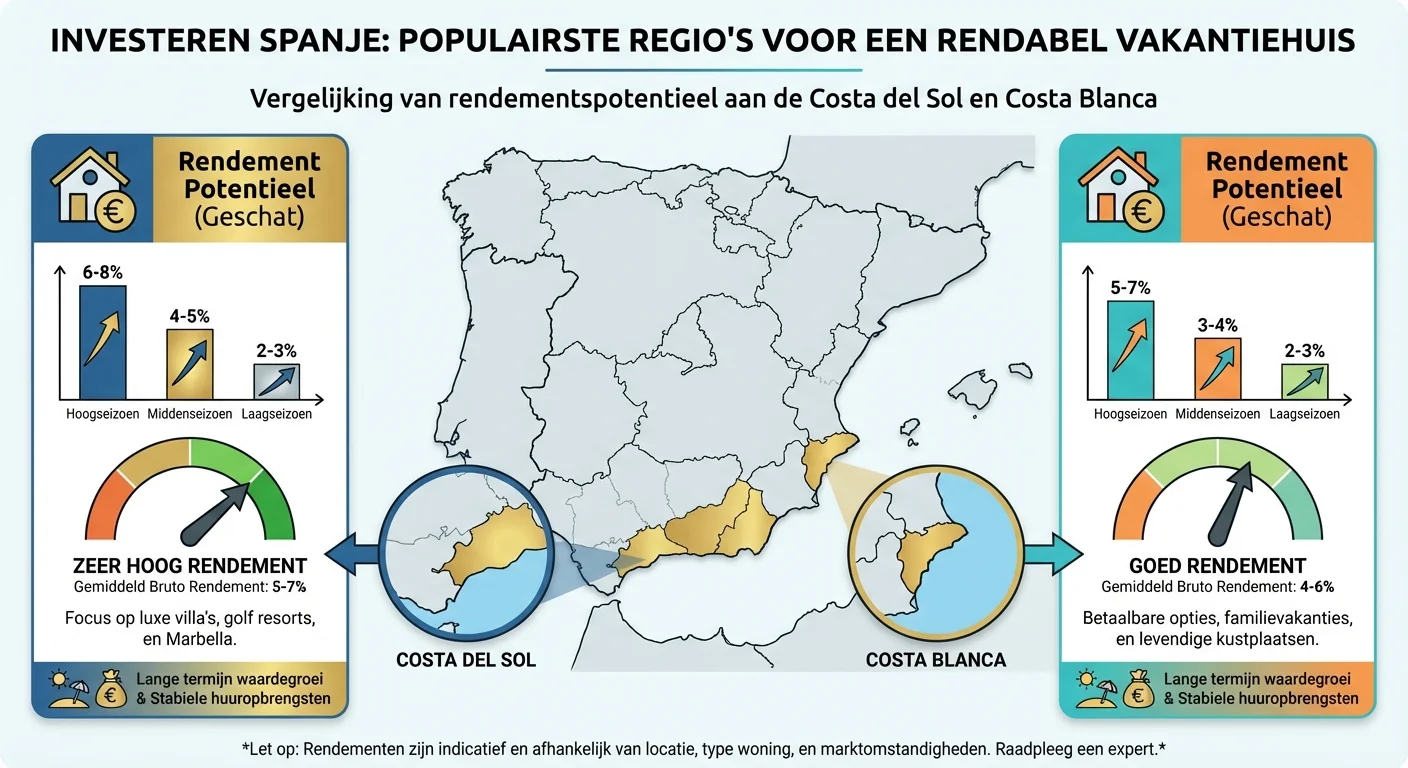
The Costa del Sol, with Marbella and Estepona as its signposts, attracts a wealthy crowd seeking luxury and exclusivity. Here, the rental market is particularly mellow, which means you can count on a professional framework to manage your flat or villa. Invest Spain in coastal property however, requires a thorough knowledge of local regulations regarding rental licences, which can vary greatly from one autonomous region to another. In Andalusia, the rules are often strict, but the huge demand for holiday homes more than offsets the administrative efforts for the active investor.
The rise of the Costa Cálida and the Balearic Islands
Besides the established values, the Costa Cálida in the Murcia region is gaining popularity with the savvy Belgian investor. This region often offers even more competitive entry prices than the neighbouring Costa Blanca, while the natural beauty of the Mar Menor is a unique asset for families with children. Invest Spain opportunities can be found here mainly in new construction projects that meet the most modern energy standards, which significantly increases future resale value. It is a region in full development, so the growth potential for the coming years remains very interesting for those who dare to step in now.
The Balearic Islands, with Mallorca in the lead, offer an exclusive market where the scarcity of building land structurally supports prices.
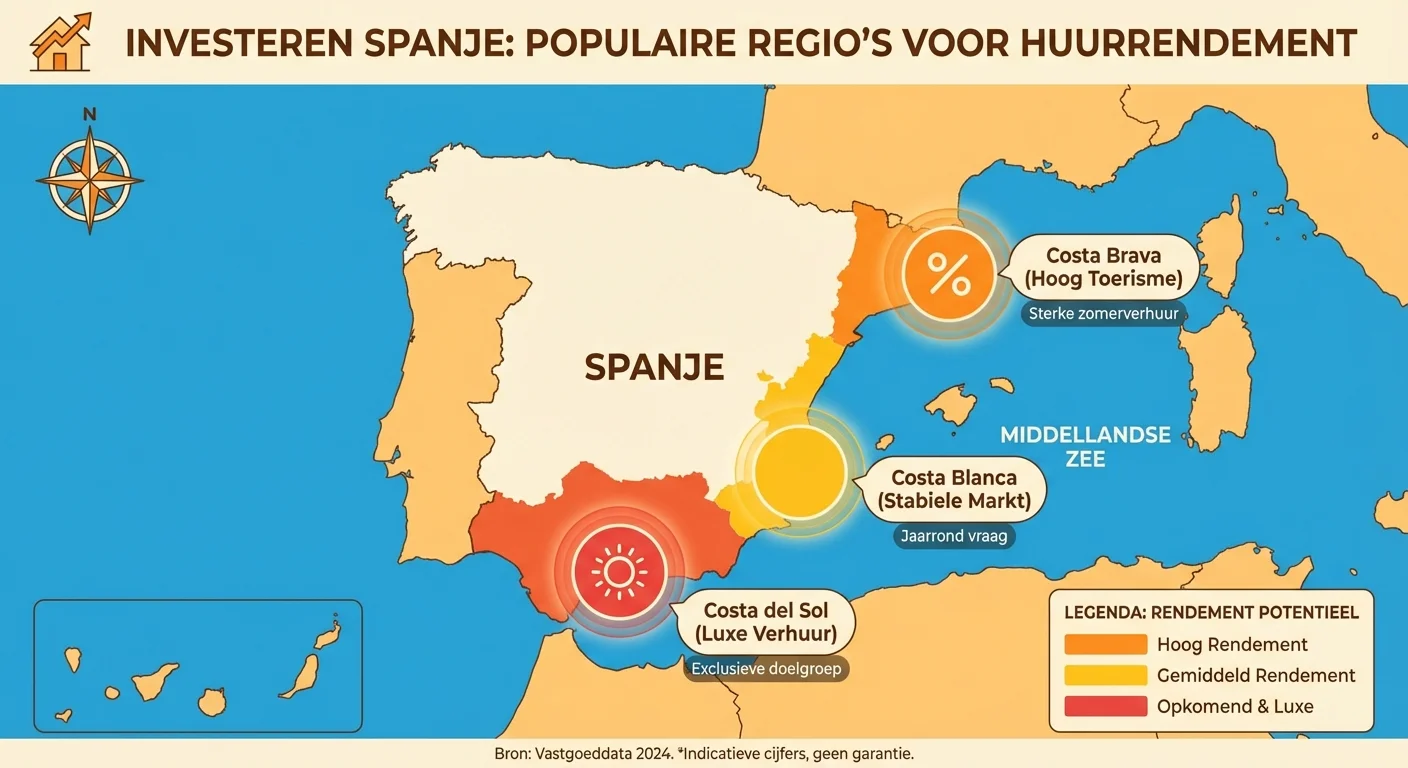
When making your choice, it is wise to consider the tax implications in your home country. For more information on the interaction between your Spanish property and the Belgian tax authorities, please visit the page on taxation in Belgium for a house in Spain. After all, it is the combination of a good location and an optimal tax structure that determines your return below the line. Invest Spain property market is best analysed by weighing the following factors:
- Proximity to international schools and hospitals for winter visitors.
- The presence of quality golf courses that extend the season.
- Local plans for infrastructure and new road works.
- The strictness of the local municipality in granting new tourism licences.
Tax benefits and costs when buying property
When you decide to choose Invest Spain, it is essential to have a clear view of the financial picture beyond just the purchase price of the property. This is because the tax laws in the different autonomous regions can vary greatly, making the overall cost structure for a Belgian buyer sometimes look complex. In addition to registration duties or VAT, you need to take into account notary fees, administrative charges and the cost of registering the property in the local register. It is therefore crucial to get proper guidance from an expert who knows the local customs and can point out the specific tax obligations associated with your purchase in the sun.
In practice, the total cost at purchase usually fluctuates between 10 and 13 per cent of the total purchase price.
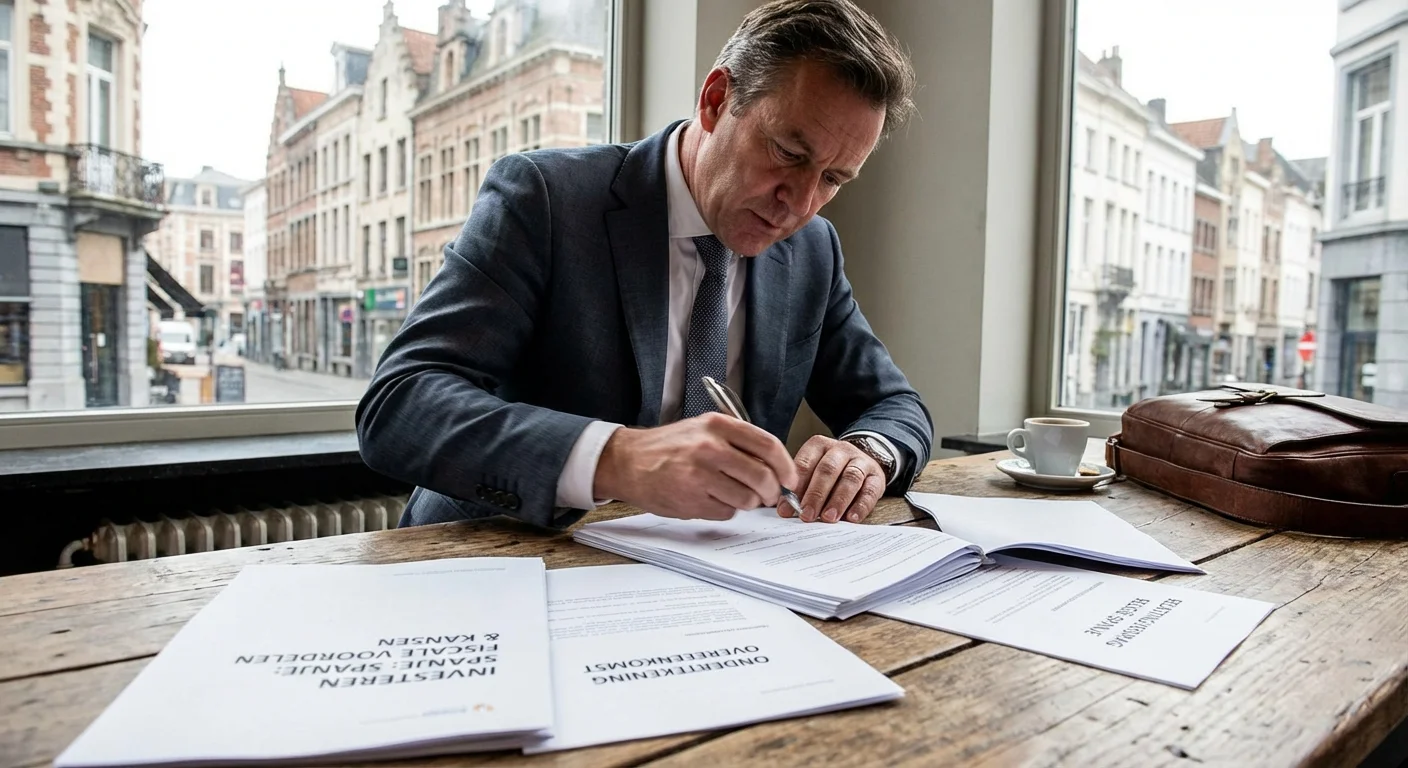
Taxes and additional costs on transfer
With a new construction project, you will usually pay Spanish VAT, known as the IVA, whereas with an existing property you will have to deal with the transfer tax or the ITP. For Flemings aiming at Invest Spain opportunities, it is important to know that these rates are not the same everywhere. regions such as Andalusia or the Costa Blanca apply their own rates that affect your net return. Also don't forget the stamp duty, which often applies when a new building is notarised. By accurately identifying these items in advance, you will avoid unpleasant surprises during the conclusion of the sales agreement at the Spanish notary, which will significantly increase your peace of mind.
It is advisable to get a detailed simulation of all one-off costs before taking the final step.
To make sure you don't skip any steps in this process, you can use this handy checklist for buying a house in Spain consult. In it, you will find an overview of the administrative requirements that often go hand in hand with the tax handling of your file.
Current tax liabilities and benefits
Once the purchase is completed, the tax interaction with the Spanish state does not stop, of course, as you, as a non-resident, have to pay a number of taxes every year. The IBI, the local property tax, is similar to the Belgian property tax and is collected annually by the municipality based on the cadastral value of your property. There is also non-resident personal income tax, where you pay a lump sum on your own use of the property or a percentage on the actual rental income if you decide to rent it out. For those who want to be smart Investing Spain property, it may be interesting to look into double taxation treaties between Belgium and Spain, which prevent you from being taxed twice on the same income in both countries.
- The annual IBI tax, based on the cadastral value and collected by the municipality (similar to property tax).
- Non-resident tax (IRNR) on own use, where you declare a flat taxable “notional rental income” if you do not rent out the property.
- Non-residence tax (IRNR) on rentals, where you pay tax on the actual rental income when you rent (holiday).
- Deductible expenses (for EU/EEA residents) when renting out: certain costs may be deductible (e.g. management/maintenance) depending on your situation and proper proof.
- Municipal waste and other local charges, such as rubbish collection (“basura”) and sometimes small municipal surcharges per region/municipality.
- On sale: capital gains tax (plusvalía municipal), a municipal tax on the increase in value of land since the previous transfer (rules and calculation have changed in recent years).
- On sale: capital gains tax for non-residents, on the realised capital gain (with a deduction by the buyer to be settled later).
- Wealth tax (Impuesto sobre el Patrimonio), applicable in some cases depending on your total assets and the region where the property is located (thresholds and rates vary by autonomous region).
- Possible regional/Spanish inheritance and gift tax, relevant for planning (on death/donation) with large regional differences and possible exemptions.
- Belgium-Spain double taxation treaty, which helps avoid double taxation on the same income (but you often still need to declare correctly in both countries).
- Administrative obligations, such as timely filing of non-resident returns and retention of documents (cadastral records, IBI notes, leases, expense receipts).
How to ensure high rental yields
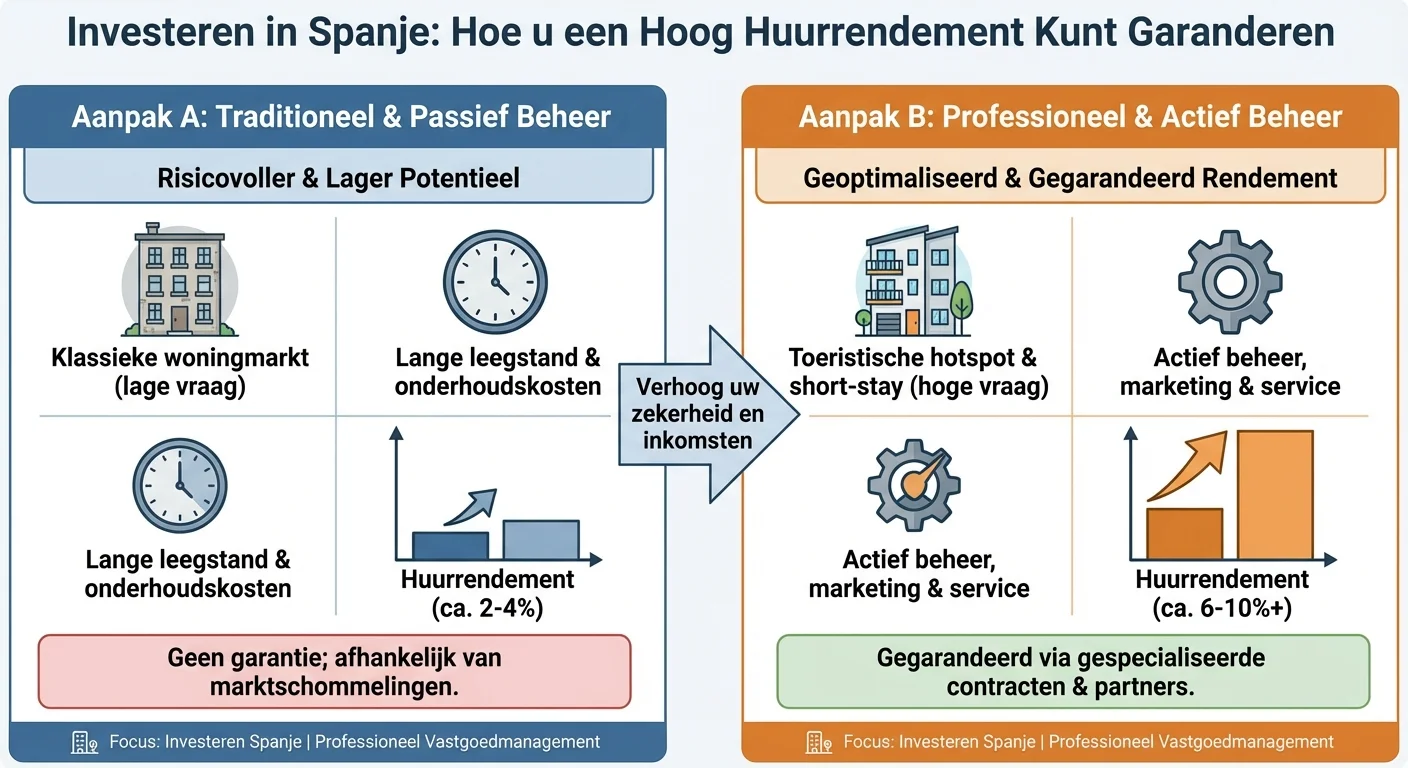
To maximise returns when investing Spain, the choice of location is the most decisive factor. It is no longer enough to simply buy a flat on the coast. you need to look at regions with a proven track record of both tourist attraction and growing demand for long-term rentals. Costa Blanca and Costa del Sol remain frontrunners, but within these regions it is often the specific neighbourhoods with good amenities that make the difference between an average occupancy rate and a fully booked calendar throughout the year.
Focus on tourist licensed properties, as this is the key to legal and profitable investment properties in Spain.
Optimising your property management
Quality management of your property will make tenants return faster and leave positive reviews, which is essential for your online visibility. Many Flemings Investing Spain underestimate the impact of local maintenance and a smooth welcoming of guests. Engaging a professional key manager or local agency can ease the operational burden, while you yourself enjoy the passive income stream. Don't forget, too, that tasteful decoration that responds to the Mediterranean ambience can significantly justify the rent without requiring massive renovations.
Maximising your profit margins requires a thorough knowledge of the local market and the tax obligations associated with rentals. Those looking to invest Spain smartly should take into account non-resident taxes and municipal taxes, which can vary greatly from region to region. By drawing up a detailed financial plan in advance, you can avoid unpleasant surprises and accurately predict your cash flow. It is therefore advisable to prepare a strategy for investing Spain with high returns determine, looking at both the immediate rental income and the potential long-term capital gain of the property.
Good preparation also includes a legal control of real estate in Spain To be sure of all permits.
Strategic choices for the future
The property market is constantly changing, which means that as an investor, you need to remain flexible in your approach and expectations. Successful Invest Spain means responding to new trends, such as the rise of digital nomads looking for quality workplaces under the sun outside the high season. By offering extra facilities, such as high-speed internet access or ergonomic workstations, you tap into a new target group that can stabilise occupancy rates during the winter months. This ensures a steady revenue stream that is less dependent on mere holidaymakers during the summer months.
“A thoughtful purchase in the right region forms the basis, but active management and tax optimisation ultimately determine the true net return on your Spanish dream home.”
Differences between the Spanish and Belgian property markets
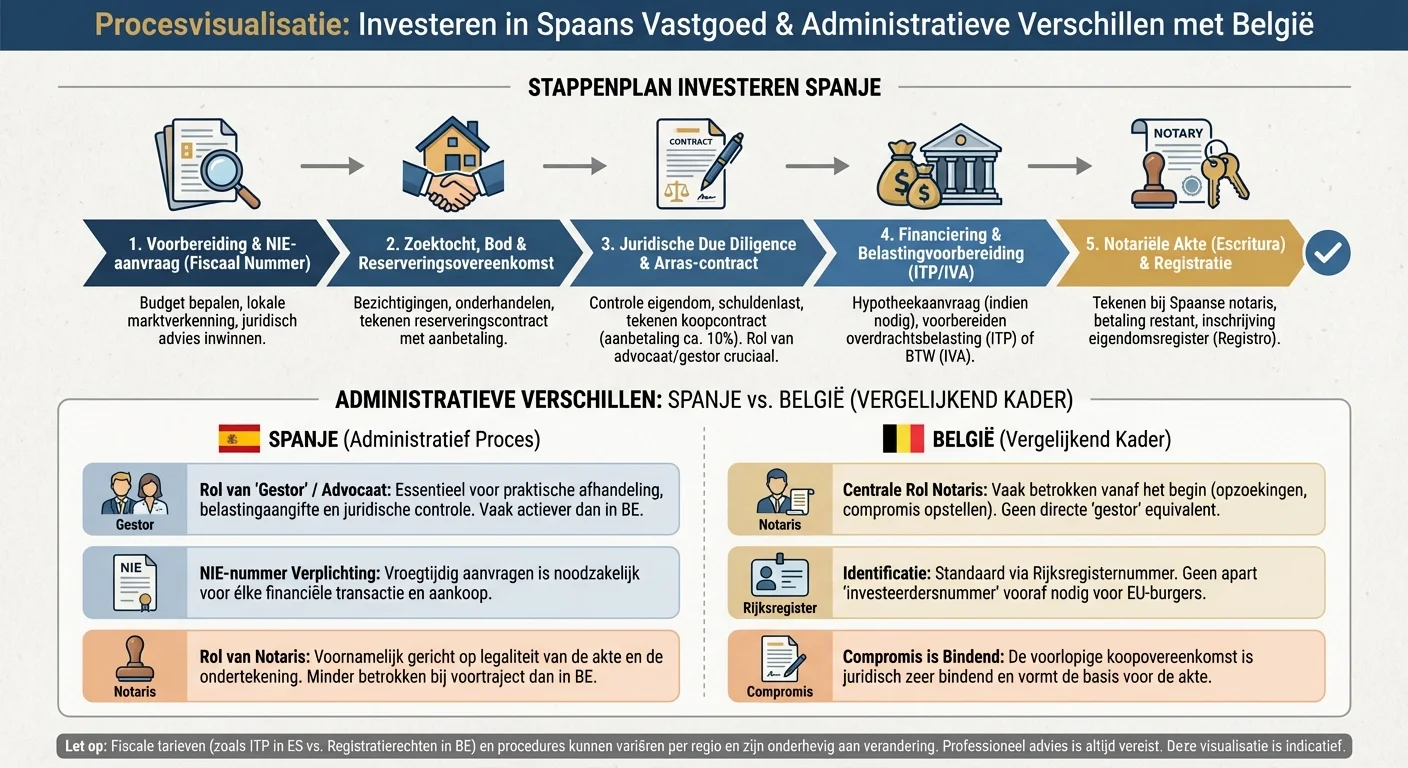
When considering investing Spain, it is essential to understand that the market rules are fundamentally different from the Belgian context. In Belgium, we are used to a strict division of roles where the notary plays a central, controlling role over the entire process. In Spain, by contrast, the notary's role is more limited to merely executing the deed, while a specialised lawyer monitors the legal depth. This means that, as a buyer, you need to be more proactive in verifying planning permissions and title deeds to avoid unpleasant surprises after the purchase.
Legal nuances and administrative procedures

The administrative mill in the south often runs at a different pace and according to a different logic than in Flanders. A crucial point to consider when buying a second residence is the tax settlement and registration of the property. Whereas in Belgium registration duties and VAT are clearly defined federally or regionally, in Spain you have to deal with significant regional variations that have a major impact on your overall budget. Moreover, owning a NIE-number (Número de Identidad de Extranjero) an absolute requirement for any transaction, something that obviously does not apply in Belgium.
It is also wise to think about long-term planning in good time, such as the inheritance law in Spain, as Spanish law has specific rules on this matter that are very different from Belgian inheritance tax. In addition, the estate agent plays a different role. In Spain, brokers often act as intermediaries for several parties, which only increases the need for independent legal advice. The market there is less centralised than the Belgian Immoweb culture, so local networks and physical presence are often decisive in finding the best opportunities.
“The success of a foreign property transaction lies not in the sunshine, but in the details of local contract law.”
Also remember that buyer's costs in Spain are usually higher than in Belgium, often fluctuating between ten and 13 per cent of the purchase price. This significantly affects the return calculation of your project in the short term.
- The role of the lawyer versus the notary.
- Regional differences in transfer tax.
- Mandatory administrative documentation such as the NIE number.
- Divergent rules on inheritance tax and inheritances.
Roadmap for a safe investment under the sun
Those dreaming of a second home on the Costa del Sol or a yield property in Alicante should proceed methodically to avoid unpleasant surprises. The process of Investing Spain always starts with a thorough preparation in which you set your budget, including additional costs such as transfer tax and notary fees, which are often higher than in Flanders. A good prospecting locally is indispensable to really get to know the neighbourhood and local amenities before you make an offer on a property.
Legal security and administrative follow-up

A crucial part of your journey is the applying for a NIE number and opening a local bank account for smooth handling.
It is also essential to engage an independent lawyer to verify the title deeds and any debts on the property. At the Invest Spain roadmap also includes an accurate valuation of the property. You can read more about the factors affecting value during the purchase process. Once the legal check is completed, the signing of the ‘contrato de arras’ and finally the official deed at the Spanish notary will follow.
Long-term management and returns
The process does not stop after the purchase, as a smart investor will immediately look at the maintenance and possible rental potential of the property. Invest Spain tips for worry-free management often focus on appointing a local key manager to oversee when you yourself are in Belgium. This ensures that your property remains in top condition and its value is preserved for the future.
“A secure property transaction abroad hinges on the quality of local expertise and a watertight legal file.”
In short, successful investing Spain requires patience, a local eye and strict adherence to administrative rules. By carefully following each step in this plan, you will transform your Spanish dream into a profitable and secure reality that you can enjoy for years without any headaches.
Always remain vigilant against overly fancy promises.
Are you ready for a smart move? Investing Spain is the way to grow your capital while enjoying the sun. The combination of a stable property market and the huge demand for holiday homes guarantees excellent returns. Whether you choose the Costa Blanca or the Costa del Sol, you benefit from tax advantages and a stable value second home in a region where life is more pleasant.
Don't wait any longer and check out our exclusive range of villas and flats today. Our local experts will guide you through the purchase process from A to Z, allowing you to rent out or relax by yourself without any worries. Contact us now for personal advice and find out how to best protect your assets in the South. Your future starts here. take the step towards a secure investment with high returns and an unrivalled quality of life for your family.
Frequently Asked Questions
Why is now the ideal time for a second stay in Spain?
The Spanish property market currently offers a unique combination of stable prices and growing demand for holiday homes. By investing in Spain now, you benefit from an attractive purchase price while the tourism sector is on the rise.
How do I start the process of investing in Spain?
It starts with determining the right region, such as Costa Blanca or Costa del Sol, and applying for a NIE number. Proper guidance from a local expert is crucial to invest safely and profitably in Spain.
What are the main tax advantages of a Spanish property?
In addition to lower life expectancy, registration fees and taxes are very competitive in certain regions compared to Belgium. Moreover, you can often offset the cost of maintenance by renting out your property when you are not staying there yourself.
When can I expect the highest return on my investment?
The highest immediate returns are achieved during the peak season through holiday rentals to tourists. In the long term, the increase in the value of property in popular coastal areas provides an extra nice capital gain in the event of a sale.
Service & Contact
Location: Alicante, Spain
Scope of work: Worldwide, Europe, Belgium, Netherlands, Germany, France
Services: Yield analysis property, Legal purchase assistance, Letting and management service, NIE number & administration assistance, Guided viewing tours, Tax optimisation Spain, Exclusive off-market opportunities
Target audience: Flemings with high investable assets (High Net Worth Individuals), Pre-retirees and active over-50s aiming for a comfortable old age, Real estate investors looking for a higher rental yield than in Belgium, Self-employed entrepreneurs and SME owners looking to diversify their working capital, Families with children looking for a holiday home for own use and rental, Digital nomads and remote workers who want to work from a sunny location, Golf and water sports enthusiasts looking for property near recreational hotspots, Inheritance receivers who want to secure their capital in tangible real estate, Belgian winter travellers who want to spend the cold months in southern Spain