Het erfrecht in Spanje bepaalt wie uw Spaanse woning erft, in welke verhoudingen en via welke juridische procedure de eigendom op naam van de erfgenamen komt. Sinds de Europese Erfrechtverordening (EU 650/2012) geldt in beginsel het recht van het land waar de overledene zijn gewone verblijfplaats had, maar u kunt in uw testament uitdrukkelijk kiezen voor uw eigen nationale recht. Wie als Belg, Nederlander, Duitser of Fransman vastgoed bezit aan de Costa Blanca, regelt de civielrechtelijke kant van de nalatenschap dus het best vooraf, los van de erfbelasting die Spanje altijd over het lokale onroerend goed heft.
In dit artikel behandelen wij de juridische kant van de vererving: welk recht van toepassing is, hoe het Spaanse wettelijke erfrecht met zijn reservatarios werkt, waarom een Spaans testament zo waardevol is, hoe de aanvaarding van de nalatenschap (de escritura de aceptación de herencia) verloopt en welke rol het vruchtgebruik voor de langstlevende speelt. De fiscale kant, met tarieven, vrijstellingen en de aangifte van de erfbelasting, leest u uitvoerig in ons aparte overzicht over erfrecht en de erfbelasting bij vastgoed in Spanje. Zo houden wij het recht en de belasting netjes uit elkaar, precies zoals een goede gestor of advocaat dat ook doet.
Welk recht is van toepassing op uw Spaanse nalatenschap?
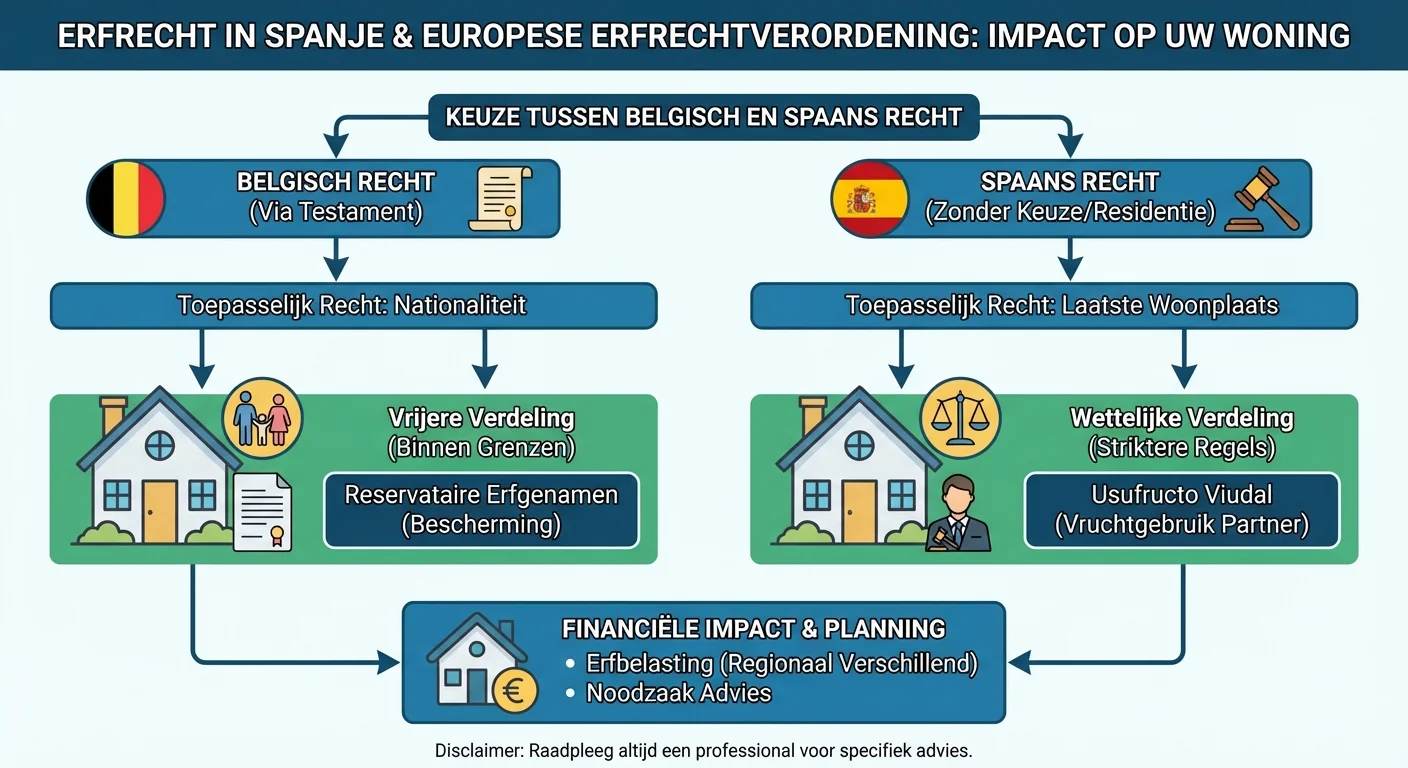
De eerste en belangrijkste vraag bij elke grensoverschrijdende erfenis is welk recht de verdeling van het vermogen regelt. Sinds 17 augustus 2015 geeft de Europese Erfrechtverordening (nr. 650/2012) hierop een duidelijk antwoord: op de volledige nalatenschap is in beginsel het recht van toepassing van het land waar de overledene op het moment van overlijden zijn gewone verblijfplaats had. Woonde uw familielid permanent in Spanje, dan regelt het Spaanse erfrecht de hele nalatenschap, ook de bezittingen in België of Nederland. Lag de gewone verblijfplaats daarentegen in het thuisland, dan geldt in principe het Belgische, Nederlandse, Duitse of Franse recht, ook voor de woning aan de Costa Blanca.
Het begrip “gewone verblijfplaats” is een feitelijk begrip. Een rechter kijkt naar waar iemand zijn leven werkelijk had opgebouwd: waar het gezin woonde, waar de sociale en economische banden lagen en hoeveel tijd per jaar in elk land werd doorgebracht. Juist voor eigenaars van een tweede verblijf die veel heen en weer reizen, is dat niet altijd vanzelfsprekend. Of u fiscaal als inwoner van Spanje wordt aangemerkt, is een verwante maar afzonderlijke vraag; daarover leest u meer in ons artikel over if you are a tax resident in Spain. Voor het erfrecht telt vooral de feitelijke woonsituatie, niet enkel een inschrijving op papier.
De rechtskeuze: kies bewust voor uw eigen nationale recht
De verordening biedt een waardevol instrument: de rechtskeuze (professio iuris). U mag in uw testament uitdrukkelijk bepalen dat het recht van uw nationaliteit van toepassing is op uw volledige nalatenschap. Een Belg kan dus voor het Belgische recht kiezen, een Nederlander voor het Nederlandse, een Duitser voor het Duitse en een Fransman voor het Franse, ongeacht waar de gewone verblijfplaats zich bevindt. Die keuze zorgt voor rechtszekerheid: u weet vooraf volgens welke vertrouwde regels uw vermogen wordt verdeeld en uw erfgenamen worden niet verrast door dwingende Spaanse verdeelsleutels.
Eén nuance is cruciaal en wordt vaak verkeerd begrepen: een rechtskeuze raakt enkel de civielrechtelijke verdeling van de goederen, dus de vraag wie hoeveel erft. De fiscale behandeling verandert er niet door. Spanje blijft altijd erfbelasting (Impuesto sobre Sucesiones y Donaciones) heffen over het onroerend goed dat op Spaanse bodem ligt, ongeacht welk civiel recht u kiest. Recht en belasting volgen hier dus elk hun eigen logica. De concrete tarieven, vrijstellingen en termijnen voor die heffing werkten wij apart uit in ons overzicht over de erfbelasting op Spaans vastgoed, met de bijzonder gunstige regeling in de Comunidad Valenciana waar de Costa Blanca onder valt.
Het Spaanse wettelijke erfrecht: reservatarios en legitieme erfdelen
Maakt u geen rechtskeuze en geldt het Spaanse recht, dan is het belangrijk te begrijpen hoe streng dat recht de vrijheid van de erflater beperkt. Het Spaanse Burgerlijk Wetboek kent de figuur van de legitieme erfdelen (la legítima) and the reservatarios: de erfgenamen die wettelijk een onaantastbaar deel van de nalatenschap toekomen. Anders dan veel eigenaars uit België, Nederland, Duitsland of Frankrijk verwachten, kunt u in Spanje uw kinderen niet eenvoudig overslaan ten gunste van uw partner.
In het algemene Spaanse civiele recht wordt de nalatenschap in drie delen verdeeld wanneer er kinderen zijn. Eén derde, de tercio de legítima estricta, komt verplicht en in gelijke delen toe aan de kinderen. Een tweede derde, de tercio de mejora, is ook voor de afstammelingen bestemd, maar de erflater mag binnen die groep een kind bevoordelen. Enkel het laatste derde, de tercio de libre disposición, mag vrij worden toebedeeld aan wie u wilt, bijvoorbeeld aan uw echtgenoot. De langstlevende partner heeft daarnaast recht op een vruchtgebruik, zoals verderop besproken.
Voor wie gewend is aan de ruimere beschikkingsvrijheid of de sterke partnerbescherming uit het eigen land, is dit een wezenlijk verschil. Wilt u uw langstlevende echtgenoot maximaal beschermen, dan is het Spaanse wettelijke kader vaak minder gunstig dan uw nationale recht. Juist daarom is een bewuste rechtskeuze, gecombineerd met een doordacht testament, voor de meeste eigenaars de verstandigste route. Een advocaat die zowel het Spaanse recht als uw thuisrecht beheerst, kan de twee stelsels naast elkaar leggen en de oplossing kiezen die uw gezin het beste beschermt. Hoe belangrijk een grondige legal review is, ondervinden eigenaars trouwens al bij de aankoop; bij de vererving geldt hetzelfde principe.
Waarom een Spaans testament (testamento) zo waardevol is
Een testament uit uw eigen land is in Spanje juridisch geldig, maar in de praktijk zorgt het bij een overlijden voor vertraging en kosten. Het buitenlandse document moet worden voorzien van een apostille, beëdigd worden vertaald en juridisch worden geïnterpreteerd voordat een Spaanse notaris ermee aan de slag kan. Dat alles kost tijd, terwijl de Spaanse fiscus voor de erfbelasting een strikte termijn van zes maanden hanteert. Erfgenamen die maanden moeten wachten op documenten uit het buitenland, lopen daardoor het risico op boetes en interesten.
Daarom raden wij eigenaars vrijwel altijd aan om naast hun thuistestament een afzonderlijk Spaans testament (testamento) op te stellen dat enkel de Spaanse bezittingen regelt. U tekent dit bij een Spaanse notaris; het wordt geregistreerd in het centrale register van uiterste wilsbeschikkingen in Madrid (het Registro General de Actos de Última Voluntad). Na een overlijden kan de notaris daar direct opvragen of er een testament bestaat en wat het bepaalt. De afwikkeling van de nalatenschap verloopt zo aanzienlijk sneller en voorspelbaarder.
In dat Spaanse testament neemt u idealiter ook de rechtskeuze voor uw nationale recht op. U combineert dan het beste van twee werelden: de snelle, lokale afwikkeling van een Spaans document met de vertrouwde verdeelregels van uw eigen land. Belangrijk is wel dat uw Spaanse en uw buitenlandse testament op elkaar zijn afgestemd en elkaar niet per ongeluk herroepen. Laat beide documenten daarom door dezelfde gespecialiseerde adviseur of door samenwerkende juristen controleren. Onze adviseurs werken hiervoor samen met betrouwbare Spaanse notarissen en advocaten, zodat uw stukken sluitend zijn.
Het vruchtgebruik (usufructo) voor de langstlevende
Een terugkerend thema bij de vererving van Spaans vastgoed is het vruchtgebruik (usufructo) voor de langstlevende echtgenoot. In het Spaanse recht bestaat de zogenaamde usufructo vidual: de overlevende partner krijgt geen volle eigendom maar een vruchtgebruik over een deel van de nalatenschap, terwijl de kinderen de blote eigendom (nuda propiedad) verkrijgen. Concreet betekent dit dat de partner de woning mag blijven bewonen of de huurinkomsten mag genieten, terwijl de kinderen juridisch eigenaar zijn en het volle eigendom pas verkrijgen na het overlijden van de langstlevende.
Deze constructie lijkt op het vruchtgebruik dat veel kopers uit België en Nederland al kennen, maar de omvang en de berekening verschillen. Bij Spaans recht heeft de echtgenoot doorgaans recht op het vruchtgebruik over het tercio de mejora wanneer er kinderen zijn. Kiest u via uw testament voor uw eigen nationale recht, dan gelden de vruchtgebruikregels van dat land, die de partner vaak ruimer beschermen. Voor samengestelde gezinnen, met kinderen uit een eerder huwelijk, is dit onderscheid bijzonder belangrijk: zonder zorgvuldige planning kan de langstlevende anders in een kwetsbare positie tegenover die kinderen terechtkomen.
Een gesplitste aankoop, waarbij bijvoorbeeld de ouders het vruchtgebruik nemen en de kinderen meteen de blote eigendom verwerven, kan in sommige gevallen een doordachte vorm van vermogensplanning zijn. Of dat in uw situatie voordelig is, hangt af van uw gezinssituatie, uw nationaliteit en de fiscale gevolgen. Zo’n structuur opzetten doet u het best vóór de aankoop, samen met een adviseur die ook de bredere context van investing in Spanish property overziet, en niet pas wanneer de nalatenschap al openvalt.
De aanvaarding van de nalatenschap: van overlijden tot inschrijving
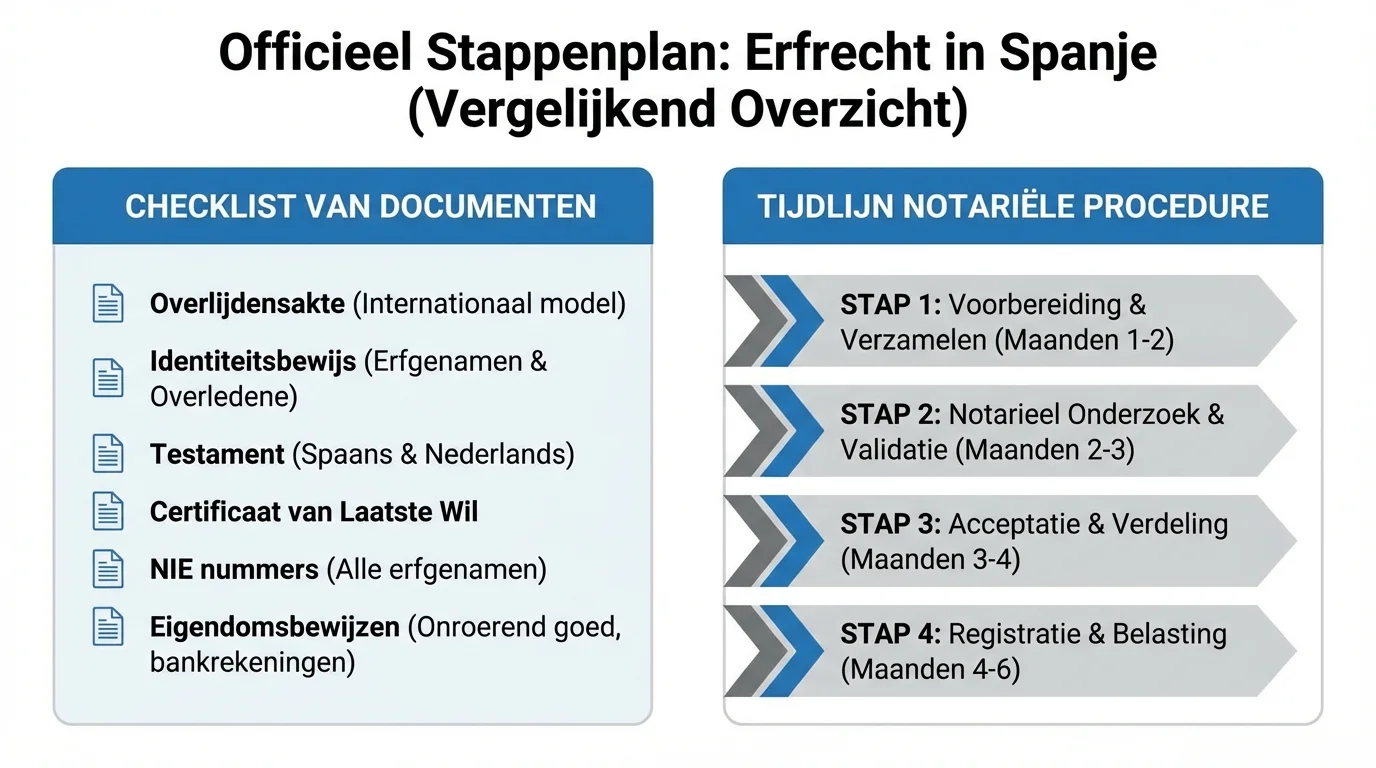
Wanneer een eigenaar overlijdt, gaat de Spaanse woning niet automatisch over op de erfgenamen. Daarvoor is een formele procedure nodig die uitmondt in de escritura de aceptación de herencia, de notariële akte van aanvaarding van de nalatenschap, en de inschrijving daarvan in het eigendomsregister. Die procedure verloopt in een vast aantal stappen, waarbij een goede voorbereiding letterlijk maanden tijdwinst oplevert.
De eerste stap is het verzamelen van de basisdocumenten: de overlijdensakte, een uittreksel uit het Spaanse register van uiterste wilsbeschikkingen (het certificado de últimas voluntades) en een gewaarmerkte kopie van het testament. Vervolgens moeten alle erfgenamen over een NIE-nummer beschikken, het Spaanse fiscale identificatienummer. Zonder dat nummer kan de notaris de akte niet verlijden en staat de hele procedure stil. Wij raden aan dit nummer ruim op tijd aan te vragen; hoe dat werkt, leest u in ons artikel over het NIE-nummer in Spanje.
Daarna wordt de nalatenschap geïnventariseerd en gewaardeerd. Het is verstandig om vooraf een note simple op te vragen bij het eigendomsregister. Dit document toont wie de geregistreerde eigenaar is en of er hypotheken of beslagen op de woning rusten. Klopt de tenaamstelling in de oorspronkelijke eigendomsakte (de escritura) niet helemaal, dan moet dat eerst worden rechtgezet, anders loopt de inschrijving later vast.
Met deze stukken verschijnen de erfgenamen bij de notaris, die de escritura de aceptación de herencia opmaakt en de toebedeling van de goederen vastlegt. Binnen zes maanden na het overlijden moet de erfbelasting worden aangegeven en betaald, samen met de gemeentelijke Plusvalía (de meerwaardeheffing op de grond). Pas wanneer die heffingen zijn voldaan, wordt de nieuwe eigendomstitel ingeschreven in het Registro de la Propiedad en zijn de erfgenamen officieel eigenaar. Pas dan kunnen zij de woning ook verkopen, verhuren of overdragen.
De belangrijkste stappen op een rij:
- Vraag de overlijdensakte en het certificado de últimas voluntades (register van laatste wilsbeschikkingen) op.
- Zorg dat alle erfgenamen tijdig een NIE-nummer aanvragen.
- Vraag een actuele nota simple op en controleer de tenaamstelling in de escritura.
- Onderteken de escritura de aceptación de herencia bij de notaris.
- Geef de erfbelasting en de Plusvalía aan en betaal binnen zes maanden na het overlijden.
- Laat de nieuwe eigendomstitel inschrijven in het Registro de la Propiedad.
Regionale verschillen en de rol van de gestor
Spanje kent een sterk gedecentraliseerd systeem. De autonome regio’s, zoals de Comunidad Valenciana waar de Costa Blanca toe behoort, Andalusië, Murcia of de Balearen, hebben elk eigen bevoegdheden rond de erfbelasting. Daardoor kan de fiscale druk per regio sterk verschillen, terwijl het civiele erfrecht grotendeels nationaal blijft. Voor eigenaars rond Dénia, Jávea, Altea en Moraira in het noorden of Torrevieja, Orihuela Costa en Pilar de la Horadada in het zuiden geldt het gunstige regime van de Comunidad Valenciana. Voor wie luxe vastgoed op Ibiza bezit, gelden de regels van de Balearen. Welke regionale voordelen op uw situatie van toepassing zijn, leest u in ons fiscale artikel over erfbelasting en vastgoed in Spanje.
Goed nieuws voor eigenaars uit het buitenland: dankzij Europese rechtspraak krijgen niet-residenten uit de EU en de EER dezelfde regionale voordelen als lokale inwoners, zodat zij niet langer worden achtergesteld. Toch blijft de praktische afwikkeling, met aangiftes, vertalingen en termijnen, complex. Een gestor, het Spaanse administratieve aanspreekpunt, is daarbij vaak onmisbaar. De gestor verzorgt de aangiftes, bewaakt de termijnen en zorgt voor een correcte inschrijving, terwijl de advocaat de juridische keuzes begeleidt.
Praktische tips voor eigenaars uit België, Nederland, Duitsland en Frankrijk
De rode draad is steeds dezelfde: regel de juridische kant van uw nalatenschap proactief, zolang u dat zelf in de hand hebt. Wie wacht tot het overlijden, laat de erfgenamen achter met een ingewikkeld dossier in een taal die zij vaak niet beheersen, op een moment dat zij rust en duidelijkheid nodig hebben. Met een aantal eenvoudige maatregelen voorkomt u dat.
- Stel een afzonderlijk Spaans testament op voor uw Spaanse bezittingen en stem het af op uw thuistestament.
- Neem in dat testament een uitdrukkelijke rechtskeuze op voor uw nationale recht (Belgisch, Nederlands, Duits of Frans).
- Controleer of de eigendomsakte en de tenaamstelling kloppen, en of de woning correct staat ingeschreven in het Registro de la Propiedad.
- Leg een overzichtelijk dossier aan voor uw erfgenamen, met de escritura, de nota simple, het testament en de gegevens van uw adviseurs.
- Laat tijdig een NIE-nummer aanvragen voor de personen die naar verwachting zullen erven.
- Laat u over de fiscale gevolgen apart adviseren, want recht en belasting volgen elk hun eigen regels.
Eigenaars die hun Spaanse woning verhuren, doen er goed aan om ook de lopende verplichtingen en het beheer in dit dossier te betrekken. Een woning die tijdens de afwikkeling in onverdeeldheid blijft, brengt immers kosten met zich mee voor onderhoud, gemeenschappelijke lasten en eventueel verhuur. Ons team kan dat maintenance and key management tijdens deze periode verzorgen, zodat de woning in goede staat blijft en de erfgenamen niets hoeven over te nemen op afstand.
Erfrecht meenemen vanaf de aankoop
De beste vermogensplanning begint niet bij het overlijden, maar al bij de aankoop. Wie nadenkt over de eigendomsstructuur, de tenaamstelling en een eventueel vruchtgebruik op het moment dat hij koopt, voorkomt veel latere kopzorgen. In onze gids over buying property in Spain komt dit aspect terug als een vast onderdeel van een doordachte aankoop. Of u nu investeerder bent, een tweede verblijf zoekt, als gepensioneerde verhuist of als expat in Spanje verblijft: een woning waarvan de juridische basis vanaf dag één klopt, vererft eenvoudiger en met minder kosten.
Ook de keuze tussen nieuwbouw en bestaande bouw, de financiering en de bredere fiscale context spelen mee in uw planning op lange termijn. Een betrouwbare partner houdt al deze elementen in samenhang in het oog, van de eerste bezichtiging tot de uiteindelijke vererving, zodat uw vastgoed een gerust bezit blijft en geen bron van onzekerheid wordt voor wie u achterlaat.
How we can help you
At Invest in Spain, onderdeel van de Luxe Vastgoed Groep, staat een ervaren team klaar dat het Spaanse erfrecht en de praktijk aan de Costa Blanca door en door kent. Onder leiding van vastgoedexpert en CEO Kenzo Fayot begeleiden wij kopers en eigenaars uit België, Nederland, Duitsland en Frankrijk bij elke stap: van de aankoop met de juiste eigendomsstructuur, over de afstemming van uw Spaanse testament met betrouwbare notarissen en advocaten, tot het beheer van de woning en de juridische begeleiding bij de vererving. Zo blijft uw Spaanse droom ook voor uw nabestaanden een zorgeloos bezit. Een grondige begeleiding bij al uw vastgoeddiensten vormt daarbij de basis.
Wilt u uw nalatenschap juridisch waterdicht regelen en met een gerust hart van uw woning onder de Spaanse zon genieten? Onze specialisten denken graag met u mee en zorgen dat alles tot in de puntjes klopt. Please feel free to contact us, with no obligation voor een persoonlijk gesprek over uw situatie.
Veelgestelde vragen over erfrecht in Spanje
Welk recht is van toepassing op mijn Spaanse woning na mijn overlijden?
In beginsel geldt op grond van de Europese Erfrechtverordening (EU 650/2012) het recht van het land waar u uw gewone verblijfplaats had. U kunt echter in uw testament uitdrukkelijk kiezen voor uw eigen nationale recht (Belgisch, Nederlands, Duits of Frans). Die rechtskeuze regelt de verdeling van het vermogen, maar verandert niets aan de Spaanse erfbelasting over het lokale onroerend goed.
Wat zijn reservatarios en legitieme erfdelen in het Spaanse erfrecht?
Reservatarios zijn de erfgenamen, met name de kinderen, die volgens Spaans recht een wettelijk beschermd deel (de legítima) van de nalatenschap toekomt. Bij kinderen is doorgaans twee derde van de nalatenschap voor de afstammelingen gereserveerd en mag slechts een derde vrij worden toebedeeld. U kunt uw kinderen dus niet zomaar overslaan, tenzij u via een rechtskeuze uw nationale recht laat gelden.
Waarom is een apart Spaans testament aan te raden?
Een Spaans testament dat enkel uw Spaanse bezittingen regelt, wordt geregistreerd in het centrale register in Madrid en versnelt de afwikkeling van de nalatenschap aanzienlijk. Het bespaart uw erfgenamen de tijd en kosten van apostille, beëdigde vertalingen en interpretatie van een buitenlands document, terwijl de Spaanse fiscus een strikte termijn van zes maanden hanteert.
Wat is het vruchtgebruik (usufructo) voor de langstlevende?
In het Spaanse recht krijgt de langstlevende echtgenoot vaak geen volle eigendom, maar een vruchtgebruik (usufructo) over een deel van de nalatenschap, terwijl de kinderen de blote eigendom verkrijgen. De partner mag de woning dan blijven bewonen of de inkomsten genieten. De omvang verschilt van het vruchtgebruik in uw thuisland; met een rechtskeuze of een doordachte structuur kunt u uw partner gerichter beschermen.
Hoe verloopt de aanvaarding van de nalatenschap in Spanje?
De erfgenamen verzamelen de overlijdensakte, het uittreksel uit het register van laatste wilsbeschikkingen en het testament, vragen een NIE-nummer aan en ondertekenen bij de notaris de escritura de aceptación de herencia. Vervolgens worden de erfbelasting en de Plusvalía binnen zes maanden aangegeven en betaald, waarna de nieuwe eigendomstitel wordt ingeschreven in het Registro de la Propiedad.