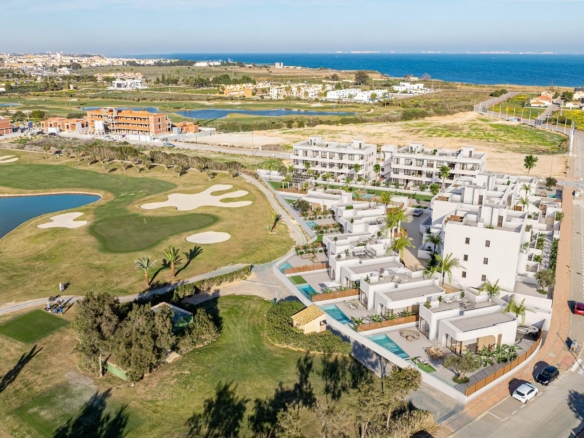
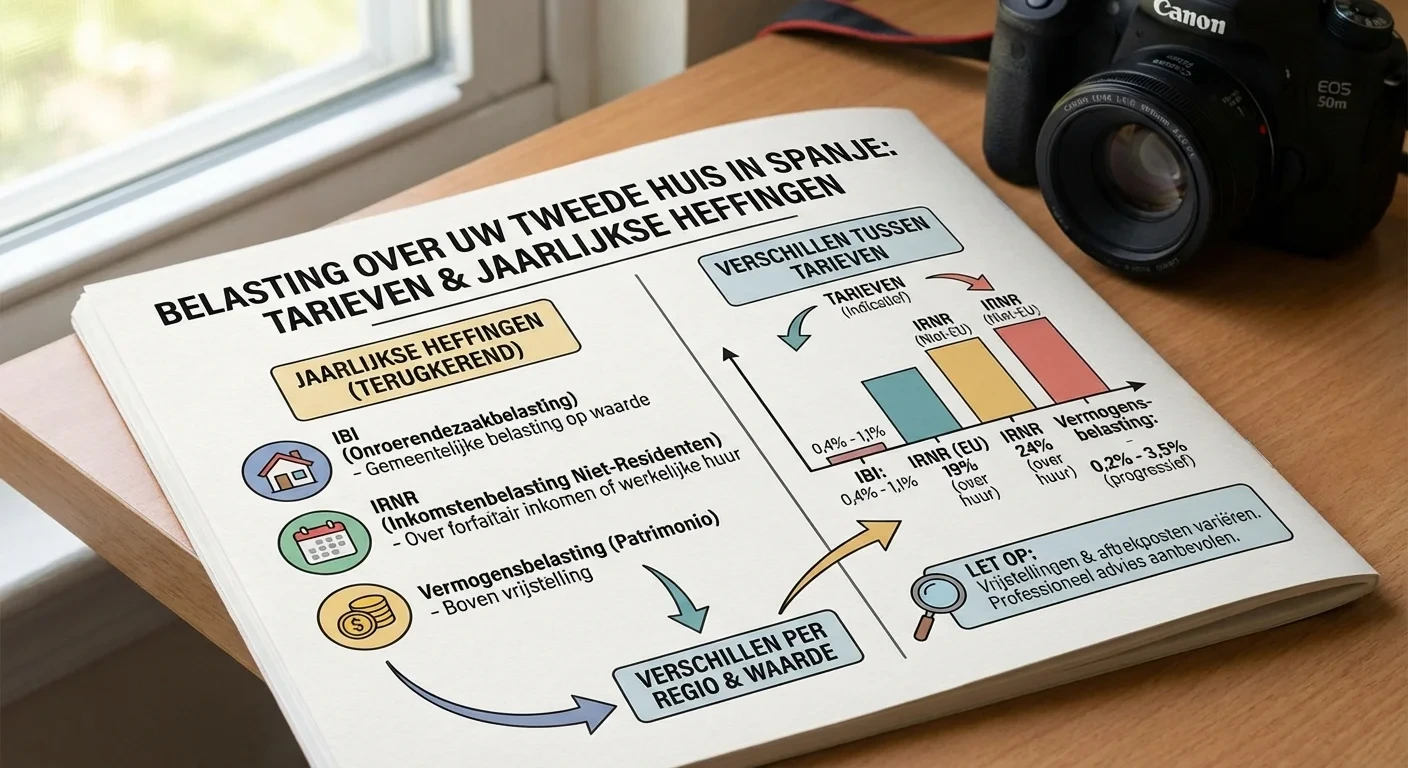
For most foreign owners, the tax on a second home in Spain consists of four fixed components: the local property tax IBI, income tax for non-residents (IRNR) regarding a notional return if the property is owner-occupied or the actual rental income if it is let, and, where applicable, capital gains tax on net assets exceeding approximately €700,000. As a non-resident from the EU or the EEA, you pay 19% IRNR; for non-EU residents, the rate is 24% on gross income. If you are keeping the property for your own use, the Spanish tax authorities will charge 19% on 1.1% (based on a recently revised cadastral value) or 2% of the valor catastral. The exact amount you pay depends on the region, the cadastral value and whether or not you let out the property.
On this page, we focus specifically on the Spanish taxes on a second home. You can find out about the tax you are required to declare in your home country in our country-specific guides on the Dutch tax on a house in Spain and the Tax in Belgium on a house in Spain. This ensures that both sides of the story are kept clearly separate and prevents double taxation or unexpected additional tax assessments.

Which Spanish taxes apply to your second home?
For many Belgians, Dutch, Germans and French people, a second home in the sunshine of the Costa Blanca is a long-cherished dream. However, owning a holiday home in Spain entails a number of annual tax obligations that differ significantly from what you are used to in your own country. The Spanish tax authority, the Agencia Tributaria, makes a clear distinction between residents and non-residents. Anyone who stays in Spain for fewer than 183 days a year is generally subject to the non-resident tax regime and therefore pays different rates. Whether you own a property in Dénia, Jávea, Moraira or Torrevieja, the tax on your second home in Spain is not a one-off payment upon purchase, but a recurring expense that you must factor in each year.
In practical terms, as a non-resident, you will be subject to four types of tax: the municipal property tax (IBI), income tax for non-residents (IRNR), possibly wealth tax and, once you let out a property, tax on that rental income via Form Modelo 210. Below, we explain each of these in turn, with the current rates and a sample calculation, so that you know exactly where you stand. Would you like to see the full tax picture first? Then do read our comprehensive overview of the Property taxes in Spain for 2026.

Property tax (IBI) and local charges
The best-known local tax is the Impuesto sobre Bienes Inmuebles, or IBI for short. This is a municipal tax comparable to the property tax in the Netherlands and Belgium, which every owner pays annually, regardless of whether the property is permanently occupied or not. The amount of the IBI is calculated based on the cadastral value (valor catastral) of the property. As a rough guide, you can expect to pay around €200 in IBI per €100,000 of property value per year, although the exact rate varies from one local authority to another. Many local authorities collect the IBI via direct debit (domiciliación); we recommend that you set this up so that you never miss a payment deadline.
In addition to the IBI, there are smaller local council charges, such as the tasa de basura for rubbish collection. These amounts vary considerably from one municipality to another along the Costa Blanca and are sometimes invoiced annually, sometimes every six months. Paying these local taxes on time is more important than many owners realise: in Spain, outstanding payments can ultimately lead to your Spanish bank account being seized. For those who would prefer to hand over the administration to us, we can maintenance and key management handle the payment and monitor the property remotely.
“The timely payment of local taxes is crucial for hassle-free ownership in Spain, as arrears can lead to bank account repossession.”
Income tax for non-residents (IRNR) on own use
If you use the property solely for your own enjoyment and do not let it out, the Spanish state still regards this as a form of notional income, known as ‘imputed income’ or imputed interest. You pay IRNR annually on this notional benefit. The calculation is carried out in two steps. First, you determine the tax base: 1.1% of the cadastral value if that value has been revised within the last ten years, or 2% if it was revised more than ten years ago. You then apply the rate: 19% for residents of the EU or EEA, and 24% for those from outside the European Union.
A calculation example will illustrate this. Suppose you, as a Belgian or Dutch owner, own a flat in Moraira with a recently revised cadastral value of €150,000. The tax base is then 1.1% of €150,000 = €1,650. On this amount, you pay 19% IRNR, or approximately €313 per year. A common mistake is to assume that you do not need to file a tax return because there is no rental income. However, the tax authorities expect you to submit the form every year Model 210, even if it is for your own use only. If you fail to submit this, you risk being charged additional tax, plus interest and penalties.
Tax on rental income from letting
If you decide to let out your second home (either in full or in part), for example as a holiday let when you are not there yourself, the calculation changes. You will then pay IRNR tax on the actual rental income rather than on the notional return, and the tax return is also filed using Form 210, but on a quarterly basis for the periods during which the property is let. The key difference lies in deductibility: if you are a tax resident of an EU or EEA country, you may deduct costs attributable to the rental period, such as a proportionate share of the IBI, insurance, service charges, interest on your Spanish mortgage, maintenance, cleaning and management. You will then pay 19% on the net income. Owners from outside the EU pay 24% on the gross rent, without any deductions; that difference makes a big difference.
Furthermore, anyone wishing to let a property on a long-term basis on the Costa Blanca will often need a tourist letting licence and would be well advised to calculate the expected return in advance. A net rental yield of 4 to 7% per year is a realistic benchmark for a well-located holiday home. In our guide to the Taxes for property investors in Spain we will take a closer look at tax optimisation for letting, and through our service property rental in Spain we’ll take care of the practicalities of letting and tax returns for you.
It is essential to declare this income correctly and on time. Failure to declare rental income can result in substantial back-tax assessments with interest, which immediately puts pressure on the profitability of your investment. A proactive approach pays off: by complying with Spanish regulations, your property will remain a source of enjoyment rather than a source of financial worry.
IRNR and capital gains tax: two different taxes
Many property owners confuse income tax (IRNR) with wealth tax (Impuesto sobre el Patrimonio), even though these are two very different taxes, each with its own tax base. The IRNR focuses on the pleasure or the reward of the property, as described above. Wealth tax, on the other hand, takes into account the net value of all your assets in Spain. Paying one tax does not, therefore, exempt you from the other; they co-exist.

The impact of capital gains tax on your assets
Wealth tax is a levy on the net value of your Spanish assets, from which debts such as a mortgage may be deducted. For non-residents, the tax applies only to assets located in Spain. In practice, you only pay tax once your net assets exceed a threshold of approximately €700,000 per person, a limit that may vary by autonomous region. For a married couple who jointly own property, this exemption generally applies per person, meaning that joint assets of nearly €1.4 million may remain exempt from the tax. Most owners of a typical second home on the Costa Blanca therefore do not reach this threshold, but the obligation to file a tax return remains a point of consideration for those investing in the luxury segment, for example in Ibiza.
“Properly distinguishing income from assets is key to a successful tax strategy for foreign property owners.”
If you are thinking of buying a property, it is a good idea to familiarise yourself with the entire process beforehand. In our guide to buying property in Spain You can read, step by step, what to expect, from the purchase costs to the annual charges. Bear in mind that many tax rules vary from one autonomous region to another, which adds to the complexity and makes expert advice invaluable.
Key features of the levies at a glance
- The IBI is a municipal annual tax levied on the cadastral value, regardless of whether the property is owner-occupied or let out.
- The IRNR for personal use amounts to 19% (EU/EEA) or 24% (non-EU) of 1.1% or 2% of the cadastral value, via Form 210.
- The IRNR for lettings is levied on the actual rent; EU/EEA owners may deduct costs, whereas non-EU owners may not.
- The wealth tax This only applies to amounts above approximately €700,000 net per person and takes into account total assets in Spain.
- Double taxation treaties between Spain and your home country, to prevent you from paying tax twice on the same income.
Please bear in mind that the IRNR is also payable for owner-occupied properties even if the property stands empty for the whole year: after all, the notional return is calculated on the basis of ownership itself, not on actual use. Whether you become a tax resident or remain a non-resident makes a significant difference to your tax return obligations. If you are unsure which regime applies to you, please read our explanation of if you are a tax resident in Spain.
Tips for managing the annual tax on your second home
Tax on your second home in Spain need not come as a surprise. By managing your tax obligations strategically, you can keep your annual costs under control and avoid penalties. It is particularly crucial to know which tax deductions are available if you let out the property temporarily when you are not staying there yourself. Keeping proper records often results in a lower effective tax burden than using flat-rate amounts.
Optimise your tax deductions
If you are a landlord and an EU or EEA resident, you may deduct various costs from your gross rental income: the interest on your Spanish mortgage, insurance premiums, service charges and even marketing or cleaning costs. Keep all invoices carefully, as they directly reduce the IRNR you pay each quarter. If you are considering financing your property with a Spanish mortgage, the interest may offer tax benefits; you can read more about this on our services page apply for a mortgage in Spain, where we also explain that non-residents can generally borrow up to around 70% of the valuation.

It is advisable to engage a specialist accountant or tax representative who is familiar with the specific rules for non-residents. This will help you avoid calculation errors on Form 210 and ensure you make full use of all the tax deductions to which you are entitled. Anyone considering becoming a tax resident, or who wishes to sell the property at a later date, would also be well advised to make the necessary arrangements in good time. transfer tax in Spain before 2026 and to provide an overview of the current rates.
“Good tax planning starts with understanding the difference between own use and rental periods for Spanish tax purposes.”
Make use of local exemptions
In addition to national regulations, there are often local variations that affect the total tax liability. Some local authorities along the Costa Blanca offer discounts on the IBI for properties with solar panels or other sustainable investments. You should therefore check annually whether you are eligible for a tax relief. Regional benefits are also worth looking into if you are planning a sale, inheritance or gift: in the Comunidad Valenciana, for example, there is a generous inheritance tax relief for spouses and children, from which non-residents from the EU and the EEA can also benefit.
- Check the cadastral value (valor catastral) of your property every year; a reassessment affects both IBI and IRNR.
- Always submit Form Modelo 210 on time, even if the vehicle is for personal use only, to avoid fines and interest.
- Ask your local council about tax incentives for energy-saving measures.
A proactive approach will save you a lot of money and headaches in the long run. Whether it’s the annual IRNR, the IBI or capital gains tax: being well prepared helps avoid unexpected additional tax assessments. Keep up to date with the current rates and regional exemptions that apply to your situation.
How we can help you
At Invest in Spain leads our team, headed by the property expert and CEO Kenzo Fayot, buyers and owners from Belgium, the Netherlands, Germany and France at every stage of their adventure on the Costa Blanca. From the initial consultation and estate agency From legal due diligence and guidance on the purchase process to ensuring your tax is declared correctly on your second home: we make sure there are no surprises. Whether you’re a retired couple spending the winter in Dénia, an investor seeking a return on your investment in Torrevieja or a family with a holiday home in Jávea, our comprehensive range of services covers purchase, letting, maintenance and sale.
Would you like to know exactly how much you need to pay to the Spanish government this year, or would you prefer to have your IRNR tax return taken care of for you? Please feel free to contact us, with no obligation for a personalised quote and expert advice, so that your second home in Spain remains a source of enjoyment.
Frequently asked questions about tax on a second home in Spain
How much tax do you pay as a non-resident on a second home in Spain?
As a non-resident, you pay the annual municipal property tax (IBI) (approximately €200 per €100,000 of the property’s value) and the income tax for non-residents (IRNR). If you occupy the property yourself, the IRNR is 19% (EU/EEA) or 24% (non-EU) on 1.1% or 2% of the cadastral value. For net assets exceeding approximately €700,000 per person, wealth tax is also payable.
What is imputed income, and why do you pay it even if you’re not letting out a property?
The Spanish tax authorities treat the ownership of a second home as imputed income (renta imputada), even if you do not let it out. You pay 19% or 24% IRNR on 1.1% of the cadastral value if it has been revised in the last ten years, or on 2% if it was revised longer ago. The tax return is filed using Form 210, which you must submit annually even if the property is used solely for your own purposes.
How is the capital gains tax on a holiday home calculated?
Wealth tax (Impuesto sobre el Patrimonio) applies as soon as the net value of your Spanish assets exceeds approximately €700,000 per person; you may deduct debts such as a mortgage. The exact threshold and rates vary by autonomous community. For a married couple, the allowance generally applies per person, meaning that many typical second homes remain exempt from the tax.
What tax do you pay when letting out your Spanish property?
When letting a property, you pay IRNR tax on the actual rental income via Form 210, on a quarterly basis for the periods during which the property is let. Residents of the EU or EEA pay 19% on the net income and may deduct expenses such as IBI, mortgage interest, insurance and maintenance. Non-EU owners pay 24% on the gross rent, without any deductions.
When should the non-resident tax return be filed?
You must submit the IRNR return for owner-occupied property relating to the previous calendar year by 31 December at the latest. If the property is let, a quarterly return applies. For the local IBI, you will receive a tax assessment from the local authority, which usually must be paid in the autumn within a set period. Submitting your return on time prevents fines and interest charges.