Importing a car into Spain means registering your foreign vehicle with a Spanish number plate at the DGT (General Directorate of Traffic). This is compulsory as soon as you become an official resident — in practice, within around six months of moving there. The process involves an ITV test, paying the registration tax (impuesto de matriculación) and the local road tax (IVTM), followed by the final registration (matriculación) with the DGT. You should allow for a processing time of several weeks and total costs of between approximately €500 and €2,000, depending largely on the CO₂ emissions and the current market value of your car.
For many expats and owners of a second home on the Costa Blanca, their own car is a familiar piece of home that they’re keen to bring with them. Whether you’re moving from Belgium, the Netherlands, Germany or France to Dénia, Jávea, Altea or the more southerly towns of Torrevieja and Orihuela Costa, registering your car with a Spanish number plate is a clearly defined administrative process. In this guide, we explain step by step when registration is compulsory, what documents you need, what it costs and when it’s advisable to engage a gestor.
When should you import your car into Spain?
The essence of the rule is simple: as soon as you have your main residence in Spain and thereby become a resident, your car must be registered with a Spanish number plate. Spanish law assumes that you will register your vehicle within a reasonable period of time after taking up residence. In practice, a period of around six months is often allowed during which you may continue to drive with a foreign number plate; after that, you risk fines and problems with your insurance. This obligation does not apply to those who, as tourists or second-home owners, spend only a few months a year in Spain and remain resident for tax purposes in their home country — although it is always wise to check your situation carefully.
The timing of your registration is therefore closely linked to your residential and tax status. We recommend that you first clarify when you, as Tax resident in Spain is important, as that very moment largely determines whether and when you need to register your car. If you plan your move carefully, you can avoid the deadline passing without you realising it. A clear overview an overview of your wider relocation and establishment plans helps to integrate car imports into the bigger picture.
Before you start, it is wise to consider whether it is financially viable to keep your current car. Sometimes the import costs outweigh the vehicle’s current market value, particularly in the case of older diesel cars or vehicles with high CO₂ emissions. This is because Spain operates a progressive tax system for vehicle registration, based on environmental friendliness. Doing your sums properly beforehand will save you a lot of frustration later on and prevent you from paying a high price for a car that you could have bought second-hand in Spain for a similar amount.
Step-by-step plan for importing your vehicle
Moving to sunny Spain is a dream for many, but the logistical process can sometimes feel like a maze of red tape. One of the most frequently asked questions by expats and second-home owners concerns taking their own car with them. The process of transferring a vehicle to a Spanish registration is subject to strict rules and requires a precise sequence of administrative steps. Below you will find the complete process, from gathering the necessary documents to the final registration with the DGT.
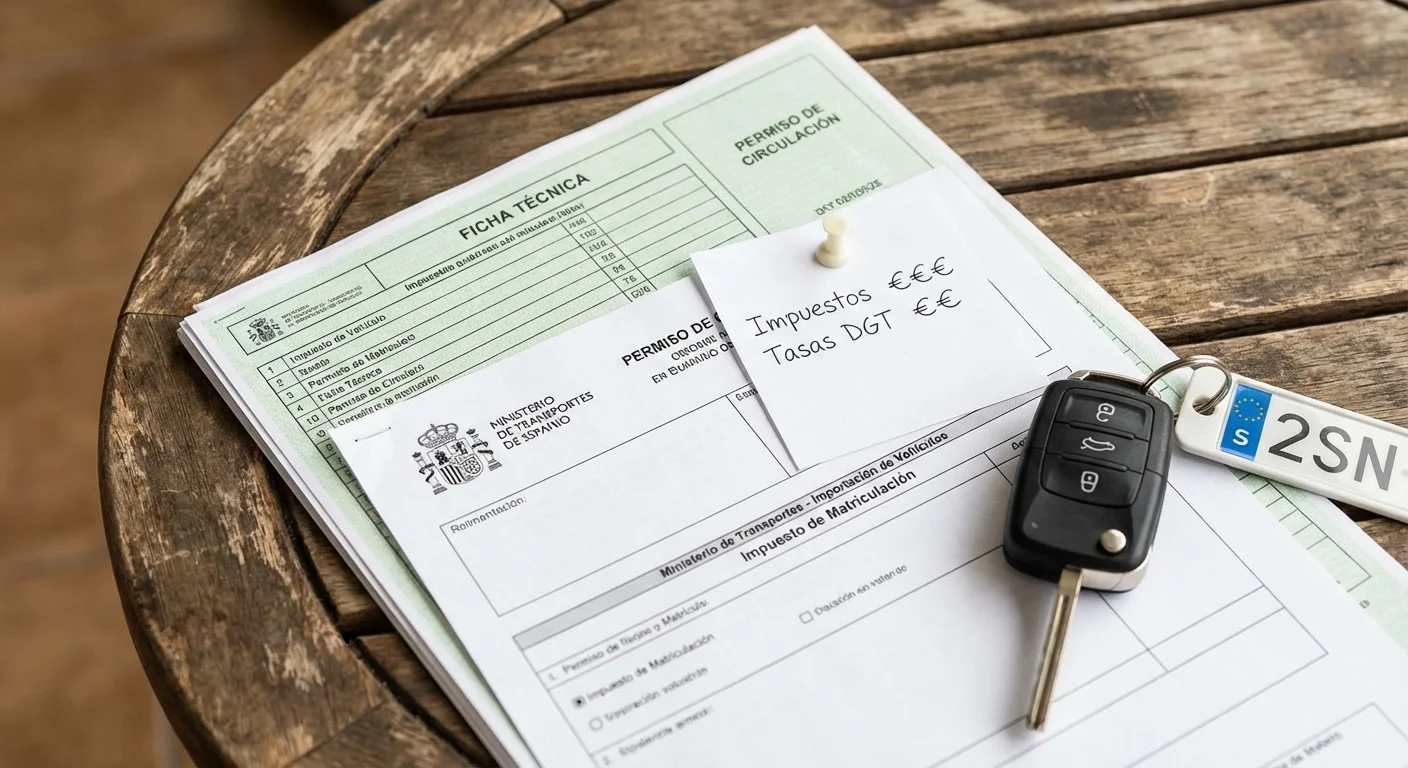
Preparation: documents, NIE and registration
The first practical step is to gather all the vehicle’s original documents. Without the complete registration certificate (Parts I and II, and the transfer certificate or the modern registration card), you won’t be able to do anything in Spain. In addition, the Certificate of Conformity (CoC), also known as the CoC document, is crucial. This document proves that the vehicle complies with European type-approval requirements and is essential for the Spanish roadworthiness test. If you no longer have this document, please request it in good time from the importer or manufacturer of the make in your country of origin.
Your personal documents are just as important. Your registration with the local council (the empadronamiento, or padrón) and your NIE number are essential when applying for a Spanish number plate. Without these documents, you cannot even officially pay the registration tax to the tax authorities. You should therefore first sort out your NIE number and your registration with the local authority; only then does it make sense to start the inspection and registration process. For those organising the entire move, a comprehensive approach to your branch on the Costa Blanca something to hold on to.
Step 1: The technical inspection (ITV)
As soon as you arrive in Spain with the vehicle, it must undergo a special inspection for import, known as the ‘ITV por importación’. This is more comprehensive than a standard annual inspection. The inspector not only checks safety but also verifies all technical specifications against the Certificate of Conformity (CvO). It is advisable to check in advance that your car does not have any modifications that are not permitted in Spain, such as certain tinted windows or non-approved tow bars, as this can significantly prolong the process and make it more expensive due to additional inspection requirements or the need for individual type-approval.
During this inspection, the following items, amongst others, are examined in detail:
- Verification of the chassis number (VIN) against the documents.
- The lighting and headlight alignment (important for cars from the UK, but also for EU cars).
- Emission values, which directly affect the amount of registration tax.
- The general condition of tyres, brakes and suspension.
- Presence of the European type-approval number on the nameplate.
Following a successful inspection, you will receive the Spanish technical certificate (Tarjeta de Inspección Técnica, known as the ‘ficha técnica’). This is an essential document for the next steps. The cost of this inspection varies by region and fuel type, but you should expect to pay between approximately €100 and €150. Make sure that all lights and emission levels have been checked by a mechanic beforehand; the ITV is often when unforeseen faults come to light, leading to additional repair costs.
“Importing a vehicle into Spain requires patience and meticulous record-keeping. The absence of even a single small document can lead to weeks of delay at the DGT.”
Step 2: Registration tax (impuesto de matriculación) and IVTM
When we look at the financial side of things, the registration tax — the ‘Impuesto Especial sobre Determinados Medios de Transporte’, commonly known as the impuesto de matriculación — is usually the largest expense. The amount depends on your car’s CO₂ emissions. Cars with emissions of less than 120 grams per kilometre are often exempt, but above that level the rates rise rapidly to as much as 14.75% of the current Spanish market value. This explains why the total costs can vary so greatly depending on the model and year of manufacture. To do this, you must complete Form 576 at the Agencia Tributaria (the Spanish tax authority).
In addition to the registration tax, you must pay the local road tax (Impuesto de Vehículos de Tracción Mecánica, or IVTM) in the municipality where you are registered. The rates are set annually by the municipality and are based on the engine’s fiscal power (caballos fiscales). You must be able to present proof of payment of the IVTM when you finally register the vehicle with the road traffic authority. Please note that this is a recurring annual tax, comparable to the motor vehicle tax in your country of origin.
Step 3: Exemption when moving house
An important benefit that many people underestimate: if you move to Spain and import your car as part of your household effects, you may be entitled to an exemption from registration tax. This could save you thousands of euros. However, you must be able to prove that you had owned the car for at least six months in your country of origin prior to the move, and that you have actually given notice to terminate your residence there. The application must be submitted within a specified period following your registration in Spain. Please note: even if you are entitled to an exemption, you must submit Form 576 to have the exemption formally confirmed — the application is not processed automatically.
Step 4: Final registration with the DGT
Below is a list of the documents you will need at the time of registration:
- The technical certificate (ficha técnica) following a successful ITV test.
- The original foreign vehicle registration certificate (Parts I and II).
- The European Certificate of Conformity (CoC).
- A copy of your NIE and passport, plus your registration certificate.
- Proof of payment of the local road tax (IVTM).
- Form 576 (registration tax or exemption) submitted and processed.
- The purchase invoice or sales contract (if the car was purchased recently).
With all these documents, you make an appointment at the Jefatura Provincial de Tráfico (DGT). This is where the final registration takes place. You pay a fixed fee (tasas), which is currently around €99 for passenger cars. Once your application has been processed, you will receive your new Spanish vehicle registration certificate (Permiso de Circulación). Only then will your car officially become a Spanish-registered vehicle. Don’t forget that you must then immediately have physical number plates made and fitted with the new number, and that you must update your insurance to reflect the Spanish registration number.
The cost of importing a car into Spain: an overview
The total cost of importing a car is largely determined by the taxes levied by the Spanish tax authorities. The main cost is the registration tax, which is directly linked to CO₂ emissions: the more environmentally friendly the car, the lower this amount will be. In addition, the ITV roadworthiness test, the IVTM tax and the DGT administrative fees all play a part. Careful calculations will help you avoid any surprises at the road traffic authority.
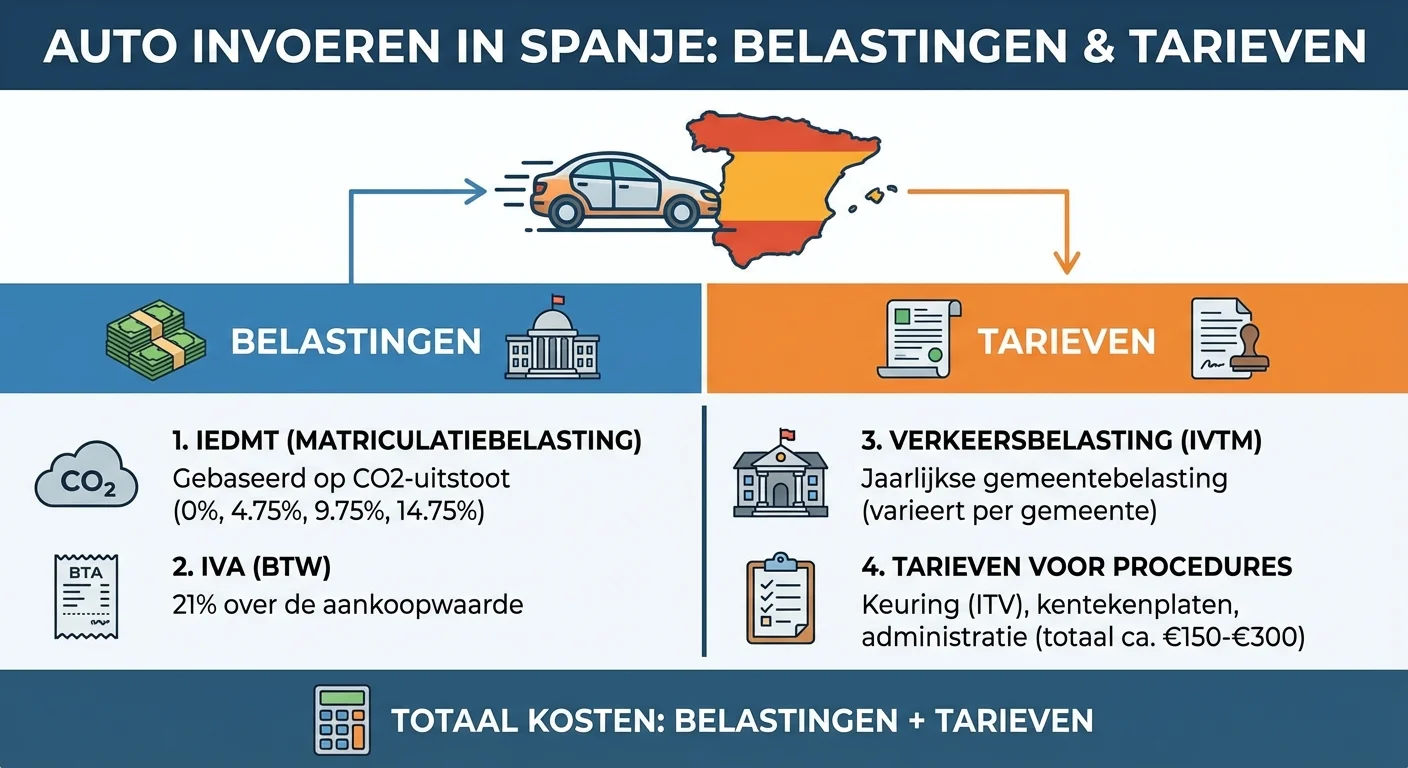
The breakdown of the costs is usually as follows:
- Registration tax: 0% to 14,75% of the current market value, depending on CO₂ emissions.
- ITV verification: approximately €100 to €150 for the import inspection and the type-approval dossier.
- IVTM: the annual local road tax, which varies from one local authority to another.
- DGT fees: approximately €99 in fees for the issue of the Spanish vehicle registration certificate.
- Gestor: usually between €250 and €500 if you have the process supervised.
- Other: new number plates, a certified translation if required, and updating your insurance.
All in all, the total costs usually amount to between approximately €500 and €2,000. The biggest variable remains the registration tax, which may be zero for a fuel-efficient, older car but can rise significantly for a powerful, polluting vehicle. The residual value of your vehicle at the time of import plays a key role in this: the tax authorities use official tables from the Ministry of Finance in which the value of vehicles is indexed annually based on make, model and year of manufacture.
Processing time: how long does it take to enter the data?
The processing time depends largely on how well you’ve prepared and on how busy the vehicle inspection centres and the DGT are in your province. Once all your documents are in order — such as the Certificate of Conformity (CoC), the foreign vehicle registration certificate, your NIE and empadronamiento — the whole process can often be completed within two to four weeks. Booking an appointment at the ITV and the DGT is usually the deciding factor; in some regions of the Costa Blanca, waiting times are longer than in others. If a document is missing or individual type-approval is still required, the processing time can take up to several months.
When should you engage a manager?
A gestor is a specialist administrative agent who knows their way around the Spanish bureaucracy and knows exactly which offices you need to visit. The role of the gestor should not be underestimated: although they charge a fee (usually between €250 and €500), this is often recouped by preventing errors and speeding up the process. A gestor can also help to calculate the registration tax precisely, based on the official valuation tables, and to submit Form 576 correctly, including any application for exemption.
We particularly recommend using our assistance if you do not speak the language, if your car has any special features (such as a missing Certificate of Conformity or non-standard modifications), or if you are combining your move with the purchase of a property and would rather spend your time on other matters. Read here to find out why a gestor is indispensable for administrative procedures in Spain. In addition, a civil servant may sometimes request a certified translation if documents are not drawn up in Spanish; a gestor can arrange this for you as well.
How we can help you
At Invest in Spain, our team, led by property expert and CEO Kenzo Fayot, we assist buyers and expats from Belgium, the Netherlands, Germany and France on a daily basis as they make the move to Spain. Importing your car is often just one part of a wider process: finding the right property, arranging your NIE, registering with the local council and sorting out your tax affairs. We’re happy to work with you to consider the full picture. Whether you’re looking to invest or move to the Northern Costa Blanca (Dénia, Jávea, Altea, Moraira), the south (Torrevieja, Orihuela Costa, Pilar de la Horadada) or even Ibiza, we can support you with purchase guidance, legal due diligence, financing and key management.
From mapping out your property and business set-up services in Spain to connecting you with reliable local partners for your car import: we’ll ensure your transition goes smoothly. Do you have any questions about your specific situation, or would you like to discuss your plans? Please feel free to contact us — We’d be happy to assist you personally, in your own language.
Frequently asked questions about importing a car into Spain
When am I required to register my car in Spain?
Once you become a resident and have your main residence in Spain, your car must be registered with a Spanish number plate. In practice, a period of around six months following your move is often allowed. Second-home owners who remain resident for tax purposes in their home country are generally not subject to this requirement.
How much does it cost to import a car into Spain?
The total costs are usually between approximately €500 and €2,000. The largest expense is the registration tax (impuesto de matriculación), which amounts to between 0% and 14,75% of the current market value, depending on CO₂ emissions. In addition, you will need to pay for the ITV roadworthiness test (€100–€150), the DGT fees (around €99), the annual IVTM road tax and, if necessary, a gestor.
Can I be exempted from registration tax?
Yes, if you are importing the car as part of your household effects. You must then prove that you had owned the car for at least six months prior to your move and that you have given notice to leave your residence in your country of origin. You must submit the application using Form 576 within the specified time limit following your registration in Spain.
Is an ITV inspection always compulsory upon import?
Yes. The ITV for imported vehicles checks whether the vehicle complies with Spanish safety and environmental standards and verifies the technical details against the Certificate of Conformity (CoC). Without a valid inspection certificate, it is not legally possible to complete the registration (matriculación) with the DGT.
How long does the whole process take?
Provided all the necessary documents are in order, the process is often completed within two to four weeks. The processing time is largely determined by the appointments with the ITV and the DGT. If a document is missing or individual type-approval is required, it can take up to several months.