The Property taxes in Spain 2026 include both the annual property tax (IBI) as the specific charges for non-residents owning property in the Iberian Peninsula. Those dreaming of a country home under the sun should take into account the tax obligations for owners of Spanish property to avoid unpleasant surprises with the tax authorities.
A thorough knowledge of the Real Estate Taxes in Spain 2026 is essential for any Belgian investor looking to optimise their returns and avoid legal complications in the future.
Property taxes in Spain 2026 often vary by region, as autonomous communities are allowed to apply their own rates of transfer tax.
- Annual IBI payments to local municipality.
- Wealth tax for larger property portfolios.
- Charges on rental income for non-residents.
- Impact of Real Estate Taxes in Spain 2026 on resale value.

Overview of main property taxes in Spain 2026
Who dreams of a second residence under the Spanish sun, should properly prepare for the tax landscape that is constantly changing. Property taxes in Spain 2026 are an essential part of your financial plan, as both buying and owning a property comes with specific obligations to the Spanish treasury. It is crucial to understand that the tax burden can vary depending on the autonomous region you invest in, as local governments often set their own rates and exemptions for transfer tax and wealth tax.

The timely mapping of the tax obligations when buying Spanish property in 2026 is the best way to avoid unpleasant surprises during the buying process.
A split between one-off and annual costs
When buying a property, you will have to deal with the VAT (IVA) for new construction or the transfer tax (ITP) for existing dwellings. There are also the annual Property Taxes in Spain 2026 that every owner has to pay, regardless of whether you live there permanently or only use the property as a holiday home. In practice, we see that many Belgians underestimate the impact of the municipal property tax, better known as the IBI, in their annual budgeting.
- The ITP (Impuesto sobre Transmisiones Patrimoniales) for resale homes.
- The IVA (Impuesto sobre el Valor Añadido) which only applies to brand new projects.
- The AJD (Actos Jurídicos Documentados) to have the notarial act officially executed.
- Annual IBI (Impuesto sobre Bienes Inmuebles) based on cadastral value.

For more in-depth information on the market evolution, please visit our blog Where we regularly post updates on the Tax rates for Spanish homes.
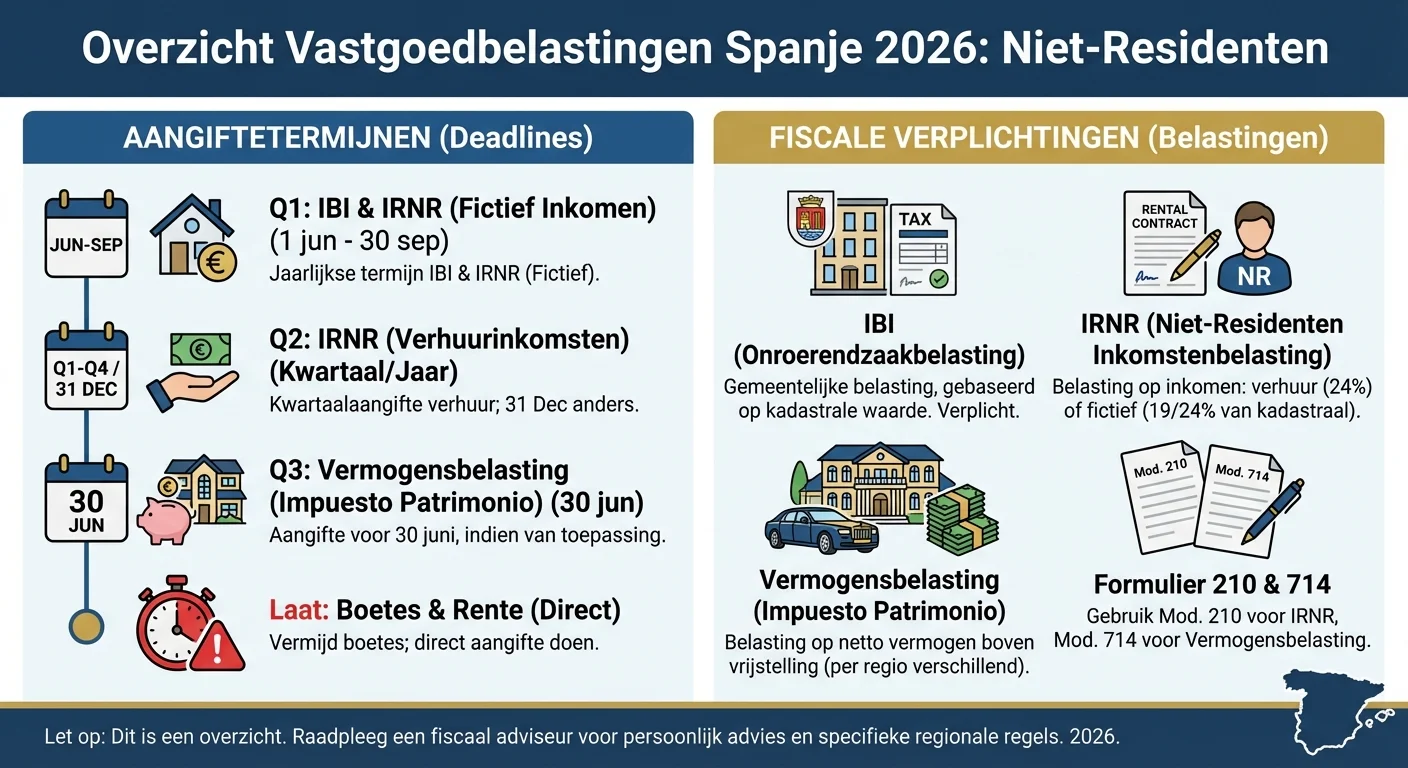
Property taxes in Spain 2026 also include non-residents tax (IRNR), a flat tax for owners who are not officially domiciled in Spain. This tax is calculated based on the property's cadastral income, even if you do not rent out the property.
Tax changes for non-residents and second residence owners
The Spanish tax authorities are making sweeping adjustments for the coming year that will have a direct impact on the wallets of Belgian owners. Those who own a holiday home without being domiciled there will face a revision of the flat-rate calculation method for non-residents' tax. Property taxes in Spain 2026 focus more strongly on the cadastral value of the property, with exemptions for certain renovations being more strictly controlled by local authorities. It is essential to collect tax certificates in time to avoid double taxation, as the exchange of data between the Belgian and Spanish tax authorities is increasingly smooth via digital platforms.
Impact on annual declaration for foreigners
For non-residents, the new regulations around Property taxes in Spain 2026 for owners That the filing deadlines are more strictly enforced. Failure to file the Model 210 on time can result in substantial penalties that are immediately payable when the property is sold.
New rules for real estate
The reform of the real estate and transfer taxes in Spain 2026 current trends points to a shift towards greener taxation where energy-efficient homes are rewarded with lower local rates.
Spain's Property Taxes 2026 also introduces an increased IBI tax for properties that are vacant for long periods in certain regions such as Andalusia and Costa Blanca. Municipalities will have more autonomy to determine these surcharges, which only increases the need for professional tax advice for Belgian investors.
Taxes are like gravity: you only really feel them when you underestimate them. Especially with a shift to “green taxation”, you need to think ahead rather than correct afterwards.
Keep the following points in mind for your file:
Professional tax advice: Before purchase, have a simulation made of total annual charges under the new regulations, including worst-case scenario (vacancy, revaluation, rising local rates).
Energy certificate (EPC / Certificado Energético): check the current rating and possible improvements. A higher energy rating can provide tax advantages as well as increase rental and sales values.
Vacancy charges: verify whether your property can be categorised as “long-term vacant” within the autonomous region concerned. Some municipalities apply additional surcharges on top of the standard IBI.
Regional differences: Property taxation in Spain is highly autonomously regulated. IBI rates, surcharges and exemptions vary by region as well as by municipality.
Cadastral value update (valor catastral): reforms may lead to revaluations. This affects not only IBI, but also wealth tax and capital gains tax.
Impact on rental strategy: higher charges on vacancy can make rentals (long-term or seasonal where allowed) more fiscally attractive.
Double tax position: Belgian (or Dutch/German/French) investors should consider how Spanish property taxes reflected in their domestic returns, taking into account double taxation treaties.
Company vs private purchase: tax reforms may increase the difference in net returns between private ownership and purchase through a company.
Value-added tax (Plusvalía & IRNR): on sale, adjusted valuation rules may affect the final tax burden.
How to prepare your Spanish tax return correctly
Collecting the right documentation in time is the first crucial step to ensure your tax obligations abroad run smoothly. For second residence owners, this means keeping accurate records of all utility bills, land registry details and proof of rental income. Property taxes in Spain 2026 require you to be proactive, taking into account both local municipal taxes and national income tax for non-residents. By creating a well-organised file now, you will avoid stress as the filing deadline approaches and ensure that you do not overlook any deductions.
Administrative accuracy and deadlines
Fiscal discipline is essential to avoid fines. Make sure you complete and submit the specific forms, such as the well-known Model 210, to the Agencia Tributaria on time.

When you decide to emigrate to Spain, your tax status changes profoundly. After all, you then become a resident, which has a major impact on how the Property taxes in Spain 2026 for residents be calculated. In practice, it is often advisable to engage a local gestor who knows the intricacies of regional legislation. Prepare property taxes in Spain 2026 with an expert can help you correctly navigate double taxation between Belgium and Spain through the existing treaties.
“Proper preparation of your tax file is the best investment you can make to enjoy your Spanish dream home carefree.”
Remember to check the following for your tax return:
- The current cadastral value (Valor Catastral) of your property.
- Proofs of IBI (property tax) paid to the municipality.
- Invoices of maintenance works that may be deductible when renting.
- Your personal NIE-number and that of any co-owners.
The rules around Real Estate Taxes in Spain 2026 may differ from one autonomous region to another, requiring extra attention to local decrees. Therefore, always stay well informed about the latest legislative changes.
In short, whoever the Property taxes in Spain 2026 filed on time, enjoy peace of mind and financial transparency.
It is crucial to anticipate the Real Estate Taxes in Spain 2026 in time to avoid unpleasant surprises.
Whether you own a holiday home or move permanently, the tax rules around IBI and wealth tax continue to evolve. Thorough preparation will help you optimise your returns and stay legally in full compliance with the Spanish tax authorities.
Want to make sure you do not overlook any tax changes for your Spanish property? Our local experts are ready to guide you through every step of your property journey. Contact us today for a tailored personalised consultation, so you can enjoy your investment under the sun with peace of mind without worrying about complex administration or unexpected taxes.
Frequently Asked Questions
What are the main changes for property taxes in Spain 2026?
In 2026, the Spanish government is focusing on stricter control of cadastral value and a possible adjustment of wealth tax for non-residents. It is crucial to consult the new rates in time to avoid surprises in your tax return.
How much is the IBI tax for a second stay in 2026?
The IBI, or municipal property tax, is calculated based on cadastral value and varies by municipality. For property taxes in Spain 2026, local governments are expected to index their rates slightly to keep up with inflation.
Why should I take into account the ‘Impuesto sobre la Renta de No Residentes’?
As a Belgian owner without domicile in Spain, you are obliged to pay this tax on the notional rental income. This remains an essential part of property taxes in Spain 2026 for anyone who owns a holiday home that is not rented out permanently.
When should tax returns for Spanish properties be filed?
The annual declaration for non-residents should usually be done before 31 December of the current year. For Spain 2026 property taxes, we recommend preparing your file as early as spring to avoid administrative penalties.
Service & Contact
Location: Alicante, Spain
Scope of work: Worldwide, Europe, Belgium, Netherlands, Germany, France
Services: Spain 2026 tax review, Optimisation of wealth tax, Non-residents tax return (IRNR), Inheritance planning Spanish patrimony, Tax structuring luxury real estate, Guidance on local transfer tax, Audit capital gains tax on sale