Een realistisch netto rendement op vakantieverhuur aan de Costa Blanca ligt tussen de 4% en 7% per jaar. Dat klinkt minder spectaculair dan de brutopercentages die u soms in advertenties ziet, maar het is wél het cijfer waarop u een gezonde investering bouwt. Het verschil tussen bruto en netto zit in de kosten die elke verhuurder onderschat: schoonmaak, beheer, comunidad, IBI, verzekering en platformkosten. Wie die posten eerlijk inrekent, een geldige verhuurvergunning regelt en op de juiste plek koopt, haalt aan deze kust een stabiel en aantrekkelijk rendement. In dit artikel leest u precies hoe u die rekensom maakt, ziet u uitgewerkte rekenvoorbeelden voor concrete woningprofielen, welke bezettingsgraad u per seizoen mag verwachten en in welke plaatsen aan de Costa Blanca het rendement het hoogst is.

De Costa Blanca trekt al decennia bezoekers uit België, Nederland, Duitsland en Frankrijk. Het milde klimaat, de ruim driehonderd zonnige dagen per jaar en de korte vliegtijd vanuit Noordwest-Europa maken deze kuststrook tot een van de meest betrouwbare verhuurmarkten van het Middellandse Zeegebied. Voor investeerders en kopers van een tweede verblijf betekent dat een combinatie die zeldzaam is: een woning die u zelf gebruikt én die, wanneer u er niet bent, voor inkomsten zorgt. Dit artikel richt zich specifiek op de Costa Blanca. Wilt u de algemene rekenmethode voor heel Spanje doornemen, lees dan ons artikel over het Calculate the return on a holiday home in Spain. Hier gaan we dieper in op de regio zelf, met cijfers die u direct op uw eigen plannen kunt toepassen.
Wat is een realistisch rendement op vakantieverhuur aan de Costa Blanca?
Laten we beginnen met het belangrijkste cijfer. Een goed beheerde vakantiewoning aan de Costa Blanca levert gemiddeld een netto huurrendement van 4 tot 7 procent per jaar op. Dat is het bedrag dat overblijft nadat u alle exploitatiekosten en belastingen van de brutohuur heeft afgetrokken, gedeeld door uw totale investering. Sommige woningen scoren hoger, bijvoorbeeld kleinere appartementen op toplocaties met een lage instapprijs, en sommige scoren lager, zoals exclusieve villa’s die vooral op waardestijging en eigen gebruik mikken. Het percentage is dus een richtcijfer, geen garantie.
Waarom is dit netto cijfer zo bepalend? Omdat de brutohuur misleidend kan zijn. Een woning die in het hoogseizoen €1.500 per week opbrengt, lijkt op papier een goudmijn. Maar van die brutohuur gaat een aanzienlijk deel af aan schoonmaak tussen gasten, het beheer van de boekingen, de bijdrage aan de vereniging van eigenaren (comunidad), de onroerendgoedbelasting (IBI), een opstalverzekering en de commissie die platforms als Airbnb of Booking.com inhouden. Pas wanneer u die posten allemaal van de brutohuur aftrekt, ziet u wat er werkelijk overblijft. Dat is het bedrag waarop u uw rendement moet baseren.
Wat het rendement uiteindelijk bepaalt, is een samenspel van drie factoren: de locatie van de woning, de bezettingsgraad die u over het hele jaar haalt en de strakheid waarmee u uw kosten beheerst. Een woning op tien minuten lopen van het strand, met airconditioning, een zwembad en een professionele listing, haalt structureel betere cijfers dan een vergelijkbare woning verder landinwaarts met een matige presentatie. In de volgende paragrafen werken we elk van deze elementen uit, en laten we aan de hand van concrete rekenvoorbeelden zien hoe de cijfers er in de praktijk uitzien.
Bruto versus netto: waarom het onderscheid alles bepaalt
Veel beginnende investeerders verwarren brutorendement met nettorendement, en dat leidt tot teleurstellingen. Het brutorendement is simpelweg uw jaarlijkse huuropbrengst gedeeld door de aankoopprijs. Dat cijfer ziet er aantrekkelijk uit en wordt graag in advertenties genoemd, maar het houdt geen rekening met de werkelijkheid van het verhuren. Het nettorendement daarentegen trekt eerst álle kosten af, inclusief de belasting en de kosten koper, voordat het wordt afgezet tegen uw totale investering. Het verschil tussen die twee getallen is vaak twee tot drie procentpunten, en juist die marge bepaalt of uw investering gezond is of niet. In dit artikel rekenen wij consequent met netto cijfers, want dat is het geld dat daadwerkelijk op uw rekening overblijft.
De rol van een geldige verhuurvergunning
Voordat we over cijfers praten, eerst een onmisbare voorwaarde: zonder geldige toeristische verhuurvergunning is rendement op vakantieverhuur aan de Costa Blanca simpelweg niet legaal. De regio Valencia, waar de Costa Blanca onder valt, heeft de regels de afgelopen jaren flink aangescherpt. Verhuurt u zonder licentie, dan riskeert u boetes die kunnen oplopen tot tienduizenden euro’s, en platforms verwijderen advertenties zonder geldig registratienummer. De vergunning is geen formaliteit, maar het fundament van uw verdienmodel.
Wij raden u aan de vergunningskwestie vóór de aankoop uit te zoeken, niet erna. Niet elke woning komt namelijk in aanmerking: de gemeente moet een verklaring van stedenbouwkundige verenigbaarheid afgeven en in veel gevallen moet ook de vereniging van eigenaren de toeristische verhuur toestaan. In ons uitgebreide artikel over de rental licence in Spain leest u stap voor stap hoe u dit regelt. Voor Belgen, Nederlanders, Duitsers en Fransen die op afstand investeren, is professionele begeleiding hierbij geen luxe maar een verstandige verzekering tegen kostbare missers. Een tijdige legal control of real estate in Spain stelt vast of uw beoogde woning daadwerkelijk vergunbaar is voordat u zich vastlegt.
Drie uitgewerkte rekenvoorbeelden voor de Costa Blanca
Cijfers spreken duidelijker dan algemene percentages. Daarom werken we hieronder drie concrete woningprofielen volledig uit, van brutohuur tot nettorendement. De bedragen zijn realistische richtcijfers voor de Costa Blanca; uw eigen woning kan hoger of lager uitvallen afhankelijk van de exacte locatie, de staat en de kwaliteit van het beheer. Het doel is dat u de méthode ziet, zodat u haar op elke woning kunt loslaten.
Profiel 1 – Appartement van €200.000 in Torrevieja
Stel: u koopt een tweekamerappartement op tien minuten lopen van het strand in Torrevieja voor €200.000. De kosten koper (ongeveer 12% bij bestaande bouw) bedragen €24.000, en u steekt €10.000 in inrichting en het in orde maken van de verhuurvergunning. Uw totale investering komt daarmee op €234.000.
De brutohuur bouwt u op per seizoen. In het hoogseizoen (10 weken juli en augustus) vraagt u gemiddeld €900 per week bij een bezetting van bijna 100%, goed voor circa €9.000. In het tussenseizoen (16 weken in voor- en najaar) vraagt u €500 per week bij 60% bezetting, ongeveer €4.800. In het laagseizoen verhuurt u twee maanden aan een overwinteraar tegen €750 per maand, oftewel €1.500. De totale brutohuur komt uit op circa €15.300 per jaar.
Nu de kosten. Beheer (20% van de huur): €3.060. Schoonmaak die u niet doorbelast en eigen coördinatie: €900. Comunidad: €1.200. IBI: €400. Verzekering: €350. Nutsvoorzieningen (deels voor uw rekening): €1.100. Platformcommissie (gemiddeld 15% over het deel dat via portals loopt): €1.700. Onderhoudsbuffer: €800. De totale kosten bedragen ongeveer €9.510, waardoor er €5.790 aan netto huurinkomen overblijft vóór belasting.
Over dat netto inkomen betaalt u als EU-resident 19% IRNR, ofwel circa €1.100. Er resteert dan ongeveer €4.690 netto per jaar. Gedeeld door uw totale investering van €234.000 komt u uit op een nettorendement van circa 2,0% uit pure verhuur. Telt u de te verwachten waardestijging mee, dan ligt het totale rendement hoger, maar dit voorbeeld laat zien hoe streng een eerlijke berekening is. Wie de bezetting in het laag- en tussenseizoen weet op te krikken naar het niveau van een topverhuurder, duwt het verhuurrendement richting de 3 tot 4%.
Profiel 2 – Appartement met zeezicht van €280.000 in Guardamar of Orihuela Costa
Een ruimer appartement met zeezicht en gemeenschappelijk zwembad op een toplocatie in Guardamar del Segura of Orihuela Costa koopt u voor €280.000. Met kosten koper (€33.600) en inrichting (€12.000) komt de totale investering op €325.600. Dankzij het zeezicht en het zwembad ligt de brutohuur hoger: €1.300 per week in het hoogseizoen (10 weken, €13.000), €650 per week in het tussenseizoen bij 65% bezetting (16 weken, circa €6.760) en in het laagseizoen drie maanden overwinteraars tegen €850 per maand (€2.550). De brutohuur bedraagt circa €22.310.
De kosten: beheer 18% (€4.016), schoonmaak/coördinatie €1.200, comunidad €1.500, IBI €560, verzekering €420, nutsvoorzieningen €1.300, platformcommissie €2.200 en onderhoudsbuffer €1.000. Samen €12.196 aan kosten, waardoor €10.114 netto vóór belasting overblijft. Na 19% IRNR (circa €1.922) resteert ongeveer €8.190 netto. Gedeeld door €325.600 levert dat een verhuurrendement van circa 2,5% op, met duidelijk opwaarts potentieel naar 3,5 à 4% bij hogere bezetting en scherpere prijsstelling. Dit profiel combineert een redelijk verhuurrendement met een sterkere waardevastheid dankzij het schaarse zeezicht.
Profiel 3 – Villa met privézwembad van €450.000 in Calpe of Altea
Aan de top van de markt koopt u een villa met privézwembad en zeezicht in Calpe of Altea voor €450.000. Inclusief kosten koper (€54.000) en inrichting (€20.000) bedraagt uw investering €524.000. Een villa met eigen zwembad rechtvaardigt forse weekprijzen in het hoogseizoen: €2.800 per week gedurende 10 weken (€28.000). In het tussenseizoen €1.400 per week bij 55% bezetting over 16 weken (circa €12.320), en in het laagseizoen twee maanden verhuur aan een welgestelde overwinteraar of een gezin op werkbasis tegen €1.800 per maand (€3.600). De brutohuur komt uit op circa €43.920.
De kosten van een villa liggen hoger door het eigen zwembad, de tuin en het grotere oppervlak. Beheer 20% (€8.784), schoonmaak/coördinatie €2.400, comunidad of urbanisatiebijdrage €1.000, IBI €900, verzekering €700, nutsvoorzieningen inclusief poolonderhoud en tuinman €4.500, platformcommissie €4.000 en onderhoudsbuffer €2.500. De totale kosten bedragen circa €24.784, waardoor €19.136 netto vóór belasting resteert. Na 19% IRNR (circa €3.636) houdt u ongeveer €15.500 netto over. Gedeeld door €524.000 is dat een verhuurrendement van circa 3,0%. Bij een villa weegt de waardestijging zwaarder mee in het totaalplaatje, en wie de zomerweken volledig boekt tegen topprijzen tilt het verhuurrendement richting 4%. Dit profiel kiest u vooral wanneer u eigen gebruik en waardevastheid combineert met een gezonde huurstroom.
Deze drie voorbeelden maken één ding duidelijk: het pure verhuurrendement valt strenger uit dan de brutopercentages doen vermoeden, en juist de bezetting buiten het hoogseizoen maakt het verschil. Wilt u een eigen berekening maken inclusief alle aankoopkosten, gebruik dan onze tool voor kosten koper in Spanje en lees de uitgebreide methode in ons artikel over het Calculating the return on a holiday home.
De beste locaties voor een hoog verhuurrendement
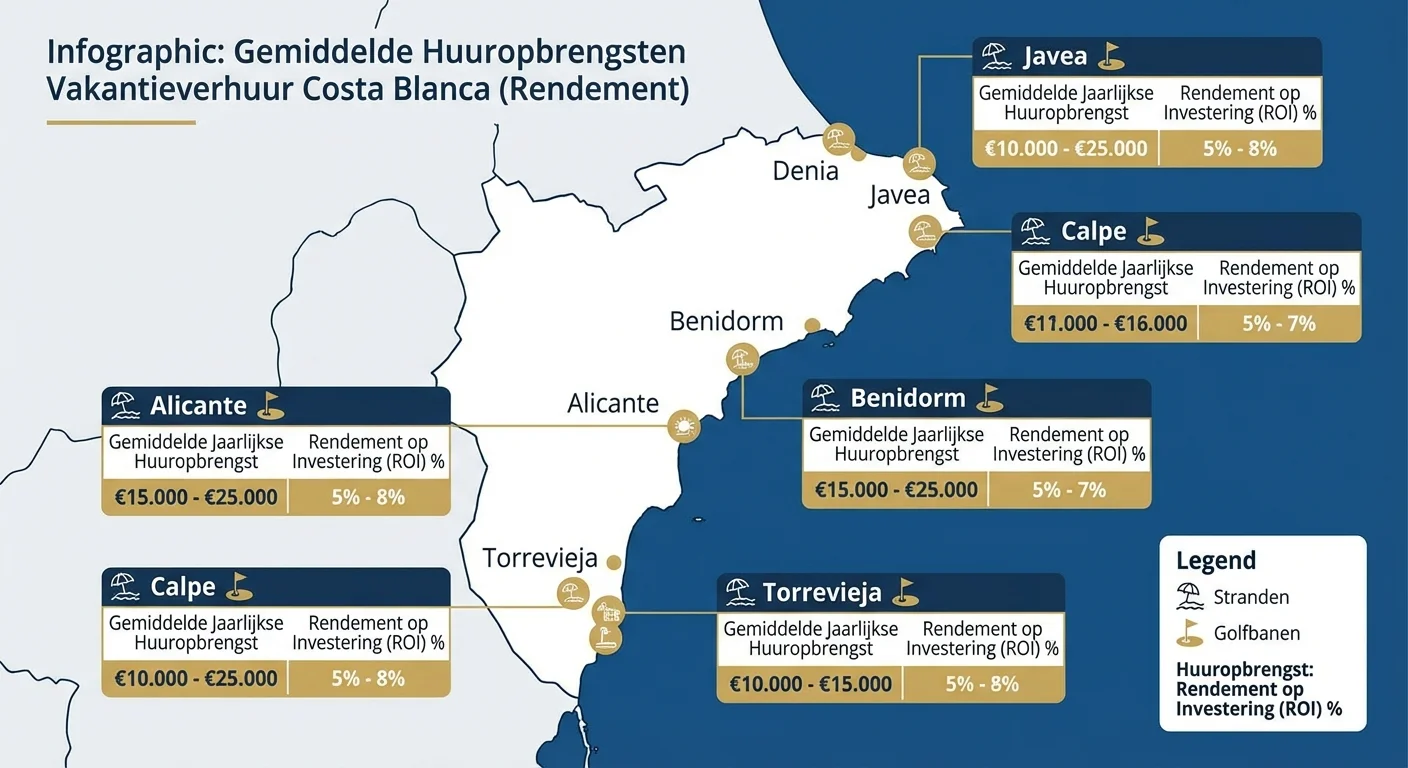
De Costa Blanca is geen homogene markt. Ruwweg valt de kust uiteen in twee karakters: de Costa Blanca Noord, met haar exclusievere uitstraling en hogere prijzen, en de Costa Blanca Zuid, die toegankelijker is en sneller terugverdient. Beide bieden kansen, maar voor een ander type investeerder. Welke regio het hoogste rendement geeft, hangt af van uw budget, uw risicobereidheid en de balans die u zoekt tussen huurinkomsten en waardestijging. Hieronder bespreken we de belangrijkste plaatsen afzonderlijk, met hun specifieke verhuurprofiel.
Torrevieja: volume en de snelste terugverdientijd
Torrevieja is een klassieker onder investeerders. De stad combineert betaalbare appartementen met een groot, internationaal toeristenpubliek dat door de zoutmeren, de stranden en het levendige centrum wordt aangetrokken. Door de relatief lage instapprijzen valt het brutorendement hier vaak hoger uit dan in het noorden, en is dit de plek bij uitstek voor wie zijn eerste investering doet of het rendement snel wil zien. Het verhuurprofiel is breed: gezinnen, stellen, overwinteraars en het hele jaar door een gestage stroom Noord-Europese gasten. Een tweekamerappartement op loopafstand van het strand vindt hier vrijwel het hele jaar huurders, wat de bezetting in de schoudermaanden gezond houdt.
Orihuela Costa: golf, gezinnen en jaarrond vraag
Orihuela Costa, met deelgebieden als Playa Flamenca, La Zenia, Cabo Roig en Villamartín, is sterk in trek bij gezinnen en golfers. De nabijheid van de luchthaven van Alicante, op ongeveer drie kwartier rijden, maakt last-minute weekendboekingen mogelijk en houdt de bezetting in de schoudermaanden op peil. De talrijke golfbanen trekken een koopkrachtig publiek dat ook buiten het hoogseizoen boekt, wat dit gebied geschikt maakt voor verhuurders die de winterleegstand willen beperken. Het commerciële hart rond La Zenia Boulevard, het grootste winkelcentrum van de regio, voegt een aantrekkingskracht toe die los staat van het seizoen.
Guardamar del Segura: brede stranden en pijnboombossen
Guardamar del Segura ligt tussen Torrevieja en de monding van de Segura en onderscheidt zich door kilometers brede zandstranden en uitgestrekte pijnboombossen die de kust beschermen. De plaats heeft een authentieker, minder verstedelijkt karakter dan haar buurgemeenten en spreekt gasten aan die rust en natuur zoeken zonder de levendigheid van een badplaats op te geven. Voor investeerders biedt Guardamar een interessante middenweg: instapprijzen die dicht bij die van Torrevieja liggen, maar met een groener imago dat langere boekingen en herhaalgasten aantrekt. Het verhuurseizoen profiteert van de gezinnen die de ruime, veilige stranden waarderen.
Calpe: zeezicht onder de Peñón de Ifach
In het noorden draait het rendement om een andere kracht: stabiliteit en kwaliteit. Calpe, met de iconische Peñón de Ifach, trekt bezoekers die bereid zijn meer te betalen voor zeezicht en sfeer. De stad heeft een levendige boulevard, een vissershaven en een hoogseizoen waarin appartementen en villa’s met uitzicht op de rots premiumprijzen halen. Het verhuurprofiel is gemengd: gezinnen en stellen in de zomer, en in toenemende mate overwinteraars en thuiswerkers die de zachte winters en de goede voorzieningen weten te vinden. Calpe combineert een sterk verhuurseizoen met een waardevaste markt door de schaarste aan bouwgrond rond de baai.
Altea: charme, kunst en de exclusievere gast
Altea, met zijn witte oude stad, de blauwe koepel van de kerk en zijn kunstzinnige uitstraling, behoort tot de meest gewilde plaatsen voor wie een luxere gast wil bedienen. De weekprijzen liggen hoger dan in het zuiden, de woningen behouden hun waarde uitstekend en de gasten zijn doorgaans koopkrachtiger en respectvoller met de woning. Het verhuurprofiel leunt naar stellen, kunstliefhebbers en welgestelde gezinnen die kwaliteit boven prijs stellen. Altea is geen plek voor maximale bezetting tegen lage prijzen, maar voor een hoger dagtarief bij een selectiever publiek, wat het netto rendement op een aantrekkelijk niveau houdt zonder de woning af te jakkeren.
Dénia: haven, gastronomie en een lang seizoen
Dénia, met zijn haven, kasteel en gastronomische reputatie als UNESCO Creative City of Gastronomy, trekt een publiek dat het hele jaar door komt. De veerverbinding met Ibiza en Mallorca, de bruisende markt en de mix van stadsstranden en rustigere baaien aan de Las Rotas-kust geven Dénia een breed verhuurprofiel. Hier vindt u zowel gezinnen die het strand zoeken als culinaire toeristen en overwinteraars die de voorzieningen van een echte stad waarderen. Het langere seizoen en de constante vraag maken Dénia tot een van de stabielere verhuurmarkten van de Costa Blanca Noord.
Jávea en Moraira: exclusiviteit en privévilla’s
Jávea (Xàbia) en Moraira vormen de exclusieve top van de Costa Blanca Noord. Jávea, met zijn drie gezichten (de oude stad, de haven en de Arenal-baai), trekt een internationaal, welgesteld publiek dat graag privévilla’s met zwembad en zeezicht huurt. Moraira, kleiner en chiquer, staat bekend om zijn ingetogen luxe, zijn jachthaven en zijn villa’s verscholen in groene heuvels. Een villa met privézwembad en zeezicht kan hier in juli en augustus weekprijzen vragen die in het zuiden ondenkbaar zijn. Het verhuurprofiel is dat van de kwaliteitsgast: langere boekingen, hogere dagtarieven en een woning die haar waarde uitstekend vasthoudt. Voor investeerders die waardevastheid en een exclusievere gast belangrijker vinden dan maximale bezetting, zijn Jávea en Moraira vaak de betere keuze. Wie de absolute top van de markt zoekt, kijkt soms zelfs verder naar Ibiza, waar de rendementen per nacht de hoogste van heel Spanje zijn.
Wilt u breder kijken naar waar de cijfers het sterkst zijn? Bekijk dan ons overzicht van de best regions for property investment in Spanje, of laat u begeleiden door onze estate agent on the Costa Blanca bij de keuze van de plaats die past bij uw doel.
Belangrijke factoren bij uw locatiekeuze
Binnen elke gemeente bepaalt de micro-locatie een groot deel van uw rendement. Twee appartementen in dezelfde plaats kunnen tientallen procenten in opbrengst verschillen, puur door waar ze precies staan. De volgende factoren wegen het zwaarst voor de gast die uw woning boekt, en dus voor uw bezettingsgraad en de prijs die u kunt vragen.
- Afstand tot het strand: woningen op vijf tot vijftien minuten lopen van het water verhuren aanzienlijk beter dan woningen waar de gast voor moet rijden. “Loopafstand strand” is een van de krachtigste verkoopargumenten in een listing.
- Voorzieningen in de buurt: supermarkten, restaurants, een gezellige boulevard en een levendig centrum verhogen het comfort van de gast en daarmee de waardering en de herhaalboekingen.
- Nabijheid van de luchthaven: de luchthavens van Alicante en, voor het zuiden, Murcia-Corvera bepalen hoe makkelijk gasten uit België, Nederland, Duitsland en Frankrijk u kunnen bereiken. Korte transfertijden vergroten het aantal mogelijke boekingen.
- Golfbanen en attracties: in gebieden als Orihuela Costa trekt de nabijheid van golfbanen een koopkrachtig, jaarrond publiek dat ook buiten het hoogseizoen boekt.
- Uitzicht en zonligging: een terras met zeezicht en de juiste oriëntatie op de zon maakt een meetbaar verschil in de prijs die u kunt vragen.
- Common facilities: een goed onderhouden gemeenschappelijk zwembad, tuin en parkeergelegenheid zijn vaak doorslaggevend bij de keuze van een gezin.
Houd er rekening mee dat de vereniging van eigenaren regels kan stellen aan toeristische verhuur. Controleer dit altijd vóór aankoop. Een degelijke legal control of real estate in Spain brengt deze beperkingen aan het licht voordat u tekent, zodat u niet voor verrassingen komt te staan.
Bezettingsgraad per seizoen aan de Costa Blanca
Uw rendement staat of valt met de bezettingsgraad: het percentage van het jaar dat uw woning daadwerkelijk verhuurd is. Aan de Costa Blanca verloopt die bezetting in duidelijke seizoenen, en wie elk seizoen slim invult, tilt zijn jaaropbrengst aanzienlijk omhoog. Een woning die alleen in juli en augustus draait, haalt nooit hetzelfde rendement als een woning die ook in het voor- en naseizoen en zelfs ‘s winters huurders vindt. Hieronder werken we elk seizoen apart uit.

Hoogseizoen (juli en augustus): maximale prijzen, maximale vraag
In het hoogseizoen draait de markt op volle toeren. Hier vraagt u uw maximale weekprijzen en haalt u bij een goede listing een bezetting die de honderd procent benadert. Dit is de periode waarin het grootste deel van uw jaaromzet wordt gerealiseerd: voor de meeste woningen komt 40 tot 55% van de totale jaarhuur uit deze twee maanden. Gasten zijn vooral gezinnen met schoolgaande kinderen en stellen die hun zomervakantie aan zee doorbrengen. Boek vroeg open, hanteer een minimaal verblijf van een week en maak het verschil met een verzorgd terras en airconditioning, want in deze maanden bepaalt comfort de reviews.
Schouderseizoen (april–juni en september–oktober): de winst zit in de marge
In het tussenseizoen of schouderseizoen blijft de Costa Blanca aantrekkelijk door het milde klimaat; de bezetting zakt naar grofweg 50 tot 70% en de prijzen liggen 30 tot 40% lager dan in het hoogseizoen, maar dit zijn waardevolle weken die uw jaarrekening flink versterken. Veel Noord-Europese gasten verkiezen juist deze zachtere maanden boven de drukke zomerhitte: paas- en meivakanties, wandelaars, fietsers, golfers en oudere stellen die de rust waarderen. Wie het schouderseizoen actief bespeelt met scherpe prijzen en gerichte advertenties, verdient hier het verschil tussen een gemiddeld en een sterk jaarrendement.
Laagseizoen (november–maart): overwinteraars en digital nomads
Het echte verschil tussen een gemiddelde en een uitstekende verhuurder maakt u in het laagseizoen. Terwijl veel woningen dan leegstaan, kunt u zich richten op twee groeiende segmenten. De eerste zijn de overwinteraars: Noord-Europese gepensioneerden die de Spaanse winterzon verkiezen boven het grijze noorden en die doorgaans één tot drie maanden aaneengesloten boeken tegen een lagere nachtprijs, maar met een stabiele, voorspelbare bezetting en minimale wisselkosten. De tweede groep zijn de digital nomads en remote workers: thuiswerkers die enkele weken tot maanden op een zonnige plek werken en die snelle wifi, een goede werkplek en comfortabel meubilair verlangen.
Om deze segmenten te bedienen, moet uw woning winterklaar zijn: goede verwarming, een snelle en betrouwbare wifi voor wie thuiswerkt, en comfortabele meubels voor langer verblijf. Een woning die het laagseizoen weet te vullen met overwinteraars en thuiswerkers, haalt al snel twintig tot dertig extra bezettingsweken per jaar binnen, en dat tilt het netto rendement merkbaar omhoog. De factoren die de bezetting jaarrond beïnvloeden zijn vooral de micro-locatie, de kwaliteit van uw fotografie en advertentie, de hoeveelheid en kwaliteit van uw reviews, en een scherpe maar realistische prijspositionering. Goede recensies werken als een sneeuwbaleffect: hoe meer tevreden gasten, hoe hoger u in de zoekresultaten verschijnt en hoe meer u kunt vragen.
Kostenoverzicht: van brutohuur naar nettorendement
Dit is het hart van een eerlijke rekensom. Veel beginnende verhuurders kijken alleen naar de brutohuur en raken later teleurgesteld als blijkt hoeveel er van afgaat. Wie vooraf elke kostenpost in kaart brengt, koopt met realistische verwachtingen en komt achteraf niet voor onaangename verrassingen te staan. Hieronder werken we elke post afzonderlijk uit, zodat u precies weet wat u van de brutohuur moet aftrekken om tot uw netto inkomsten te komen.
Beheer en verhuurkantoor (15–25%)
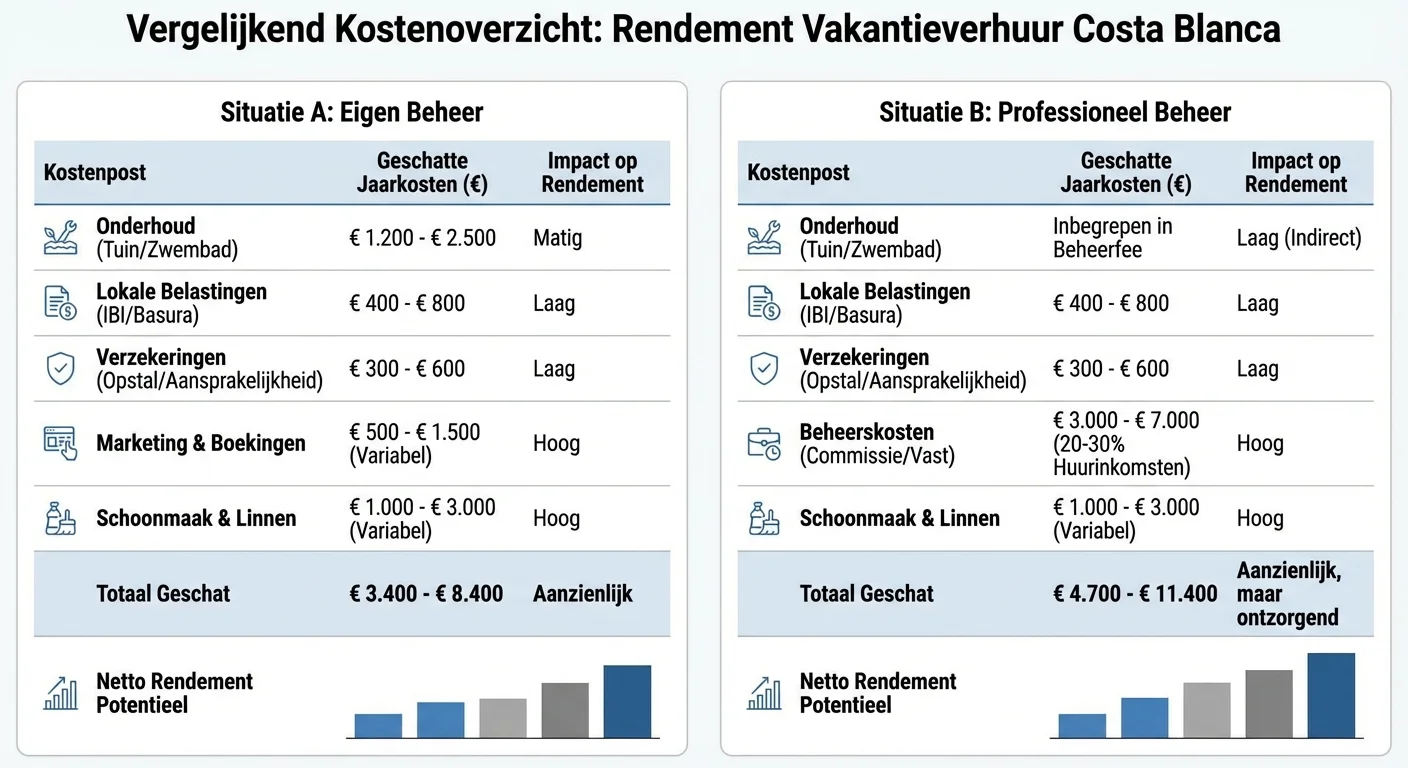
Een professioneel beheer- of verhuurkantoor rekent doorgaans 15% tot 25% van de huursom. Daarvoor regelen zij de boekingen, de communicatie met gasten, de check-in en check-out, het sleutelbeheer en het toezicht op de woning. Voor wie op afstand investeert, is deze post zelden te vermijden, maar hij verdient zichzelf vaak terug: een goed kantoor haalt een hogere bezetting, betere reviews en minder leegstand dan u op afstand zelf zou bereiken. Let bij de keuze op de exacte commissie, of platformkosten al inbegrepen zijn en welke diensten precies onder het tarief vallen.
Schoonmaak
Tussen elke gast moet de woning grondig schoongemaakt en klaargemaakt worden. Bij korte verblijven in het hoogseizoen kan dit een substantiële, terugkerende kostenpost zijn, omdat u soms wekelijks of vaker een volledige wisselbeurt heeft. Vaak rekent u de schoonmaakkosten door aan de gast als aparte post in de boeking, maar de coördinatie, de kwaliteitscontrole en eventuele extra beurten horen bij uw exploitatie. Een vlekkeloze schoonmaak is bovendien direct gekoppeld aan uw reviews, dus hier bezuinigen kost u op termijn boekingen.
Comunidad (vereniging van eigenaren)
De comunidad is de maandelijkse of jaarlijkse bijdrage voor het onderhoud van het gemeenschappelijk zwembad, de tuin, de lift, de gevels en de gemeenschappelijke ruimtes. Reken op enkele honderden tot meer dan duizend euro per jaar, afhankelijk van de faciliteiten van het complex. Een resort met groot zwembad, tuinen en bewaking kost meer dan een klein gebouw zonder voorzieningen. Vraag vóór aankoop altijd de actuele comunidad-bijdrage op, want deze drukt rechtstreeks op uw nettorendement.
IBI (onroerendgoedbelasting)
De IBI is de gemeentelijke vastgoedbelasting en bedraagt ruwweg €200 per €100.000 woningwaarde per jaar, afhankelijk van de gemeente en de kadastrale waarde. Voor een appartement van €200.000 betaalt u dus grofweg €400 per jaar, voor een villa van €450.000 ongeveer €900. Dit is een vaste, voorspelbare last die u eenvoudig in uw begroting opneemt.
Verzekering
Een opstal- en inboedelverzekering is onmisbaar, idealiter met dekking voor verhuur en aansprakelijkheid jegens gasten. Een standaard woonverzekering dekt toeristische verhuur niet altijd, dus controleer de polisvoorwaarden of kies bewust voor een verhuurdekking. Reken op enkele honderden euro’s per jaar, afhankelijk van de waarde en de dekking.
Utilities
Water, elektriciteit en internet vormen samen een terugkerende kostenpost, met in de zomer een hogere rekening door de airconditioning. Bij een villa met privézwembad komen daar het poolonderhoud en vaak een tuinman bij, wat deze post fors verhoogt. Een deel van het verbruik belast u soms door aan de gast, maar de vaste abonnementen en het basisverbruik blijven voor uw rekening.
Platformcommissies
Airbnb, Booking.com en vergelijkbare portals houden een commissie in, doorgaans een percentage per boeking dat varieert van enkele procenten tot meer dan vijftien procent, afhankelijk van het platform en het model. Reken hier structureel mee, en spreid uw woning over meerdere kanalen om afhankelijkheid van één platform te beperken en de bezetting te maximaliseren.
Onderhoud en reserveringen
Reserveer jaarlijks een buffer voor reparaties, vervanging van versleten meubels en kleine renovaties. Een verouderd interieur leidt tot mindere reviews en lagere boekingen, dus zie deze post niet als verlies maar als investering in uw bezetting. Een vuistregel is om jaarlijks een vast bedrag opzij te zetten zodat u niet voor onverwachte kosten komt te staan wanneer de wasmachine of de airco het begeeft midden in het hoogseizoen.
Wanneer u al deze posten van de brutohuur aftrekt, blijft uw netto huurinkomen over. Deelt u dat door uw totale investering, inclusief de buyer's costs in Spain die doorgaans 10 tot 15% bovenop de aankoopprijs komen, dan heeft u uw werkelijke nettorendement. Dat is de rekensom die telt, precies zoals in de drie rekenvoorbeelden hierboven.
Belasting op huurinkomsten: IRNR en Modelo 210
Een veelgemaakte misvatting onder buitenlandse eigenaren is dat zij hun huurinkomsten alleen in hun thuisland hoeven aan te geven. Dat klopt niet. Spanje heeft het eerste heffingsrecht op inkomsten uit een Spaanse woning, en de Spaanse fiscus belast de huurinkomsten van niet-residenten via de IRNR (Impuesto sobre la Renta de no Residentes). Wie dit nalaat, riskeert naheffingen en boetes. Een correcte fiscale aangifte is dus een vast onderdeel van uw exploitatie.

De tarieven: 19% voor EU/EER, 24% daarbuiten
Het tarief dat u betaalt, hangt af van waar u woont. Bent u resident van een EU- of EER-land, zoals België, Nederland, Duitsland of Frankrijk, dan betaalt u 19% IRNR over uw netto huurinkomsten en mag u de exploitatiekosten aftrekken. Woont u buiten de EU/EER, dan geldt een tarief van 24% over de brutohuur, zonder aftrek van kosten. Voor de meeste lezers uit Noordwest-Europa is dus het gunstigere EU-tarief van toepassing, met aftrekbare kosten, wat de effectieve belastingdruk aanzienlijk verlaagt.
De aangifte gebeurt met het formulier Model 210. Niet-residenten die verhuren, doen deze aangifte periodiek, in de praktijk per kwartaal wanneer er huurinkomsten zijn. Als EU-resident mag u kosten als beheer, schoonmaak, nutsvoorzieningen, verzekeringen en hypotheekrente naar evenredigheid aftrekken, mits u de Spaanse facturen en bonnen bewaart. Een goede administratie is hier letterlijk geld waard. Laat u bijstaan door een gestor of fiscalist die de Modelo 210 voor u verzorgt; dat voorkomt fouten en kost minder dan u denkt.
Een rekenvoorbeeld van de IRNR
Neem het appartement uit Profiel 1, dat €15.300 brutohuur opbracht. Na aftrek van €9.510 aan exploitatiekosten resteert €5.790 netto huurinkomen. Als EU-resident berekent u de IRNR over dit netto bedrag wanneer de kosten naar evenredigheid van de verhuurde dagen aftrekbaar zijn: 19% van €5.790 is afgerond €1.100 belasting per jaar. Was u géén EU-resident geweest, dan had u 24% over de brutohuur van €15.300 betaald, ofwel ruim €3.670, zonder enige aftrek. Het verschil van meer dan €2.500 per jaar laat zien hoe belangrijk uw fiscale woonplaats en een correcte aangifte zijn voor uw uiteindelijke rendement.
Andere fiscale verplichtingen om rekening mee te houden
Naast de belasting op uw huurinkomsten zijn er nog enkele fiscale aspecten. Voor de perioden dat u de woning niet verhuurt en zelf gebruikt, kent Spanje een forfaitaire belasting op eigen gebruik, de zogenoemde imputación de rentas: 19% over 1,1% van de kadastrale waarde (bij een recent, binnen tien jaar herziene waarde) of over 2% daarvan wanneer de waarde ouder is. Verder kan er, afhankelijk van de waarde van uw bezittingen, vermogensbelasting verschuldigd zijn; de drempel ligt rond de €700.000 netto per persoon, al varieert dit per regio. Een volledig overzicht van uw verplichtingen vindt u in ons artikel over de Taxes for property investors in Spain en in ons overzicht van de Property taxes in Spain for 2026.
Tot slot een praktische verplichting die veel verhuurders vergeten: u bent wettelijk verplicht om de identiteitsgegevens van uw gasten te registreren en binnen 24 uur te melden bij de Guardia Civil of de Policía Nacional. Een professioneel beheerkantoor neemt deze meldplicht voor u over en zorgt dat u altijd binnen de regels blijft.
Hoe u uw rendement op vakantieverhuur maximaliseert
Met een geldige vergunning, de juiste locatie en een eerlijke kostenbegroting heeft u de basis op orde. Het verschil tussen een gemiddeld en een uitstekend rendement zit vervolgens in de uitvoering: presentatie, prijsstrategie en gastvrijheid. Hieronder de hefbomen die uw netto inkomsten het sterkst beïnvloeden.
- Professionele fotografie en een sterke listing: de eerste foto bepaalt of een gast doorklikt. Investeer in vakkundige fotografie en een aantrekkelijke, eerlijke beschrijving die de sterke punten van uw woning en locatie benadrukt. Goede foto’s met natuurlijk licht en een opgeruimd interieur verhogen de doorklikratio aantoonbaar.
- Een verzorgd, sfeervol interieur: een smaakvol ingericht en goed onderhouden interieur rechtvaardigt een hogere prijs en levert betere reviews op. Investeer in comfortabele bedden, voldoende serviesgoed, een goed uitgeruste keuken en kleine accenten die de woning warm en compleet maken.
- Dynamische prijsstelling: pas uw prijzen aan op vraag, seizoen, lokale evenementen en het boekingsritme. Slimme prijsalgoritmes halen meer uit elke periode dan een vaste prijs het hele jaar door.
- Snelle reactie op aanvragen: wie binnen enkele minuten tot een uur reageert, wint meer boekingen. Snelheid is een directe omzetfactor en weegt mee in de ranking van de platforms.
- Uitstekende reviews verzamelen: tevreden gasten leiden tot hogere posities in de zoekresultaten en rechtvaardigen hogere prijzen. Een vlekkeloze schoonmaak, een soepele check-in en kleine attenties betalen zich terug in waarderingen.
- Langere boekingen stimuleren: bied korting voor verblijven van een week of een maand om de bezetting in de schoudermaanden en het laagseizoen te verhogen. Langere boekingen drukken bovendien uw schoonmaak- en wisselkosten per nacht.
- Multi-channel verhuur: adverteer niet alleen op één platform maar spreid uw woning over meerdere kanalen om de bezetting te maximaliseren. Channel management voorkomt dubbele boekingen.
- Comfort dat eruit springt: airconditioning, snelle wifi, een goed uitgerust terras en een verzorgd interieur zijn voor de moderne gast geen luxe maar verwachting.
Veel van deze taken vragen tijd, lokale aanwezigheid en kennis van de markt. Voor eigenaren die op afstand investeren, is professioneel vastgoedverhuur en beheer in Spanje daarom geen kostenpost maar een rendementsverhoger. Een goed beheerkantoor verdient zijn commissie ruimschoots terug door een hogere bezetting, betere reviews en minder leegstand.
De impact van professioneel beheer op uw netto inkomsten
De keuze tussen zelf beheren of uitbesteden is een van de meest onderschatte beslissingen voor uw rendement. Wie honderden kilometers verderop woont, kan onmogelijk zelf de check-ins doen, de schoonmaak coördineren, op spoedgevallen reageren en de prijzen dagelijks bijsturen. Een professionele partner neemt dat over en zorgt voor de continuïteit en kwaliteit die hoge waarderingen opleveren.
Wat goed beheer concreet oplevert
- Hogere bezetting: door multi-channel verhuur, dynamische prijzen en snelle reacties stijgt het aantal verhuurde nachten.
- Betere reviews: consistente schoonmaakstandaarden en een vlotte check-in leiden tot tevreden gasten en hogere posities in de zoekresultaten.
- Minder zorgen en risico: de meldplicht bij de autoriteiten, het onderhoud en de gastcommunicatie worden voor u geregeld, ook wanneer u zelf niet in Spanje bent.
- Kostenbeheersing: structureel onderhoud voorkomt dure reparaties, en lokale kennis houdt u op de hoogte van veranderende regels en toeristenbelastingen.
- Sleutelbeheer: een betrouwbare partner voor sleutels, sleutelmomenten en het toezicht op uw woning tussen verhuringen door.
Naast verhuurbeheer is ook het onderhoud van de woning zelf cruciaal voor het behoud van uw rendement. Ons Maintenance and key management in Spain zorgt ervoor dat uw woning altijd in topconditie verkeert, of u nu zelf komt of een gast ontvangt. Meer over de voordelen leest u in ons artikel over professional key management in Spain.
Vakantieverhuur versus langetermijnverhuur
Een terechte vraag bij elke investering aan de Costa Blanca: kies ik voor kortlopende vakantieverhuur of voor een vast jaarcontract? Beide hebben hun plaats, en de juiste keuze hangt af van uw doelen, uw locatie en de mate waarin u de woning zelf wilt gebruiken.
De financiële afweging
Vakantieverhuur levert per nacht doorgaans twee tot drie keer meer op dan een vast jaarcontract. Daar staat tegenover dat de kosten en de inspanning hoger liggen: vaker schoonmaken, meer check-ins, hogere beheerkosten en een bezetting die per seizoen schommelt. Langetermijnverhuur geeft een lagere maar zeer stabiele opbrengst, met minder werk en minder kosten, maar u kunt de woning dan niet zelf gebruiken en bent gebonden aan de huurder.
Voor de meeste kopers van een tweede verblijf aan de Costa Blanca is vakantieverhuur de aantrekkelijkste optie: u behoudt de flexibiliteit om de woning zelf te gebruiken in de perioden die u kiest, het wanbetalingsrisico is nihil omdat gasten vooraf betalen, en het netto rendement ligt bij goed beheer hoger. Wie maximale rust en zekerheid zoekt en de woning niet zelf nodig heeft, kan juist baat hebben bij een vast contract. Onze adviseurs helpen u graag de afweging te maken die past bij uw situatie. Voor de bredere strategische overwegingen rond investeren is ons artikel over investeren in Spanje voor een tweede verblijf met rendement een waardevolle aanvulling.
Hoe u zelf een goede rekensom maakt
Tot slot het belangrijkste praktische advies: maak vóór elke aankoop een eerlijke berekening op papier. Een goede rekensom volgt steeds dezelfde stappen, en wie ze nauwgezet doorloopt, koopt met open ogen.
- Stap 1 – Totale investering: tel bij de aankoopprijs de kosten koper op (10 tot 15%), eventuele inrichting en de vergunningskosten. Dit is uw basis.
- Stap 2 – Verwachte brutohuur: schat realistisch in op basis van de seizoenen. Reken hoogseizoen, schouderseizoen en laagseizoen apart door met haalbare bezettingspercentages, niet met een optimistisch jaargemiddelde.
- Stap 3 – Trek alle exploitatiekosten af: schoonmaak, beheer (15–25%), comunidad, IBI, verzekering, platformkosten, nutsvoorzieningen en een onderhoudsbuffer.
- Stap 4 – Trek de belasting af: 19% IRNR over uw netto inkomsten (als EU-resident, met aftrekbare kosten), aan te geven via Modelo 210.
- Stap 5 – Bereken het rendement: deel uw netto jaarinkomen door uw totale investering. Komt u uit tussen 4 en 7% inclusief waardeontwikkeling, dan zit u op een realistisch en gezond niveau voor de Costa Blanca.
Wilt u deze berekening niet helemaal zelf maken? Gebruik dan onze handige tool en lees de uitgebreide methode in ons artikel over het Calculate the return on a holiday home in Spain. Wie de stap naar een gerichte aankoop wil zetten, kan terecht bij onze pagina om searching for property in Spain dat past bij uw verhuurdoel.
Toekomstverwachtingen voor de Costa Blanca
De vooruitzichten voor vakantieverhuur aan de Costa Blanca blijven gunstig. De groeiende groep digitale nomaden, de aanhoudende stroom Noord-Europese toeristen en de schaarste aan nieuwbouw op de beste locaties ondersteunen zowel de huurprijzen als de waardeontwikkeling van uw woning. Investeringen in de infrastructuur rond Alicante en Valencia maken de regio nog beter bereikbaar, en de toenemende interesse van thuiswerkers verlengt het verhuurseizoen tot ver buiten de zomer.
Tegelijk professionaliseert de markt. Gasten verwachten steeds meer een hotelwaardige ervaring: smart-home-comfort, duurzaamheid en een vlekkeloze service. Wie hierop inspeelt met een goed onderhouden, energiezuinige woning en professioneel beheer, onderscheidt zich en houdt de bezetting op peil, ook als het aanbod groeit. De verhuurder die kwaliteit levert, wint. Meer over de marktrichting leest u in ons overzicht van de Property trends in Spain for 2026.
How we can help you
Bij Investeer in Spanje, onderdeel van Luxe Vastgoed Groep, begeleiden wij dagelijks kopers en investeerders uit België, Nederland, Duitsland en Frankrijk bij het opbouwen van een renderende vakantiewoning aan de Costa Blanca. Ons team staat onder leiding van vastgoedexpert en CEO Kenzo Fayot en combineert lokale marktkennis met een eerlijke, cijfermatige aanpak. Wij helpen u de juiste woning op de juiste plek te vinden, de verhuurvergunning te regelen, de juridische en fiscale kant waterdicht te maken en het beheer uit handen te nemen.
Of u nu op zoek bent naar een appartement in Torrevieja, een woning met zeezicht in Guardamar of Orihuela Costa, of een villa in Calpe, Altea, Jávea of Moraira: wij denken met u mee vanaf de eerste oriëntatie tot ver na de sleuteloverdracht. Van makelaardij en aankoopbegeleiding tot investeringsadvies en verhuurbeheer: u heeft één aanspreekpunt dat uw belang vooropstelt.
Wilt u weten welk rendement realistisch is voor een specifieke woning, of een vrijblijvend gesprek over uw plannen? Please feel free to contact us. Wij maken samen met u een eerlijke rekensom en begeleiden u stap voor stap naar een vakantiewoning die rendeert.
Veelgestelde vragen over rendement op vakantieverhuur aan de Costa Blanca
Wat is een realistisch netto rendement op vakantieverhuur aan de Costa Blanca?
Een goed beheerde vakantiewoning aan de Costa Blanca levert gemiddeld een netto huurrendement van 4 tot 7 procent per jaar op. Dat is het bedrag dat overblijft nadat u alle exploitatiekosten, zoals schoonmaak, beheer, comunidad, IBI, verzekering en platformkosten, en de belasting op uw huurinkomsten van de brutohuur heeft afgetrokken. Kleinere appartementen op toplocaties met een lage instapprijs scoren vaak hoger; exclusieve villa’s mikken meer op waardestijging.
Hoe bereken ik het rendement van een concreet appartement?
Tel eerst de totale investering op: aankoopprijs plus 10 tot 15% kosten koper plus inrichting en vergunningskosten. Schat daarna de brutohuur per seizoen realistisch in en trek alle exploitatiekosten af (beheer 15–25%, schoonmaak, comunidad, IBI, verzekering, nutsvoorzieningen, platformcommissies en een onderhoudsbuffer). Trek vervolgens 19% IRNR over uw netto inkomen af en deel het resultaat door uw totale investering. Voor een appartement van €200.000 in Torrevieja komt het pure verhuurrendement zo doorgaans rond de 2 tot 4% uit, exclusief waardestijging.
Heb ik een verhuurvergunning nodig om aan de Costa Blanca te verhuren?
Ja. Zonder geldige toeristische verhuurvergunning is vakantieverhuur in de regio Valencia niet legaal en riskeert u boetes die kunnen oplopen tot tienduizenden euro’s. De gemeente moet een verklaring van stedenbouwkundige verenigbaarheid afgeven en vaak moet ook de vereniging van eigenaren de verhuur toestaan. Regel deze vergunning bij voorkeur vóór de aankoop, want niet elke woning komt in aanmerking.
Welke belasting betaal ik over mijn huurinkomsten in Spanje?
Niet-residenten betalen belasting via de IRNR. Bent u resident van een EU- of EER-land, zoals België, Nederland, Duitsland of Frankrijk, dan geldt 19% over uw netto huurinkomsten, met aftrek van kosten. Woont u buiten de EU/EER, dan is het 24% over de brutohuur, zonder aftrek. De aangifte gebeurt periodiek met het formulier Modelo 210.
Welke plaatsen aan de Costa Blanca geven het hoogste verhuurrendement?
In het zuiden bieden Torrevieja, Orihuela Costa en Guardamar lage instapprijzen, een groot toeristenvolume en een snelle terugverdientijd. In het noorden geven Calpe, Altea, Dénia, Jávea en Moraira hogere weekprijzen, een exclusievere gast en stabielere waardeontwikkeling. De beste keuze hangt af van uw budget en of u mikt op snel rendement of op waardevastheid.
Verdien ik meer met vakantieverhuur of met langetermijnverhuur?
Vakantieverhuur levert per nacht doorgaans twee tot drie keer meer op dan een vast jaarcontract, maar gaat gepaard met hogere kosten en meer werk. U behoudt wel de flexibiliteit om de woning zelf te gebruiken en het wanbetalingsrisico is nihil omdat gasten vooraf betalen. Langetermijnverhuur geeft een lagere maar zeer stabiele opbrengst met minder inspanning.